Near Dark, A Nightmare on Elm Street III: The Dream Warriors, Evil Dead II, Hellraiser and Predator – 1987 Was a Great Year for Horror Movies
I recently wrote a fun article for The Ringer and it got me thinking about how much I love the horror films of 1987. Here are some further thoughts about Predator, A Nightmare on Elm Street III: The Dream Warriors, Hellraiser, Near Dark and Evil Dead II.
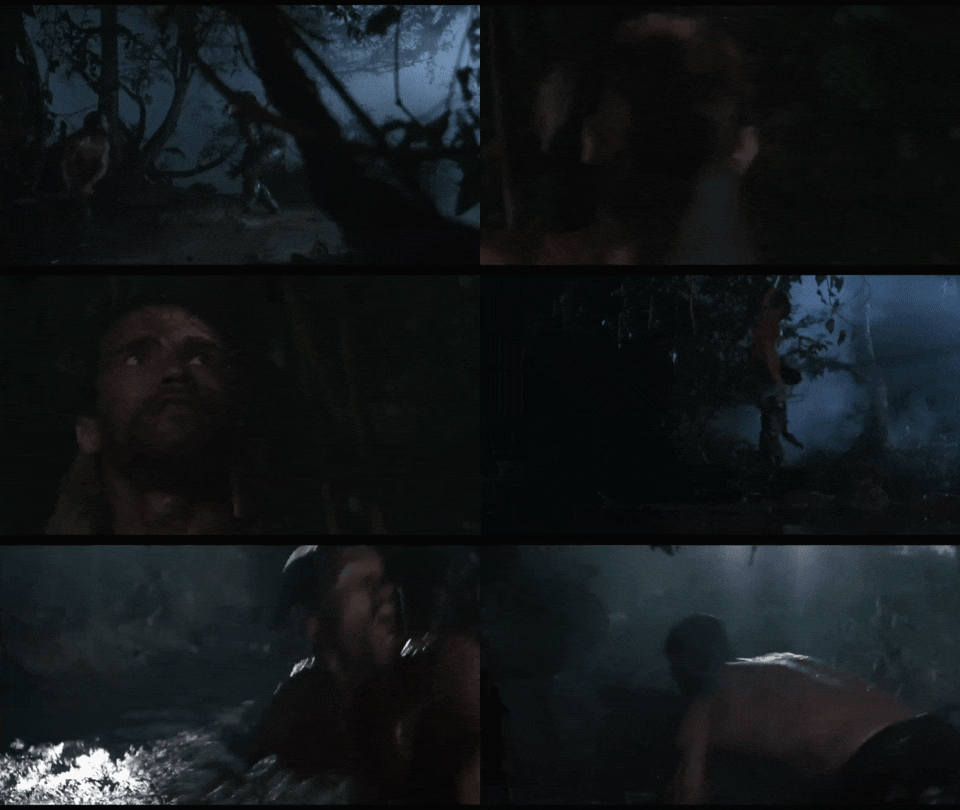
For the first 42 minutes of Predator, John McTiernan pulled out every trick in the book to make audiences believe that Major Alan “Dutch” Schaefer (Arnold Schwarzenegger) and his rescue team were the baddest dudes on the planet – and he succeeded. The tough talking crew consisting of guys named Dutch (Arnold Schwarzenegger), Mac (Bill Duke), Hawkins (Shane Black, Blain (Jesse Ventura), Billy (Sonny Landham), Poncho (Richard Chaves), and Dillon (Carl Weathers), could’ve all headlined their own action franchises (maybe not Hawkins…Hawkins). The actors themselves were also a collection of tough guys composed of Mr. Olympia winners, professional wrestlers, and in the case of Sonny Landham, a former adult film star who needed a bodyguard to keep people safe from his drunken rampages.
While the film goes heavy on macho posturing, it’s important to note that a group of muscle-bound actors who worked out tirelessly during the film’s production, signed on to act in a slasher movie where they and their muscles get obliterated by an alien. Mac, Hawkins, Blain, Poncho and Dillon land no meaningful offense on the Yautja, and they only exist to have their arms, heads and spines separated from their torsos. This is the beauty of Predator, it’s a slasher movie inside a straight-forward action film – and the easily-killable prey are elite soldiers with enough weaponry and ammunition to take over a small country.
One of the most subversive elements of Predator is how Arnold Schwarzenegger resembles a beach ball at a Matt and Kim concert during his final fight with the Yautja. A year earlier Schwarzenneger wiped out an entire army in Commando, and in Predator he became a “final girl” who must channel his inner-Nancy Thomson to outsmart the slasher. Throughout the final brawl Arnold crawls, runs, and shrinks away from the Stan Winston designed Yautja that was beautifully inhabited by the 7’2” Kevin Peter Hall – and it’s wonderful. Watching a seven time Mr. Olympia winner looking tiny and afraid is a welcome change of pace and part of the reason why Predator is an all-star monster movie.
A Nightmare on Elm Street III: The Dream Warriors is mean -, and this is coming from someone who enjoys movies like I Saw the Devil, Thirst, The Texas Chain Saw Massacre, Martyrs and The Sadness. What hurts so much about the Chuck Russell directed sequel is that the victims are innocents who are being punished because they are the last remaining Elm Street kids. They aren’t horny camp counselors or snarky high schoolers, they are troubled teenagers who since being targeted by Freddy Kreuger have endured drug addiction, suicide attempts, and 1980s adults who don’t listen to them.
When Freddy Kreuger is killed there’s a feeling of relief that you seldom get from other horror movies. Sure, lines like “Welcome to prime time – bitch” opened the door for a more wisecracking Kreuger, but script and direction also made him the meanest he’s ever been in the franchise. A moment that haunts my dreams is when Freddy turn’s his fingers into needles filled with drugs and plunges them into the awaiting arms of a 17-year old named Taryn White (Jennifer Rubin). Kruger knows about Taryn’s issues with addiction, and kills her in the meanest way possible that is punctuated by Taryn’s terrified screams and a look of absolute fear on her face. It especially hurts because she’s a troubled teenager who found strength as part of a group, and just when she becomes confident with herself – she dies horribly. According to the documentary Never Sleep Again: The Elm Street Legacy, Wes Craven wrote a profane and dark script that had to be softened by writers Chuck Russell and Frank Daradont. I don’t think I could take a more violent and bleak version of The Dream Warriors.

What makes Hellraiser so iconic comes down to several reasons. After not being satisfied with end results of Underworld (1985) and Rawhead Rex (1986) – movies that he wrote the screenplays for, Barker decided that he would direct a feature-length film based on his 1986 novella The Hellbound Heart. During the Blu-ray commentary, Barker mentions that directors like Felini and Tarkovsky deeply influenced the film’s imagery first style, and his adherence to not turning women into “passive entities” are why he was able to land well-respected stage actors like Clare Higgins to give the film extra prestige. Look at the GIF below, I don’t think Higgins got the memo that she was acting in a 1987 horror film.

Another smart decision Barker made was to dedicate the majority of the film’s one million dollar budget towards the gooey special effects created by Bob Keen and his Image Studios team. This was a good idea considering that the movie is about a woman named Julia Cotton (Higgins) helping an extremely gooey skeleton become less gooey. She does this by luring men back to the home she shares with her husband Larry Cotton (Andrew Robinson) – who is Frank’s brother and also a total wet noodle. The unsuspecting men are consumed by Frank, and when he reaches his final form – which resembles a juicier version of Captain America: The First Avenger’s Red Skull, he kills his brother Larry so he can wear his skin. It’s a lot.
On the Blu-ray commentary, Barker mentions that Ene Watts, the film’s script supervisor said that the movie should’ve been called “What a Woman Will do for a Good F**k,” and she’s not wrong. Hellraiser is meant for adult horror experiences that focus on pleasure, pain, adultery, perversity, addiction, sexual obsession and Freudian nightmares (Barker uses all these words during the commentary). Lust or infatuation has long been a catalyst in horror movies like The Phantom of the Opera (1925), Dracula (1931), Onibaba (1964), Daughters of Darkness (1971), Ganja and Hess (1973), and The Fly (1986), but Hellraiser weaponizes it differently. Frank’s lust for the next pleasurable high infects Julia, who then uses her sexuality to lure men to their deaths so her lover can become less gooey. Hellraiser treats lust like an addiction, and as the film plays out we see how Julia and Frank’s quest for pleasure leads to their destruction – which is what makes Hellraiser a solid film
In the Near Dark DVD commentary, Bigelow said it’s a movie about the consequence of love, attraction and addiction, which puts it in a similar category with Hellraiser, but while Frank Cotton was trying to get inside a box, Bigelow was busy thinking outside of it. Bigelow and co-writer Eric Red originally wanted to shoot a western, but were forced to toss vampires into the mix in order to get it funded and ensure that Bigelow could direct it. Near Dark ditches a lot of the vampire myths involving crosses and garlic and instead follows around a “family” of vampires as they drive around a desert landscape that offers them no cover from the deadly sun. For these vampires, life isn’t about listening to saxophonists or moving to the suburbs. They’re just trying to survive – which means lots of takeout blood from hitchhikers, people who pick up hitchhikers, and hole-in-the-wall bar patrons who don’t shave much. Things change when Mae (Jenny Wright) turns a cowboy named Caleb (Adrian Pasdar) into a vamp, and the tight-knit gang are forced to accept the untested newbie while being chased around by police who rightfully want them to stop consuming so much human blood.
One of the smartest things Bigelow did was hire Lance Henriksen, Bill Paxton, and Jenette Goldstein as the elder vampires. The three had worked together on Aliens, and their chemistry combined with their well-worn costumes makes you feel like you can almost smell how bad they smell. The addition of 12-year old Joshua John Miller as Homer, an old-ish vampire stuck inside a preteen body. Watching Homer dance unsympathetically while the blood from a waitresses throat drips into a beer glass is a gnarly sight to behold and proves Bigelow wasn’t messing around with her vampire western. Before cameras rolled, Bigelow put them through a vampire boot camp involving blocking all the light out of cars and hotel rooms in under two minutes. Lance Henriksen took it so seriously that he drove across the country and picked up hitchhikers to get into character.
The most iconic moment happens inside a locals only bar that plays much more intimately than The Titty Twister shenanigans in From Dusk Till Dawn. This is where Severen (Bill Paxton) shines, as you can tell his character was an absolute shithead who loves killing fellow shitheads who haven’t been blessed with vampirism. There’s no remorse or mercy, and Bigelow wisely leaned into Paxton’s manic sensibilities and he’s never looked cooler than when he’s standing against the bar with a sawed-off shotgun sitting on his shoulder.

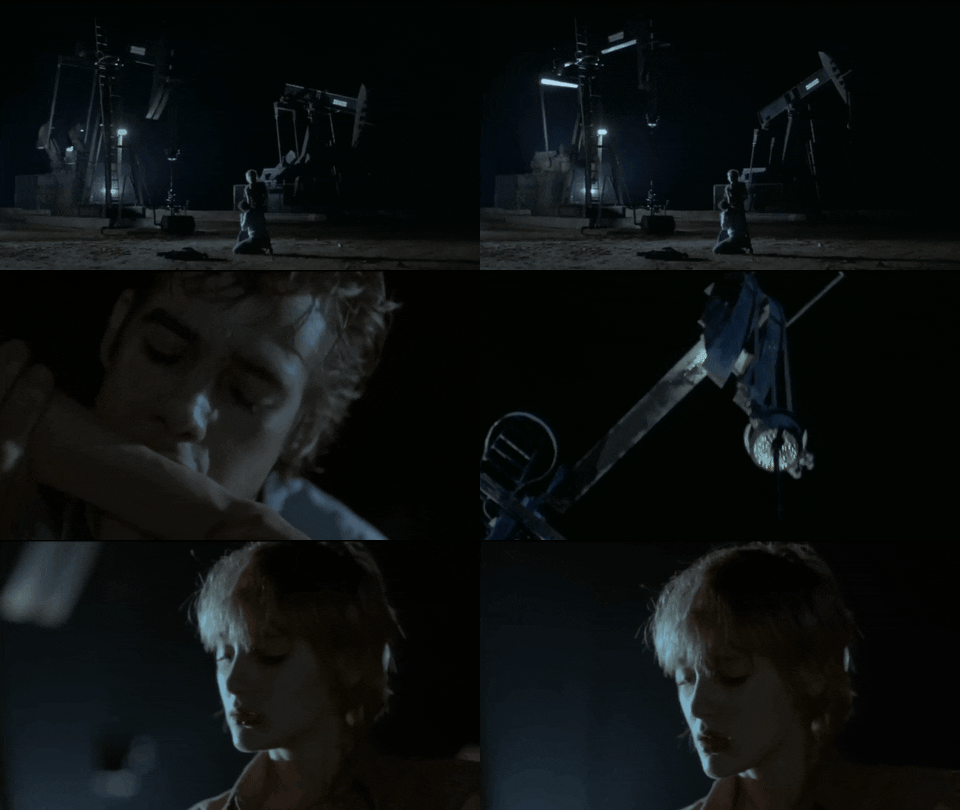
It’s also a visually stunning film that’s rich with lush cinematography by Adam Greenberg (The Terminator, Iron Eagles) that makes the sight of blood sucking next to a pumpjack look very seductive.
When it comes to Evil Dead II, Quentin Tarantino, Guillermo del Toro, Edgar Wright and horror-hater Roger Ebert all love it, which makes sense because it’s loaded with creativity, insanity and some truly inspired physical comedy from Bruce Campbell – who explained the filming as “We were like Jackass with plot.”
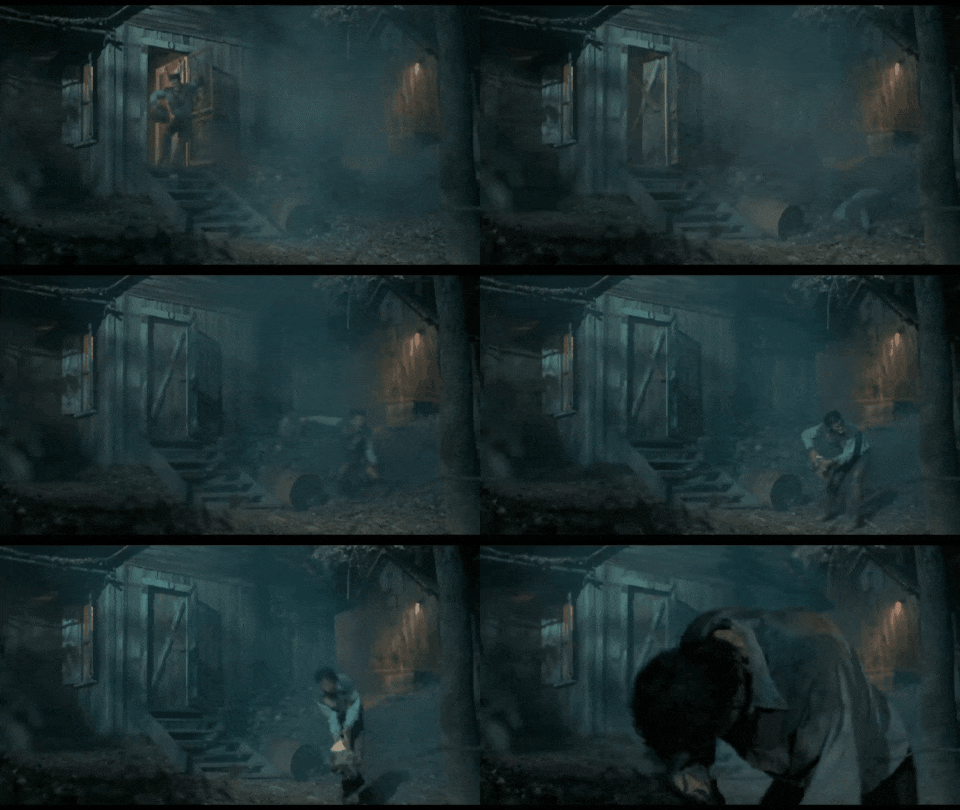
In the Blu-ray commentary (which is a blast) Sam Raimi said his intention was to “soak Bruce’s membranes with as many strange dyes, liquids, potions and chemicals as possible,” – and I think he succeeded. Throughout the movie he’s bombarded with mud, puddle water, demon goo, and the blood of his beheaded girlfriend whom he fights inside the infamous “workshed.”
I think Ash might be the most concussed horror character ever, but he doesn’t let brain swelling stop him from fighting evil. It’s true that he’s the one who played the mysterious tape inside a cabin that he broke into, but, like Jack Burton in Big Trouble in Little China, he’s a tough idiot who stumbles his way to the film’s climax while others do the smart work. To his credit, he’s always ready to fight and say things like “Swallow this” to deadites who want to swallow his soul. In the same commentary, Bruce Campbell says “As dumb as Ash is, he’s actually a capable guy with regard to dealing with monsters.” That’s why people love him, because he’s a blowhard who will scrap with demons if the world is in need of saving.
The movie is loaded with brilliant special effects gags from Howard Berger, Robert Kurtzman and Greg Nicotero, and the “Ram-O-cam,” a 30-foot steel pole with a camera attached that was created to ram things, is an ingenious delight. The movie is bursting with bloody joy and the handmade feel adds to its charm.


 Movies, Films & Flix