Dracula (2025) – Review
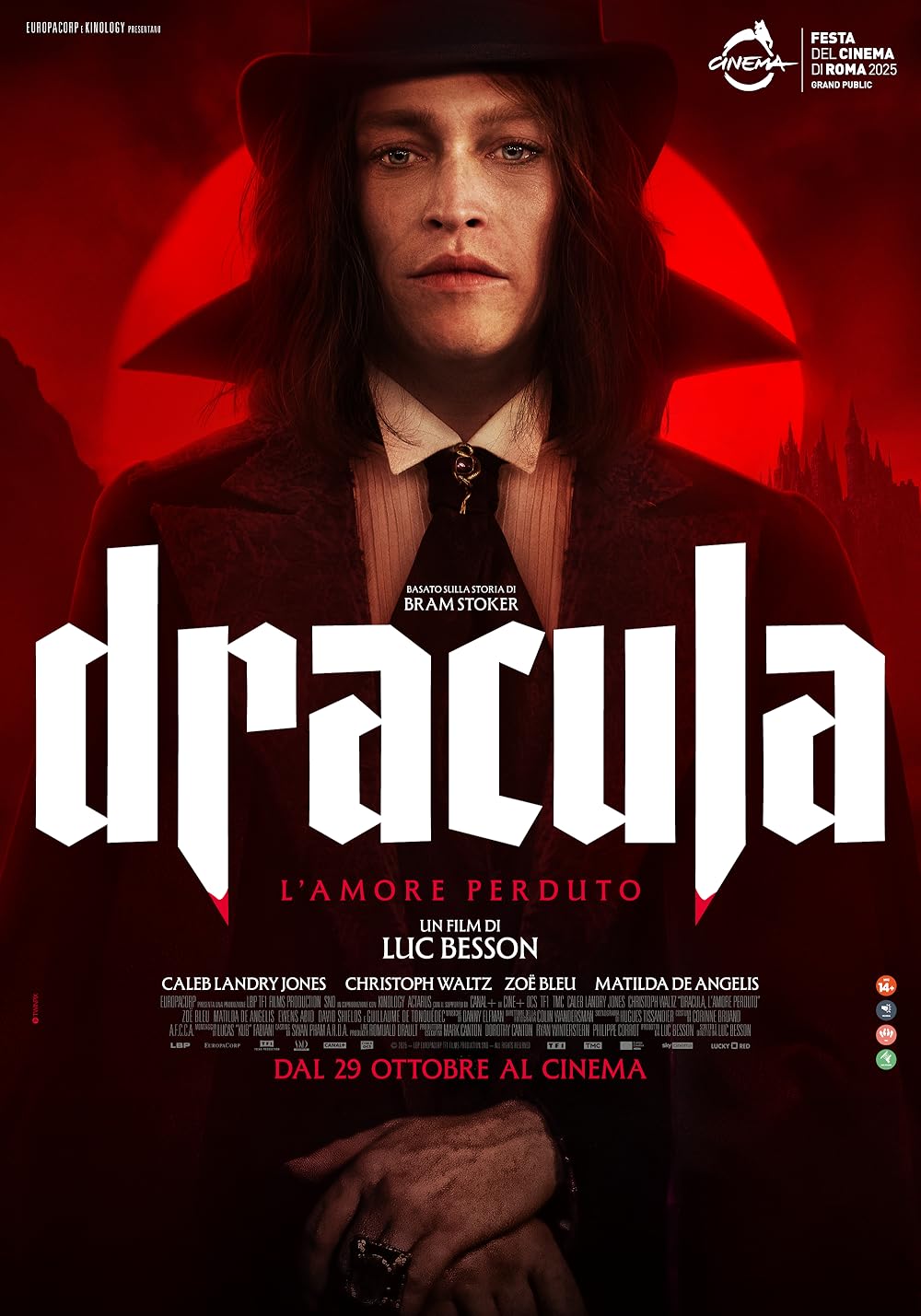
Dracula (2025) thoughts
- You haven’t fully lived until you’ve seen a gargoyle land a hurricanrana on a Romanian soldier.
- Matilda De Angelis is the MVP. She’s on another level
- It’s a Dracula film directed and written by a person who has no interest in Dracula. It’s an interesting choice.
- After appearing in Frankenstein (2025) and Dracula (2025), Christoph Waltz should continue appearing in monster movie remakes.
- I love that a $50 million budgeted Dracula film exists because Luc Besson loves Caleb Landry Jones.
- Between Get Out, The Outpost, The Dead Don’t Die, Three Billboards Outside Ebbing, Missouri, The Florida Project, War on Everyone, Byzantium, and No Country for Old Men, Caleb Landry Jones has a stacked filmography.
After Guilermo del Toro (Frankenstein) and Robert Eggers (Nosferatu) tackled their long-time passion projects with intense reverence, it was a unique experience watching the Luc Besson directed Dracula. What’s interesting and unique about Besson’s film is that he isn’t a fan of Dracula, or horror movies. The reason Dracula exists is that Besson loves Caleb Landry Jones (who starred in DogMan, which was directed by Besson), and he wanted to create a starring vehicle for him. The end result is a tonal mishmash that ends with a gang of gargoyles battling a platoon of Romanian soldiers led by a guy named Prist (Christoph Waltz). Besson wasn’t interested in blood-sucking, vampire orgies, or a dreary mood, and instead was laser-focused on an immortal vampire spending 400 years looking for his reincarnated wife. Dracula’s sharp edges (and teeth) are softened as he becomes a tragic villain who after attempting to kill himself many times (in a funny moment involving at least eight jumps from a castle tower), develops a perfume to help him find his reincarnated wife.
The film opens with Prince Vladimir of Wallachia (Caleb Landry Jones) and his wife Elisabeta (Zoë Bleu) enjoying a loving romp in their large bedroom located inside a gothic Romanian castle. The two are clearly in love and they genuinely seem to like each other, but their lovemaking is interrupted when Prince Vladimir is dragged out of his bed so he can fight a group of invading Ottomans (his ornate armour will remind many people of Dracula’s red armor in Coppola’s Bram Stoker’s Dracula). While he’s away, Elizabeta is sent to a safe location several miles from the battlefield. While on her journey, her convoy is attacked, and she’s killed during a skirmish between Prince Vladimir (who left the battlefield to save her) and several Ottoman soldiers. After her death, Vladimir renounces his faith, kills a head priest, and is cursed with immortality by God. From there, Dracula travels the world for hundreds of years looking for his reincarnated wife, with little success. During his quest, he creates a pungent perfume that intoxicates women, and the smelly concoction aids him when he turns a group of French socialites into an army of vampire investigators who scour the world looking for Elisabeta. Chief among them is Maria (Matilda De Angelis – having a blast), who locates a woman named Mina (the reincarnation of Elisabeta) in Paris after Dracula sees her face in a locket owned by solicitor Jonathan Harker (Ewens Abid), who visited Dracula’s Romanian castle for business reasons. I don’t want to spoil the rest of the proceedings, but I will say that there are beheadings, dance scenes, sword fights, mouse blood cocktails, lobster towers (amazing), magic candles, transfusions, sinking gargoyles, and ornate rings worn by Dracula.
The interesting thing about Besson’s Dracula film is that he’s clearly not interested in the action or horror elements that come with Dracula. The opening battle looks cheap, there’s never any tension, and the final battle features Dracula’s gargoyle servants using WWE wrestling moves on overmatched Romanian soldiers. What Besson was interested in were the costumes, castles, makeup, ballrooms, and music of the era. This kept Corinne Bruand (costume designer), Danny Elfman (composer), Julia Floch-Carbonel (key makeup artist) and Hugues Tissandier (production designer) very busy as they were tasked with creating gowns (there’s a gown with an eight meter headdress that looks great during a horse chase), ballrooms (which took up entire soundstages), musical cues, props, and prosthetic makeup to transform Caleb Landry Jones into a 400-year old vampire. Overall, it’s a fantastic-looking production that was clearly focused on lavish production design and costuming.
In interviews, Besson has said that Dracula was sparked by his “fascination” with Caleb Landry Jones rather than by a particular interest in the Dracula tale. If you’re looking for something akin to Bram Stoker’s Dracula or Nosferatu (any of them), you’ll be disappointed because Besson’s take on a vampire legend is more interested in love, perfume, and Caleb Landry Jones.


 Movies, Films & Flix
After being amazed by Frankenstein I wondered if this would have the same magic.
It’s tough top Frankenstein’s technical aspects. Dracula is not as technically focused as Frankensteion (and has half the budget). It’s worth a watch because of how cheeky it is.
Will definitely give it a try.