“Wuthering Heights” (2026) – Review
Quick Thoughts:
- I’m a fan of chaos, so I love that Emerald Fennell was given $80 million to direct a wildly unfaithful adaptation of Wuthering Heights.
- I wanted moor (I had to do it).
- The jellied fish is a fun visual gag, and cinema needs more flesh walls.
- The world needs to learn more about Edgar Linton’s interior design choices.The guy seems pretty chill, but he has some bold taste.
- Cathy’s victory roll hairstyle is inspired and adds devilish dimensions to her character.
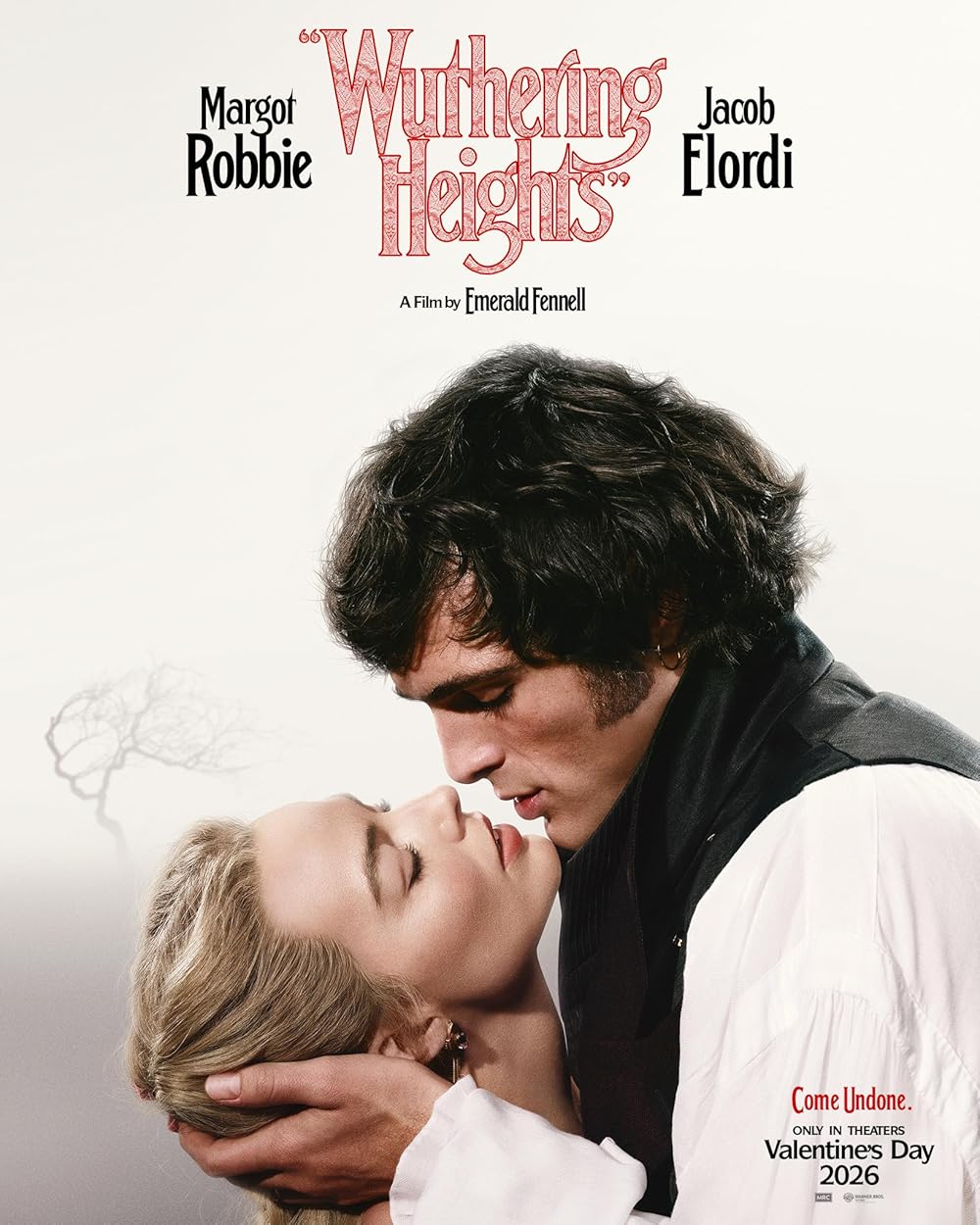
When it comes to adapting literary classics, there are several choices filmmakers can make. They can stay loyal(ish) to the text (No Country for Old Men, The Green Mile), make a few adjustments (del Toro’s Frankenstein) or disregard everything and make a movie because they like an actor and want to give them a starring vehicle (Besson’s Dracula). Emerald Fennell’s adaptation of Emily Brontë’s 1847 novel is unique in that Fennell is “making a version” of the text that’s trying to recreate the feelings she had while reading it as a teenager. It was a unique experience watching how she chopped up Emily Brontë’s text to create her 136-minute romance epic. Fennell removed the second half of the book (like most adaptations do), ditched a copious amount of characters, and laser-focused on the tortured relationship between Catherine “Cathy” Earnshaw (Margot Robbie) and Heathcliffe (Jacob Elordi) that will get a physical (and emotional) response from audiences. While researching the project, Fennell watched her favorite sweeping alt-romantic movies like Bram Stoker’s Dracula (1992), Crash (1996), Romeo + Juliet (1996), and The Handmaiden (2016), to help her create a visually distinctive romance that challenges the conventions of traditional love stories. The problem is that The Handmaiden and Crash go for it, whereas “Wuthering Heights” seems content to bombard the senses of theatergoers while avoiding the novel’s much-discussed themes of class, racism, generational trauma, and class conflict. To be fair, going hard on the romantic entanglements of characters played by Jacob Elordi and Margot Robbie was a smart business decision (the movie will make decent money), and is probably what helped Fennell get an $80 million budget from Warner Bros.
Fennell’s version of “Wuthering Heights” kicks off with a public execution that features a criminal (with an erect penis – because it’s a Fennell movie) being hanged for the enjoyment of a horny crowd. From there, we’re taken to a large estate (Wuthering Heights) in the moors of Yorkshire that looks more like a hellscape from a fantasy film than a location in England. The craggly and constantly wet Wuthering Heights is home to a young girl named Cathy (Charlotte Mellington), her housekeeper friend Nelly Dean (Vy Nguyen), and her drunkard father Mr. Earnshaw (Martin Clunes), who drunkenly comes home from the execution with a feral kid (Owen Cooper), whom he picked up during his drunken journey home (the guy drinks mountains of gin). After some debate, the kid is given the name Heathcliff (named after Cathy’s deceased brother), and he and Cathy become fast friends as they deal with the abusive Mr. Earnshaw, who stays busy by accruing gambling debt and beating Heathcliff.
Years pass, and the relationship between the now uber-beautiful Cathy (Robbie) and Heathcliff (Elordi) has blossomed into a full-blown unconsummated romance. A wrench gets tossed into their burgeoning love affair when a wealthy man named Edgar Linton (Shazad Latif) and his ward, Isabella (Allison Oliver – a lot of fun) move into a nearby property named Thrushcross Grange. While trying to get a glimpse of her new neighbors, Cathy hurts her ankle and is forced to reside at the sprawling estate for six weeks. While she’s there, the wealthy Mr. Linton takes a liking to her and proposes marriage. The proposal is convenient because their union would alleviate Mr. Earnshaw’s money problems, but it’s also problematic because Cathy and Heathcliff are in love. After a miscommunication perpetrated by Nelly (who is the villain in this film), Cathy accepts the proposal, and a sulky Heathcliff disappears into the English countryside. From there, the film becomes a messy romance between two messy people who do some terrible things to each other (and others).
The cinematography by Linus Sandgren (First Man, Saltburn, Babylon) is top-notch (the movie was shot on 35mm VistaVision cameras), but features too many “Hey, you know what would look cool?” shots. Whether it’s Cathy sleeping on a boulder or leeches on a wall, a few of the setups don’t feel organic and solely exist to look awesome. The most impressive aspect of the film is the production design by Suzie Davies (Saltburn, Conclave, Hard Truths, Mr. Turner), who helped make Wuthering Heights feel otherworldly and mystical. The best bit of production design is Cathy’s room at the Linton estate. The walls are the color of Cathy’s skin, and there are freckles and veins painted onto the wall to mirror her face. It’s simultaneously creepy and romantic, which is when “Wuthering Heights” is at its best. The look of Thrushcross Grove is interesting as well, because Mr Linton seems to be a level-headed fellow, but he’s decorated the place to look like a combination of the Overlook Hotel (The Shining), the house from Cries and Whispers, and something from a Wes Anderson movie.
Fennell was looking to recapture how the book made her feel when she was in her teens, so we’re watching a lavish production meant to recreate the feelings of a teenager. It’s clear that she really wanted to see Heathcliff and Cathy having sex, so she dedicated a large portion of the budget to ensuring the two good-looking actors had many steamy scenes. The problem is that even with all the bodice-ripping, the movie never feels cohesive because it gets lost in sultry visuals. It would’ve been nice to see Fennell tackle the complexity of the novel instead of solely focusing on the Romeo and Juliet-esque (which is recapped in the film by Isabella) relationship. However, I have a feeling that “Wuthering Heights” is going to make a lot of money because it blasts the senses and gives mainstream audiences (who haven’t read the book) an epically bad romance.


 Movies, Films & Flix