The Movies, Films and Flix Podcast – Episode 641: – Joker: Folie à Deux (2024), Todd Phillips, and Blank Check Movies
You can download or stream the pod on Apple Podcasts, Tune In, Podbean, or Spreaker (or wherever you listen to podcasts…..we’re almost everywhere).
If you get a chance please make sure to review, rate and share. You are awesome.
Mark and Nathan discuss the 2024 sequel Joker: Folie à Deux. Directed by Todd Phillips, and starring Joaquin Phoenix, Lady Gaga and lots of face paint, the movie focuses on what happens when the Joker goes on trial. In this episode, they also talk about non-musicals, blank check movies, and courtroom shenanigans.
If you are a fan of the podcast, make sure to send in some random listener questions (we love random questions). We thank you for listening, and hope you enjoy the episode!
You can download the pod on Apple Podcasts, Tune In, Podbean, or Spreaker.

Share this post:

Baby Assassins: Nice Days (2024) – Review

Quick Thoughts:
- I love it
- It features several beautifully staged action scenes from Kensuke Sonomura
- Director Yugo Sakamoto is becoming more confident
- Saori Izawa and Akari Takaishi are the best. I want 30 more of these films
- Baby Assassins 3 features the most action in the franchise. This might disappoint fans who love watching Mahiro and Chisato being slackers
Baby Assassins 3 (or Baby Assassins: Nice Days) rules. Director/writer Yugo Sakamoto and action choreographer Kensuke Sonomura make the most of their increased budget by crafting a more action-oriented Baby Assassins film that focuses on what happens when Mahiro (Saori Izawa) and Chisato ( Akari Takaishi) are forced to battle a brutal assassin on the island of Miyazaki, Japan. The new action-first direction might annoy fans who love the slacker vibes of the previous two films, however, the new phase is smart because the professional murderers need to grow up and leave the safety of their apartment couch as they get older and become more effective murders That being said, a lot of screen time is dedicated to their friendship and the addition of two older agency assassins (Atsuko Maeda and Mondo Otani) allows them to be sassy to their elders.
After watching Mahiro and Chisato assassinate people for years (and eat food on their couch), it’s easy to forget that they are still teenagers. In the film, Mahiro celebrates her 20th birthday by drinking warm beer inside the home of one of their targets, and it’s a good reminder that they are psychopathic teenagers who became contract killers after graduating from high school a couple of years prior. Also, because their employers are worried about Japanese tax officials, the baby assassins have to work day jobs to prevent audits. Typically, forcing legit maniacs to blend into modern Japanese society isn’t wise, but it’s what makes the franchise great. In Baby Assassins 3, it’s fun watching them battle more experienced villains and teaming up with adult assassins who are flummoxed by their teenage coworkers.
The villain in the film is Kaede Fuyumura (Sosuke Ikematsu), an assassin who is close to completing a years-long assignment that saw him murdering 150 people. Before he can kill his final victim, Mahiro and Chisato interrupt the milestone and a beautifully staged battle takes place in the hallways and offices of a government building. The highlight of the action scene is a fight between Mahiro and Kaede that shows what happens when two elite Japanese assassins engage in hand-to-hand combat (some gun stuff is thrown in as well). The two actors bring it, and their 5-minute battle is a marvel of action choreography, inventive staging and lightning-quick strikes.
In the script stage, Kaede wasn’t too violent, but Sakamoto, a fan of violent movies, went overboard and created a maniac while filming. What’s nice is that Kaede never earns sympathy, but you understand his character via flashbacks and his interactions with the equally deadly Mahiro. There’s a moment when he’s waiting for a kill order, and he spends the time hitting a punching bag while the victim lies tied up on the floor next to him. It’s a startling image, which is surprising because despite all the carnage in the franchise, it’s never been something cruel. With villains like Kaede, the two baby assassins need to grow up because as they make their way up the hitperson ladder, their competition gets much deadlier.
Final thoughts – Baby Assassins 3 is one of the best action films of recent memory, and the 13-minute final fight in an abandoned warehouse is one of the best fights of the decade.
Share this post:

Weapons (2025) – Review

Quick Thoughts:
- Zach Cregger is the best. His follow-up to Barbarian (2022) is an ambitious crowd-pleaser.
- Josh Brolin, Julia Garner, Cary Christopher, Alden Ehrenreich, Austin Abrams, Benedict Wong, and Amy Madigan understood the assignment and delivered fun performances
- Cinematographer Larkin Seiple (Swiss Army Man, Everything Everywhere All at Once, Beef) will hopefully be remembered come awards time.
- Cregger loves a creepy house.
- Don’t watch any trailers, stay away from spoilers and go into the movie with zero idea of what’s going to happen (after reading this spoiler-free review).
- Don’t be annoyed if it doesn’t surprise you as much as Barbarian. Barbarian came out of nowhere and had the luxury of not having much hype or anticipation.
Weapons is great because it’s ambitious, fun, and proves that writer/director Zach Cregger can go big. Much like Jordan Peele, Julia Ducournau, Coralie Fargeat, Parker Finn, Ari Aster, Robert Eggers and the Philippou brothers, Cregger used the success of his first horror film to craft a technically ambitious follow-up that doesn’t disappoint. It’s fun watching Cregger become more confident behind the camera while still understanding what made Barbarian (2022) so great (it’s an audacious and unpredictable experience).
Weapons revolves around the sudden disappearance of 17 elementary school kids and the effect it has on a small community. There are no clues, witnesses or a clear motive, so the cops and local authorities come to a standstill. The only facts they know are that the children were in the same class taught by a new teacher, Justine Gandy (Julia Garner), and 17 of the 18 kids woke up at 2:17 a.m. on the same morning and ran out of their houses towards an unknown location. Spoiling anything more wouldn’t be cool, just know that the film skips around between a teacher Justine), a bereaved father (Josh Brolin), a local cop (Alden Ehrenreich), a junkie (Austin Abrams) and a school principal (Benedict Wong) who all are dealing with the aftermath of the mysterious tragedy differently (or not at all). Like Barbarian, the film is broken up into multiple chapters, and a lot of credit needs to go to editor Joe Murphy (Barbarian, Swallow) for successfully tying together multiple storylines into a coherent and enjoyable manner.
What I like most about Weapons is how the characters are given time to become interesting people. After Julia Garner was wasted in Wolf Man (2025), it’s fun watching her play a complex character who loves her students but can’t stop crossing boundaries. She spends most of the film being shot in profile, and she has excellent chemistry with Ehrenreich, Brolin and Wong. The central actors must’ve been a fan of Barbarian, because you can tell that they enjoy being in this film and relish their opportunity to be serious, silly and scared stupid
The story behind Weapons is interesting because of how quickly it came together (and was hit by multiple roadblocks). Cregger needed years to fine-tune the Barbarian screenplay (while looking for funding), but Weapons poured out of him after the sudden death of one of his closest friends. After the tragedy, Cregger parked himself in his garage/laundry room (where he also wrote Barbarian) and started writing his “epic” script. Drawing inspiration from the Paul Thomas Anderson-directed Magnolia (1999), Weapons is an ensemble piece that’s simultaneously funny and melancholic. In an interview with Entertainment Weekly, he uses the word “bigger” three times in one paragraph, and he isn’t wrong. The good news is that the bigger plot doesn’t create an unwieldy mess. The film is easy to follow and there are several very funny moments that blend well with the melancholic story. Like Barbarian, there are moments in Weapons that made the audience erupt in laughter, which is impressive for a film about the disappearance of children.
The cinematography from Larkin Seiple (Swiss Army Man, Everything Everywhere All at Once, Beef) is fantastic, and I love the way he shoots the characters in profile and his wide shots are a thing of beauty. When awards season rolls around, I hope people remember his work because it’s perfect.
Between Barbarian and Weapons, Cregger has found a way to combine comedy with terror in a way that doesn’t grind the film to a stop. This partly comes from his experience with The Whitest Kids You Know sketch comedy troupe, but comedy sketches and 128-minute films are a different beast. There are violent moments in Weapons that are genuinely hilarious (it features the best person being thrown around moments of 2025), and the punchlines never halt the narrative. It’s also interesting how Cregger creates vast amounts of tension and then drops a joke to relieve the tension. This may annoy people looking for a 128-minute tension bomb, but his brand of “tense and release” works for me.
Final thoughts – Watch it in theaters.
Share this post:

You can download or stream the pod on Apple Podcasts, Tune In, Podbean, or Spreaker (or wherever you listen to podcasts…..we’re almost everywhere).
If you get a chance please make sure to review, rate and share. You are awesome.
Mark and Norbert draft their favorite movie jerks from films like Hall Pass (2011), The Hunchback of Notre Dame (1996), Aliens (1986), 12 Monkeys (1995) and Hereditary (2018). If you’re a fan of cinematic jerks you’ll love this episode!
If you are a fan of the podcast, make sure to send in some random listener questions (we love random questions). We thank you for listening, and hope you enjoy the episode!
You can download the pod on Apple Podcasts, Tune In, Podbean, or Spreaker.

Share this post:

Warning – Spoilers – Barbarian rules and I recommend you watch it before reading this dumb movie data article.
Once again – Spoilers
I love Barbarian. It’s hilarious, stressful, scary, unpredictable and pretty much every other complimentary word I can think of. Shea Serrano recently watched it for the first time and posted about it on his Good Movie Substack page and it reminded me of a moment in the film when a character named AJ (Justin Long) discovers a labyrinthian basement and tunnel system underneath one of his rental properties in Detroit. Instead of being scared, he’s over-the-moon and immediately starts researching whether it adds to the square footage of the property. Sadly, it doesn’t, but “it can be noted separately in the listing’s total area (yeah…b**ch).” Shortly, after learning this, he finds a tape measure and starts measuring the square footage of the subterranean torture tunnels. He doesn’t get to finish the measurements because horrible things happen, so I decided to analyze the movie and figure it out for him. Here’s what I did
- Rewatched the movie
- Listened to the director’s commentary (very helpful) and watched the behind the scenes docs.
- I also used a tape measure at certain moments to figure out house length (when compared to the 6’2 Richard Brake).
- I analyzed rectangular pallet length, counted stairs, and figured out step counts
- Counted how steps the characters walked, then I walked the same amount and measure the distance
- Drew a color-coded visual
- Did it all again because I’m a maniac
- Collected timestamps
- I researched the production – Zach Kuperstein’s Instagram page was very helpful because it provided me with a nice layout of the area.
Quick Note – Yes – I put way too much work into getting the numbers because these posts only work when they are wildly detailed. I can’t stand lazy numbers or guestimates pulled from nowhere, so I always make sure to base my numbers on something tangible and researched. There’s no way to get a 100% correct estimate, but I tried my best!
Several Assumptions
- With a trial looming, AJ is going to need $140,000 for legal fees. Since he has no new money coming in, I am 100% certain that he was going to measure every inch of the basement. It doesn’t matter if it’s not on his property, he seemed hellbent on getting the numbers.
- I initially thought AJ was using a 25-foot tape measure. However, when he measures the distance between two rooms (01:04:00 – Cage Room to Mother’s Room) he takes close to 38 steps (of varying distance) which would max out the 25 feet. So, I have to assume he has a 50-foot tape measure. It’s too small to be a 50-foot tape measure, but it’s a fictional world where tape measure logistics are different
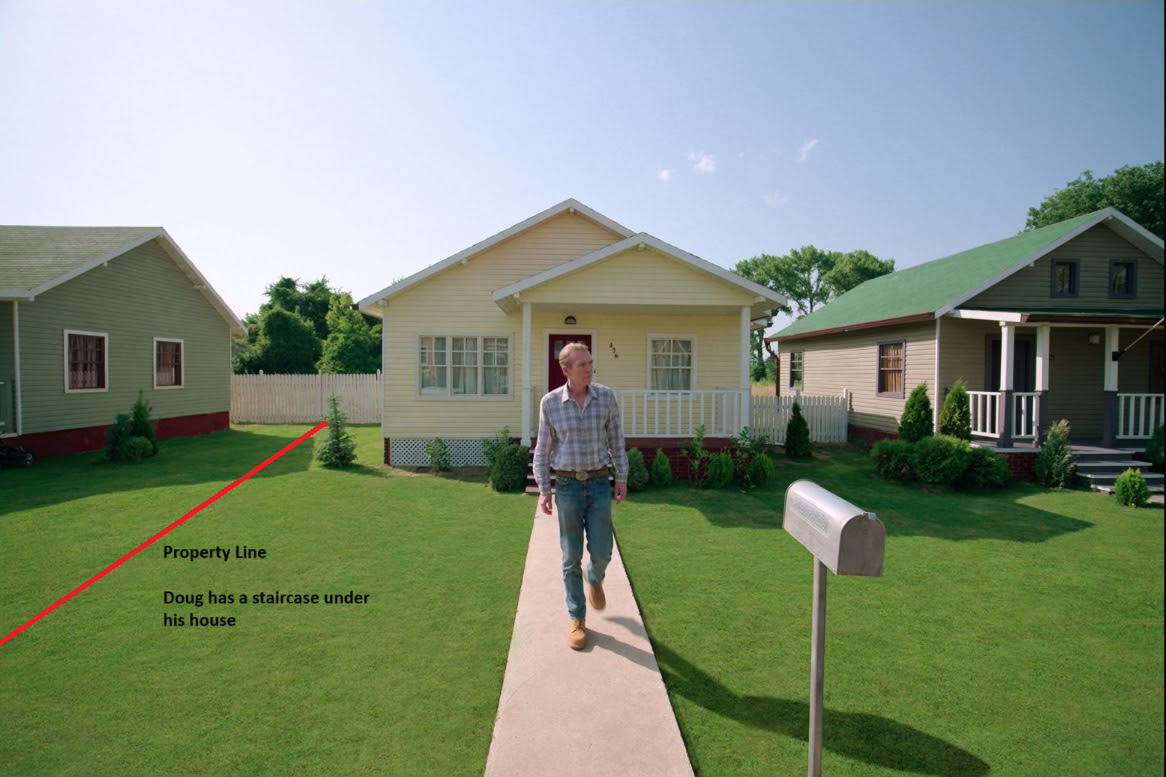
- Doug’s (Frank’s neighbor) house doesn’t have a basement. Only 33% percent of homes in Wayne County (where Detroit is located) have basements – so I feel pretty good about this assumption. I say this because of tunnel setup, there can’t be a basement
- In the commentary, Zach (with some uncertainty) says 150 meters of tunnels were built for the production, (01:03:10). My numbers are close but they don’t reach the 150 meter mark. So, I decided to use my numbers and calculations.
- During the commentary, Zach is adamant that the staircase is 30 meters long (00:40:00), but I only counted 27 steps. The math doesn’t add up. I’m not saying he’s wrong, I just like using numbers I can vouch for.
- They used Zeiss Supreme Prime lenses that exaggerate the space. It may make the rooms seem larger than they are.
To get to the total, I’ll start with the rooms (and the hole in the ground).
There are five rooms in the underground tunnels
- Video Camera Room
- Cage Room
- Mother’s Room (with the TV)
- Hole in the ground – Prisoner holding
- Frank’s Room
Video Camera Room – 108 square feet. After measuring the room, AJ says to himself “This comes in at 9 by 12.” (01:02:20) The average guest room in the US is 120 square feet, so I feel good about this number.
Cage Room – 104 square feet – There are four rectangular pallets in the room (01:03:25). They are typically four-feet long,. Based on the way they are placed in the room, I was able to get a solid estimate.
Mother’s Room – 108 square feet – I went with 9 by 12 based on the length of the bed and location of the television (01:04:25).
Hole in the Ground (Prisoner Holding) – 36 Square Feet – There isn’t much room to maneuver in the hole – so six by six works for me. Also, based on a few photos I saw on Instagram, the estimate seems right (01:14:00)
Frank’s Room – 144 square feet – Based on research of similar military-style beds (they’re typically a little over 6-feet long), I calculated the room to be around 12 x 12 (01:21:39).
Total Square Footage of Underground Dungeon Rooms (and hole in the ground) – 500 Square Feet
Hallway to stairs leading further underground – 120 Square Feet – (01:02:15) – based on the amount of steps I feel safe saying the hallway is about 25 to 30 feet. Also, in the script (page 41), it says “it seems to go on for some 25 feet at least.” Later In the script (page 75) Cale (switched to AJ) says the hallway is “30 by 4.”
Staircase – 115 square feet – If there are 27 steps, the math comes out to 115 Square Feet (based on tread depth, riser height, and stair width).
Bottom of Stars to Cage Room – 131 square feet – It’s about 10 feet to the metal door (after the stairs end), and this is where AJ starts his measurements. I went 22.75 feet. This guess makes sense because it took Georgina Campbell (who is 5’6) 10 steps to reach the room. (01:03:20).
Quick Note – In the script (page 75), when he gets to the bottom of the stairs he measures the width of the hallway and says “Four Feet.” I’m going with a width of four feet for the hallway.
Cage Room to Mother’s Room – 182 square feet – AJ takes 23 tiny backward steps before he stops and sees light coming from Mother’s room (01:04:00). I retraced his steps and covered 16.5 feet. Then. He then takes about 18 steps toward the room which is around 29 feet (I took 18 steps and measured them. It’s close).
Mother’s Room to the End of the Tunnel (it branches off left and right) – 240 Square Feet – AJ runs/jogs for 8 seconds (01:05:07) before he has to make a decision whether he should go left or right. Based on a similar running speed he covered close to 60 feet during his eight-second jog.
Quick Note – After Tess escapes the hole in the ground, she makes it to Mother’s room much faster than AJ (01:16:16 – She takes about 12 steps from the bell). The two distances don’t match, so I went with the longer running scene. Also, while Tess is walking to Mother’s room, there’s a cut, so it might’ve skipped a bunch of steps to make things zippier. Last thing, shortly after AJ escapes the room he needs 17 steps to get to the bell. The numbers are all over the place, so I trust the straightforward running scene.
AJ Takes a Left and Falls Into a Hole – 250 square feet – AJ runs for three seconds before dropping his flashlight (01:05:15). He crawls backward for several seconds, and runs for 4 seconds before falling into the hole in the ground.
AJ Gets to the Bell and Takes a Right Towards Frank’s room – 288 Square Feet – This one is tricky, AJ walks for a total of 16 seconds (I only counted on-screen walking) before he stops and sees Mother lurking in the tunnels. When he turns around, he’s about seven feet from Frank’s door (01:19:02).
Conclusion – If AJ has been able to complete his measurements, he would’ve come up with a total of at least 1,826 square feet (169.641 square meters). This number isn’t exact, but based on an absurd amount of research (and measuring my steps), I’m happy with it.
Here’s the twist!
I’ve mapped out the tunnel system and it expands well past AJ’s property line, so he’d only be able to add part of the first tunnel and camera room. Based on the property lines, and distance between the homes, it’s about 77 square feet that could be added to the total listing area. This is an inflated number for sure, but AJ would give it a shot.


Share this post:

The Movies, Films and Flix Podcast – Episode 639: Heretic (2024), Hugh Grant, and Bob Ross Monopoly
You can download or stream the pod on Apple Podcasts, Tune In, Podbean, or Spreaker (or wherever you listen to podcasts…..we’re almost everywhere).
If you get a chance please make sure to review, rate and share. You are awesome.
Mark and John discuss the 2024 horror film Heretic. Directed by Scott Beck and Bryan Woods, and starring Hugh Grant, Sophie Thatcher, Chloe East, and Bob Ross Monopoly, the movie focuses on a villain who loves to lecture people. In this episode, they also talk about metal walls, hidden rooms, and 2024 horror films. Enjoy
If you are a fan of the podcast, make sure to send in some random listener questions (we love random questions). We thank you for listening, and hope you enjoy the episode!
You can download the pod on Apple Podcasts, Tune In, Podbean, or Spreaker.

Share this post:

Cloud (2024) – Review

Quick Thoughts:
- Director Kiyoshi Kurosawa has crafted an “action thriller” that is loaded with surprises, tension and dread.
- Internet reselling seems horrible.
- Hire reliable assistants.
- Masaki Suda is excellent, and he plays his puzzle-box character to perfection. He’s impulsive, instinctual, unassertive, resourceful, and completely unknowable.
- Since it’s a Kurosawa film, expect a heavy dose of loneliness, isolation and technological woes.
- It made me very happy.
The best thing that can be said about Cloud is that it’s on its own wavelength. Director Kiyoshi Kurosawa (Pulse, Cure, Tokyo Sonata, Chime, Serpent’s Path – he has an amazing filmography) has always wanted to make an action film, but he wasn’t interested in flashy combat or expert sharpshooters, so he’s placed a bunch of “ordinary” people into a deadly situation and let them loose. The action in Cloud is ugly, fast and almost comical, which is exactly what Kurosawa wanted. The point isn’t to showcase sexy revenge plots; instead, the violence leads characters down open-ended paths that are far from optimistic.
The film revolves around a character named Yoshi (Masaki Suda) who works at a clothing factory during the day and resells goods at night. He’s not the type of guy who waits hours outside a store to snag an exclusive item; instead, he instinctively pounces on good deals and occasionally lets his impulses guide him towards purchasing pallets of “designer” purses and hand-crafted figurines. He rarely discusses his methods, but the opening scene where he buys surplus “therapy machines” from a desperate couple which he then flips for a large profit – shows he isn’t afraid to financially cheat people.
There are seemingly only three people in Yoshi’s life, and they are his girlfriend Akiko (Kotone Furukawa), a fellow online seller Muraoka (Masataka Kubota), and his factory boss Takimoto (Yoshiyoshi Arakawa). Akiko won’t move in with him because his apartment is too small, Muraoka is mad at him because he won’t invest in a startup, and Takimoto is flummoxed by the disciplined man who refuses promotion offers. The captivating thing about the lone wolf Yoshi is that he’s direct in a cold manner that adds a layer of ambiguity to the seemingly ordinary guy. In an interview with Cinema Daily US, Kurosawa mentions that since Yoshi is Japanese, “his feelings of joy, anger, sorrow, and pleasure are not so clear.” The lack of clarity becomes a problem as his nonchalant demeanor rubs people the wrong way which leads to steel cables being placed across his bike path and dark figures lingering behind him on buses.
After a big sale, he dispassionately quits his factory job (while turning down a promotion) and moves to a suburb that provides extra space for him to work. His reselling business becomes successful enough that he hires an assistant (Daiken Okudaira), and loads his spacious house with a swanky espresso machine (that rarely works) and dozens of boxes. Yoshi’s isolated tranquility doesn’t last long as a car part is thrown through a bedroom window, and the investigating cops don’t seem happy with his reselling business.
What follows is an examination of mob mentality, ugly violence and capitalism gone awry. An interesting tidbit is that Kurosawa is friends with an online reseller, and their relationship adds a level of realism to what Yoshi is doing. Also, by wanting to feature “muddled, unrefined, and realistic violence,” Kurosawa makes the violence hard to stomach as there’s no heroics or guns-ablazing theatrics. Yoshi as a character is intriguing because what he does is morally dubious as he resells knockoff goods at huge prices while hiding behind the online alias “Ratel.” However, he can compartmentalize his bad deeds, and since he’s one of many online resellers (who do the same thing), is he that bad? The guy is a mystery and a bit of a blank slate, so it’s up to the audience to decide what/who he is.
Cloud offers a unique journey and if you want to watch a master filmmaker direct his first “action” film, I totally recommend that you check it out.
Share this post:

The Movies, Films and Flix Podcast – Episode 638: Aliens (1986), James Cameron, and Xenomorph Goo
You can download or stream the pod on Apple Podcasts, Tune In, Podbean, or Spreaker (or wherever you listen to podcasts…..we’re almost everywhere).
If you get a chance please make sure to review, rate and share. You are awesome.
Mark and Norbert discuss the 1986 classic Aliens. Directed by James Cameron, and starring Sigourney Weaver, Bill Paxton, Michael Biehn, and lots of goo, the movie focuses on what happens when the Weyland-Yutani Corporation makes another greedy mistake. In this episode, they also talk about James Cameron, smart ideas, and alien goo. Enjoy!
If you are a fan of the podcast, make sure to send in some random listener questions (we love random questions). We thank you for listening, and hope you enjoy the episode!
You can download the pod on Apple Podcasts, Tune In, Podbean, or Spreaker.

Share this post:

The Fantastic Four: First Steps (2025) – Review

Quick Thoughts:
- 1. It’s a four-star MCU film
- 2. Vanessa Kirby, Pedro Pascal, Joseph Quinn and Ebon Moss-Bachrach have excellent chemistry and can easily anchor future MCU films.
- 3. Paul Walter Hauser steals the show
- 4. The cinematography, production design and costume design are A+. It’s one of the best-looking MCU films.
- 5. It’s nice watching a group of people who like each other.
Directed by Matt Shakman (WandaVision, It’s Always Sunny in Philadelphia, Game of Thrones, You’re the Worst), The Fantastic Four: First Steps is an amiable superhero movie that avoids the group-dynamic drama that plagues The Avengers, Guardians of the Galaxy and Thunderbolts. By leaving out Norse Gods, brilliant jerks, daughters of purple maniacs, former villains and deadly spies who suffer from crippling depression, The Fantastic Four: First Steps eschews drama and instead focuses on a group of likable people as they attempt to save the world. It’s a bit predictable, but what’s surprising is the team never has to be assembled or reassembled; instead they work well together and genuinely like each other.
The film opens with a scene that shows how Reed Richards (Pedro Pascal), Sue Storm (Vanessa Kirby), Johnny Storm (Joseph Quinn) and Ben Grimm Ebon Moss-Bachrach) got their powers (cosmic nonsense), and then quickly moves onto a montage that showcases their first battles with Giganto and The Mole Man (played beautifully by Paul Walter Hauser). It then jumps four years into the future, where they’re beloved by the public and have defeated most of the major supervillains in the world.
Since several Fantastic Four films have been made, Shakman decided that he could skip an origin story movie and instead tell a story about a well-oiled superhero team who are forced to battle an ancient planet eater. The most interesting choice by Shakman and writers Josh Friedman, Eric Pearson, Jeff Kaplan and Ian Springer was to make The Fantastic Four: First Steps as straightforward as possible. The plot revolves around a character named the Silver Surfer (Julia Garner) traveling to Earth to warn humanity of its impending demise. The Surfer works as a herald for Galactus (voiced by Ralph Ineson), a cosmic being who crunches planets to fulfill a never-ending hunger. The news isn’t fantastic, and it forces the Fantastic Four to do everything in their power to prevent a large alien from smelling Earth’s dirt (in a great scene) and eating their home. This includes confronting Galactus in space, and making decisions that are felt worldwide.
I don’t want to spoil anything else, just know that the rest of the movie features a stretchy guy, a human fireball, a large rock, and an invisible powerhouse battling a large cosmic being, who really wants a baby. There are several fun action set pieces and it’s nice watching Vanessa Kirby proving that she looks awesome while putting her hands in the air and hoping that the VFX crew don’t make her look silly. While researching the role Kirby talked to Shakman about Sue’s powers, and the two talked about “refracting light through prisms, and what altering the light of molecules does when you look at it.” This practical knowledge allowed Kirby to look like she knew what she was doing while pretending to use her magical powers. It’s little things like this that make The Fantastic Four: First Steps a top-tier MCU film, and a lot of credit needs to go to Shakman for putting together a cast who have fantastic chemistry.
Special mentions need to be given to the production design, costume design and musical score by Michael Giacchino. One of my favorite things about the film is that it takes place on “Earth 828,.” and can look however it wants to look. Production Designer Kasra Farahani (Loki – which also looks great) excels at creating worlds where advanced technology and retro design blend to create unique locations and visually interesting sets. The costume design by six-time Oscar nominee Alexandra Byrne is fantastic, and each actor looks perfect in their bespoke tailored clothes. The highlights of Byrne’s costuming work are sweaters and cardigans that Ben Grimm (a walking rock) wears as he cooks dinner or buys his favorite cookies from a local spot. It makes me happy that the person who won an Oscar for Elizabeth: The Golden Age (2008) designed clothes for a rock man.


The biggest issue with the film is related to the biggest character in the Marvel Universe. Galactus has always been one of my favorite characters; he’s a cosmic force who destroys planets and tasks cool-looking heralds (Morg!) to find him edible planets. He’s such a gigantic character that it’s hard to do much with him because he’s a Kaiju-sized blob of VFX. It’s nice that he’s not a giant cloud in this iteration, but when Galactus is introduced, it means only one thing – that a planet will potentially be eaten. He’s a credible threat (and Ralph Ineson is great), after so many world-destroying threats in the MCU, it would’ve been nice to give the Fantastic Four a smaller villain who only wants to eat 13% of “Earth 828.”
Final Thoughts – If you’re looking for an MCU film about capable people being capable, you’ll love The Fantastic Four: First Steps.
Share this post:

The Movies, Films and Flix Podcast – Episode 637: Star Trek: First Contact (1996), Borg, and Holodecks
You can download or stream the pod on Apple Podcasts, Tune In, Podbean, or Spreaker (or wherever you listen to podcasts…..we’re almost everywhere).
If you get a chance please make sure to review, rate and share. You are awesome.
Mark and Niall discuss the 1996 sci-fi sequel Star Trek: First Contact. Directed by Jonathan Frakes, and starring Patrick Stewart, Alfre Woodard, James Cromwell, and a bunch of Borg, the successful sequel is the highpoint for the Next Generation crew. In this episode, they also talk about even-numbered Star Trek films, holodecks, and Swedish Borg. Enjoy!
If you are a fan of the podcast, make sure to send in some random listener questions (we love random questions). We thank you for listening, and hope you enjoy the episode!
You can download the pod on Apple Podcasts, Tune In, Podbean, or Spreaker.


 Movies, Films & Flix