The Death of Robin Hood (2026) – Review
Quick Thoughts:
- The Death of Robin Hood is a contemplative and occasionally ultra-violent film whose goal is to be honest and truthful about the brutality of 13th-century life.
- Hugh Jackman is 100% believable as an unstoppable killing machine whose demons (and people seeking revenge to settle blood debts) constantly haunt him.
- It doesn’t reach the amazing emotional heights of Pig (2021), but it’s neat that director Michael Sarnoski has attempted to deconstruct the story of Robin Hood.
- Excellent mud fight. It encapsulates the grimy, dirty, and sloppy fighting that is sprinkled throughout the film.
- Murray Bartlett, Jodie Comer, and Bill Skarsgård provide solid supporting work.
- It’s neat that Sarnoski met Jackman and Comer because they love Pig (2021), and wanted to work with him.
- In the press notes, Sarnoski mentions that he pitched the film as something that “starts out as The Revenant but winds up like Phantom Thread.” It’s a pretty accurate summation (on a smaller scale).
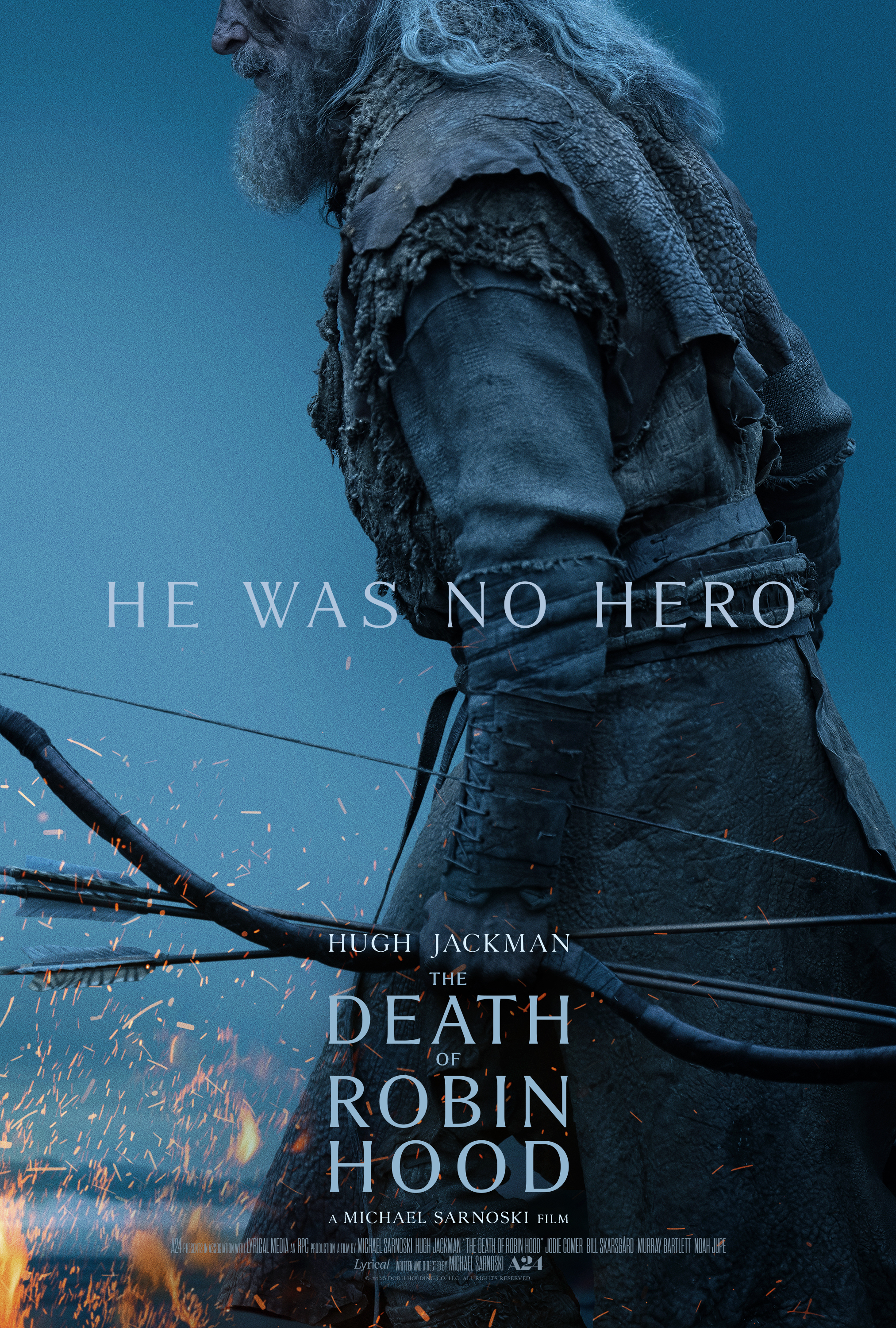
The Death of Robin Hood is the type of film that happens when a director is flying high and has enough cash in the movie bank to develop a revisionist telling of a famous bandit who stole from the rich and gave to the poor. After extensive research, Michael Sarnoski wrote a script about an aging Robin Hood (Hugh Jackman), who gets pulled into one last battle by his long-time friend (and Little John. The attack goes awry, Robin gets smashed, and he’s healed by Sister Brigid (Jodie Comer), a mysterious woman who lives on an island. The Death of Robin Hood is methodically paced, ultra-violent, and an interesting look into cycles of violence that follow violent men – and the stories their exploits create.
The film takes place in 1247 A.D., and opens with a young woman making her way through miles of isolated terrain that is home to boulders, smaller boulders, and an incredible amount of mist. At first, it seems like she’s hopelessly lost, but salvation comes when she sees smoke rising from a rocky hillside. She walks towards the smoke and finds a bearded man (Hugh Jackman – wearing a gigantic fur coat) cooking rabbit over an open fire. Later that night, she attempts to kill him, but her revenge plot fails as the wily old man anticipated her scheme, and tells her she should’ve taken a bath (and not attacked upwind). After slitting her throat, he drags her body to a gravesite and places her in a pre-dug hole. While covering her body with rocks, an overhead shot shows that she is not alone, and is amongst dozens of graves filled with would-be assassins. In a prior life, “Robin” was a murderous bandit who rampaged through the forests of England with his group of indoctrinated “merry men.” During his killing sprees, he made many enemies, and now he’s killing their children as they come to fulfill blood oaths. It’s a vicious cycle of murder that doesn’t have any end in sight.
There is no merryness in Robin’s life; instead he’s encamped himself in the mountains waiting for overmatched assailants who will fill up his rock graves (the smoke from his fires acts as a murder beacon). Robin is pulled from his exile when Little John (Bill Skarsgård) shows up after a 15-year absence and asks Robin to help him dispatch a family of men who’ve taken his home and land. This leads to a bloody battle involving mud fights, broken ribs, stab wounds, child murder, the death of John’s wife, and a bloody and broken Robin. To save his life, Little John and his daughter Margaret (Faith Delaney) take Robin to a mysterious island that’s inhabited by a renowned healer named Sister Brigid.
After Sister Brigid heals his wounds, Robin hangs around the island that’s home to a collection of friendly children and women (this isn’t a Wicker Man situation). Since he’s no freeloader, Robin uses his skills to trap rabbits (sustainably), and help a leperous man (Murray Bartlett) tend the trees and foliage. Robin’s “happy” existence is threatened when Margaret returns to the island with news that Little John was killed by a group of men seeking revenge for their family members who died during the mud brawl (revenge and violence follow Robin). It would be a shame to spoil the rest, just know that it involves blood-letting, methodical pacing, and wonderful threats.
The cinematography by Pat Scola (Pig, We Grown Now, Sing Sing, Lurker) is fantastic as it relies on multiple aspect ratios (2:39 – 1:66:1) that shift between the violent opening and the contemplative second half. If you ever wanted to see every pore on Jackman’s face, this is the film for you, as his bearded face is front and center throughout. The Northern Ireland and Ireland locations aid the film as the various landscapes look hellish or lushly gorgeous. The costume design from Lorna Ó Ríordáin (Peaky Blinders, A Knight of the Seven Kingdoms) is top-notch as well, with the standout costume belonging to Bartlett’s leper character. In the press notes, Sarnoski told Ó Ríordáin that he wanted the leper’s costumes to have a soulfulness and elegance, and she succeeded in creating a gorgeous look for the good man.
If you’re expecting a rousing and merry Robin Hood adventure, you might be disappointed, because Sarnoski was interested in slowly and methodically deconstructing the myth of Robin Hood. While pitching the film to Bill Skarsgård, he described Little John as being a “murder baby” and the plot following the storylines of The Revenant (with less grunting) and Phantom Thread (with less humor). The description makes a lot of sense as the early scenes feature copious grunts, and the second half belongs to a broken man finding peace. Overall, it’s not the most successful venture as you feel almost every minute of the 123-minute running time, but it’s neat that Sarnoski took a swing, and it’s been watching him focus on human elements. I’m excited to see what he does next.


