John’s Horror Corner: Boys from County Hell (2020), this Irish horror-comedy is a stylish vampire movie that hocks “Piss Off” to Dracula.

MY CALL: Providing a feisty Irish play on the vampire genre, this odd little film is one I’d readily recommend (even if only for a one-time viewing). While not in league with Grabbers (2012) or Shaun of the Dead (2004), this horror comedy delivers as much charm as it does bloody fun along with some dire death. MORE MOVIES LIKE Boys from County Hell: For more Irish horror movies check out Leprechaun Origins (2014), Leprechaun 2 (1994), Leprechaun (1993), Rawhead Rex (1986), Isolation (2005), Outcast (2010), Grabbers (2012), Cherry Tree (2015), Holidays (2016; St. Patrick’s Day segment), The Hallow (2015) and Hole in the Ground (2019).
Contestably the oldest story on record about a blood drinking creature, our ne’er-do-well protagonists Eugene (Jack Rowan; Peaky Blinders), William (Fra Fee; Hawkeye) and SP (Michael Houg; Chapelwaite, Grabbers) find shenanigans in preaching about their local folklore’s vampire that predated Bram Stoker’s rip-off. The legendary blood drinker Abhartach (Robert Strange; Howl, Penny Dreadful) was told to rise every time he was killed, and his grave is marked by a pile of stones about to be leveled for new road construction in the Irish countryside.
When a freak farm accident kills William with his blood soaking into the ground by the old stone pile, Abhartach is awakened and death befalls the nearby farm.
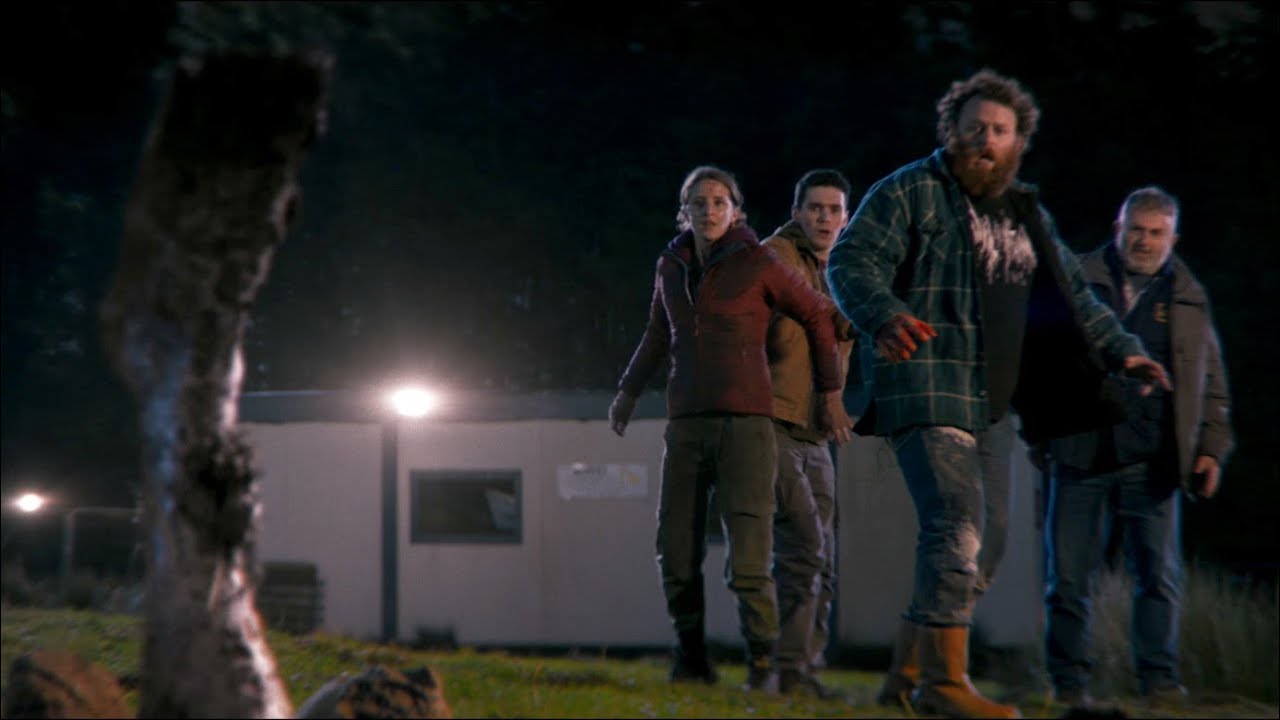
Advertised as a horror comedy, the comedy is somewhat infrequent once the killing starts. But it certainly has its humorous moments. Much in the vein of Shaun of the Dead (2004), the monster attacks are dire and visceral, yet sometimes killing a monster comes with a laughably cheeky gory spin. The key word here is “sometimes.” Overall this film is more serious than Shaun, but every now and then it reminds you of its probable influence.

The Abhartach monster is a black-skinned, blood-hungry, emaciated ghoul that looks good and moves well on-screen. I honestly expected cheaper or less-revealing effects, so this was a lovely surprise. Likewise, the horror action is good, packing a lot of blood along with some shocking moments including broken bone protruding through the skin and a brutal “pulling” dismemberment. Yikes!

An interesting play on the vampire subgenre is Abhartach’s power to pull blood towards him (as if by “blood telekinesis” or… haemokinesis?), even at great distance and from a living body! It’s no Magneto smoke show, but it’s a very cool, well-executed concept that brings gravity to the creature’s menace.
This film is entertaining, rather fun, pretty good, really well-made, and very easy to watch. The acting, writing, and general filmmaking are all refreshingly capable considering I didn’t recognize any of the cast or director (Chris Baugh; Bad Day for the Cut). One mild warning I’d issue is that the Irish accents are thick, and some viewers may want the subtitles on for this one. But those accents are part of the charm for this odd little movie that I’d strongly recommend, even if only for a one-time viewing.

Share this post:

Home Sweet Home Alone (2021) – Review: A Glossy and Uninspired Attempt at Making a New Holiday Classic

Quick thoughts: Grade – D+ – Home Sweet Home Alone is a failed attempt at recreating the magic of Home Alone. There are some fun elements, but the core conflict doesn’t justify its existence.
When it was announced that Archie Yates would be starring alongside Ellie Kemper and Rob Delaney in a sequel to Home Alone, optimism was high, as Yates proved himself to be extremely likable in the Taika Waititi directed Jojo Rabbit. However, director Dan Mazer (I Give it a Year, Dirty Grandpa) and writers Mikey Day and Streeter Seidell decided to take a simple and effective concept (kid battles dumb robbers), and muddy it up with mortgage problems, misunderstandings, and montages that feature an 11-year old named Max (Archie Yates) recreating scenes from Scarface with M&Ms and whipped cream.
It’s understandable why the creators avoided murderous thieves like Harry and Lloyd from the original franchise, because in 2021, watching two grown men threaten a child with mutilation isn’t ideal. Instead, they have a married couple (who have children themselves), played by Ellie Kemper and Rob Delaney, infiltrating the house so they can get back an ugly doll worth $200,000, that they think Max stole from them. They need the doll because Jeff (Delaney) is unemployed, and they might have to sell their home because they’ve had some lean months, and will need to downsize. So, instead of waiting for Max’s mom Carol Mercer (Aisling Bea) and other family members (who left Max behind) to return home from Japan, they break into the house multiple times, step on Legos, and are almost killed by an icicle trap, that if successful, would’ve left them impaled on a sidewalk.
By having the main conflict be centered around a thievery misunderstanding, and attempting to make the criminals sympathetic, the movie loses its edge, and makes everyone unlikable. It’s a pointless exercise that takes solid actors, and zaps anything human about them. Also, the simplicity of the first film was its biggest strength, as Kevin had to battle two criminals who were trying to rob his home. This iteration gets too convoluted, and takes away from focusing on Max, whom the audience is supposed to like and support. Yates proved himself to be extremely likeable in Jojo Rabbit, but in this film, due to uninspired direction (or studio notes), he mainly reacts to things, quotes one-liners, and never gets himself into trouble like Macaulay Culkin did in his two films. Home Sweet Home Alone lacks bite, and sadly feels like a direct-to-streaming option that is nothing more than content. It’s wild to think that Mazer, a contributor with Sacha Baron Cohen, who wrote (or co-wrote) the scripts for Da Ali G Show, Brüno, Office Christmas Party, and Ali G Indahouse, directed this film.
This may sound like more dogpiling, but the set design never plays believably, and it’s always obvious that the shenanigans are taking place inside a soundstage. Shooting on location isn’t an ideal option for movies like this, as houses don’t have movable walls or lighting grids that can attach to ceilings, but it would’ve been nice to watch something that didn’t play totally fake.
Share this post:

The Deep House (2021) – Review: An Ambitious Horror Film That Features an Underwater Haunted House
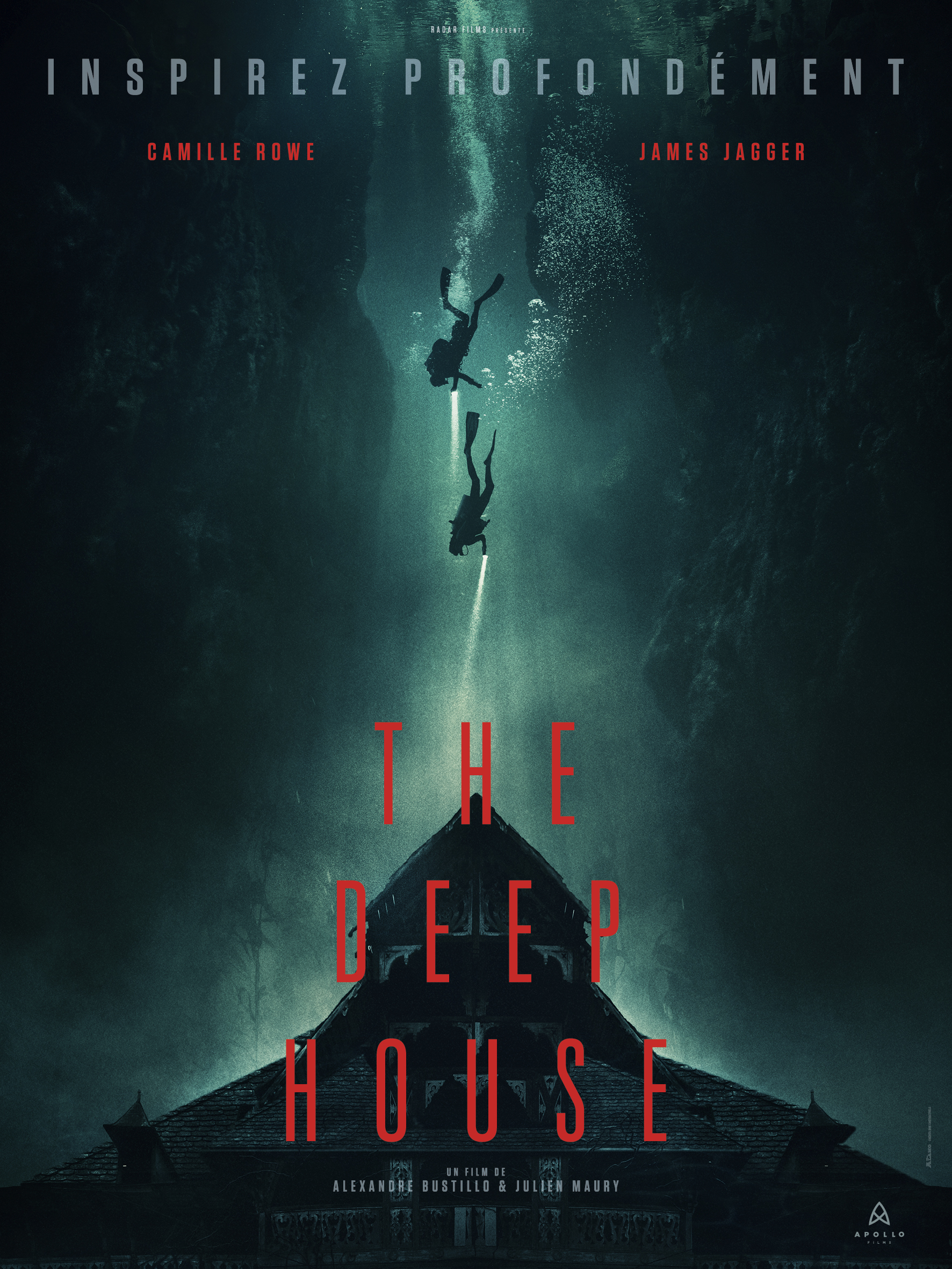
Quick Thoughts: Grade – C+ – The Deep House is an ambitious and silly horror movie that goes to extreme depths to entertain. Directing duo Alexandre Bustill and Julien Maury (Inside, Livid, Leatherface) deserve credit for the inspired idea, and insistence on filming the movie in massive water tanks, which add to the atmosphere and believability.
In a horror landscape that’s loaded with sequels, remakes, prequels, reboots, ripoffs, and the same ideas (which is nothing new, and is to be expected) it’s always nice when you see a movie synopsis that reads “A couple enters the interior of a strange house located at the bottom of a lake and their presence awakens a dark spirit that haunts the house.” When David Cross, of the Award Wieners Movie Review Podcast put this film on my radar, it felt like Christmas, and this is the perfect horror film gift, as it combines ghosts, underwater shenanigans, and an element of claustrophobia inside the underwater haunted house. Bustill and Maury hired famed underwater cinematographer Jacques Ballard (Deep, Beyonce’s Run the World (Girls)), to film the ghost story, and it paid off, as it’s a good looking film that’s a tiny bit too clean, as the tanks they filmed in don’t necessarily capture the murky water of a lake. It’s totally understandable why they shot in water tanks, as they had more freedom to build sets, and it’s much safer than shooting outside where weather, waves, water temperature, and random tourists can be a problem.
The film focuses on Ben (James Jagger), and Tina (Camilla Rowe), a couple of internet influencers who visit haunted locations, and film the experience for their small but growing audience. After one of their locations is a bust, they find themselves investigating a submerged house in an isolated area of a lake that on normal circumstances should be avoided at all costs. The two arrive at the location via a creepy guy who undoubtedly is up to no good, and they proceed to dive deep down to film the surprisingly well-maintained house of horrors. It would be a shame to spoil anything, just know that there are ghosts (free divers were hired to play the ghosts, which is cool), scary corridors, and several jump scares involving fish.
The production design by Hubert Pouille (Mandy – watch it now) is inspired, and he’s created a labyrinthian home full of creepy props, ominous chains, and chimneys that will 100% collapse when people swim in them. It must’ve been a beast to create the sets, as wallpaper, paint and props needed to endure a long shoot underwater, and not fall apart or make the tank water murky. Overall, it’s a fine production that’s light on story, and heavy on “Hey, that’s impressive how they filmed that” moments. Camilla Rowe proves herself to be a likable screen presence, and she’s much more agreeable than James Jagger, who has to play a sulky influencer who complains incessantly about his followers. Overall, they aren’t given much to do, and that hurts the overall proceedings because there is zero emotional attachment to the pair of ghost chum.
What makes the 84-minute film worth watching is that it’s something new and inspired. The scares aren’t there, the characters aren’t exactly likable, but, it’s AN UNDERWATER GHOST STORY! If you are a fan of the horror genre, you’ll enjoy the new concept.
Share this post:

The Movies, Films and Flix Podcast – Episode 396: Armageddon, Animal Crackers, and Asteroids
You can download or stream the pod on Apple Podcasts, Tune In, Podbean, or Spreaker (or wherever you listen to podcasts…..we’re almost everywhere).
If you get a chance please make sure to review, rate and share. You are awesome!
Mark, Norbert, and Niall discuss the 1998 blockbuster smash hit Armageddon. Directed by Michael Bay, and starring Bruce Willis, Ben Affleck, Liv Tyler, and an asteroid the size of Texas, the movie focuses on what happens when a group of oil drillers go to space to blow up a mean looking asteroid. In this episode, they discuss disaster films, movie soundtracks, and the career of Michael Bay. Enjoy!
If you are a fan of the podcast, make sure to send in some random listener questions (we love random questions). We thank you for listening, and hope you enjoy the episode!
You can download the pod on Apple Podcasts, Tune In, Podbean, or Spreaker.

Share this post:

Movies, Films and Flix Random Data: Analyzing the Hang Time in the 1993 Action Classic Cliffhanger
I love Cliffhanger, it’s one of my favorite action films, and it’s aged beautifully since 1993. Between Renny Harlin’s direction, the on-location shoot in Italy, and the inspired performances from John Lithgow, Michael Rooker, Sylvester Stallone, and Rex Linn, it’s aged like a fine Italian wine.
If you haven’t watched it, the movie revolves around a guy named Gabe Walker (Sylvester Stallone) battling a gang of criminals led by Eric Qualen (John Lithgow), who are wandering around the Colorado mountains looking for cases of cash that blew out of an airplane during a heist (Yes, there’s an airplane heist, and it’s glorious). The problem is, a year prior, Walker was involved in a tragic accident that saw the girlfriend of his best friend Hal Tucker (Michael Rooker), falling a long way to her death. The tragic accident weighs heavily on Gabe, and it doesn’t help that he has to team up with Hal, to defeat the deadly criminals (who shoot rockets into the side of a mountain, and cause an avalanche that kills some of them), who really want the millions of cash that are spread around the mountain. It all culminates with a beautiful fight between Stallone and Lithgow that takes place on an upside down helicopter that is attached to the side of a mountain. It’s a glorious brawl, and it provides another example of how Harlin loves adding multiple elements to his action films.
While watching the movie again, I really wanted to know how much time Stallone spends hanging from various items. So, I used timestamps and a stopwatch to clock the times, and I came up with the following graphic. It’s neat knowing that he spends more time hanging from a ladder than he does on cliff faces.
Quick Definition – Hanging – suspend or be suspended from above with the lower part dangling free.
Basically, in the beginning of the film, Stallone is attached to a cable, and his legs are wrapped around it. This isn’t considered hanging. It’s conderied hanging when he’s climbing on the side of a mountain, loses his footing, and he grips a piece of rock in hopes of not falling to his death. Take a look at the image below, and you’ll have a solid idea of what I mean.

I’ve covered the film extensively on the Movies, Films and Flix Podcast (here and here), and it’s also been discussed on Deep Blue Sea – The Podcast. Check out the episodes!
Here’s the breakdown of Stallone’s hang time. Enjoy!

Share this post:

The Harder They Fall (2021) – Review: Director Jeymes Samuel Has Given the World an Entertaining Western
Quick Thoughts: Grade – B+ – Directed and co-written by Jeymes Samuel, The Harder They Fall is a thrillingly stylish western that features inspired production design, cinematography, and performances. It’s cool knowing that the characters are based on historical figures, and hopefully will inspire people to research the real-life characters.
What makes The Harder They Fall so special is that director Jeymes Samuel loves the western genre, and wanted to use today’s technology to film jailbreaks, gunfights, bank robberies, and horse chases. The end result is a beautiful looking film that employs drones, split-screens and huge crane shots to tell the story of Nat Love (Jonathan Majors), a gunslinger who really wants to kill Rufus Buck (Idris Elba), the man who murdered his family. The cinematography by Mihai Malaimare Jr. (The Master, The Hate U Give, Jojo Rabbit) harkens back to the days of the legendary Sergio Leone, who wasn’t afraid to let the camera linger on his actors faces, and was always up for wide open vistas and gnarly carnage. What’s nice is that The Harder They Fall has a distinct visual language that involves bright colors, close ups, zooms, and stylish centralized framing, which makes it stand out from its peers, but also wears you out, as the dedication to visual flourishes are nonstop. Also, kudos to Samuel and production designer Martin Whist (The Cabin in the Woods, Bad Times at the El Royale) for creating White Town, which provides one of 2021’s best sight gags.
The Harder They Fall centers around the showdown between two different groups of gunslingers ﹘who are both very good at killing people. On one side, there is revenge-driven Nat Love, and his associates Bill Pickett (Edi Gathegi), and Jim Beckworth (RJ Cyler), two outlaws who make their money by stealing from other criminals. They team up with Love’s girlfriend Stagecoach Mary Fields (Zazie Beetz), her bouncer/bodyguard Cuffe (Danielle Deadwyler), and a Marshall named Bass Reeves (Delroy Lindo), who rounds out their deadly crew. Against them is legendary outlaw Rufus Buck, and his two partners “Treacherous” Trudy Smith (Regina King), and Cherokee Bill (LaKeith Stanfield), a man who loves to monologue and shoot people when they aren’t looking. Their epic battle takes place in a town called Redwood, and it involves explosions, monologues, fistfights, gunfights, and more explosions. It’s a wildly violent brawl that relishes in exploding heads that spray copious amounts of blood and the killing of dozens of henchmen who should know better than to stand in the way of Delroy Lindo.
You can tell that Samuel pulled from his background as a musician and music video director, as the soundtrack is loaded with excellent songs (the opening Kid Cudi/Jay-Z is solid), and it shows that he learned a lot from his time as the executive music supervisor on the Baz Luhrman directed The Great Gatsby (2013). There’s a lot of style in this film, and it’s propelled by musical performances and songs that prove to be very memorable.
In the end, every performance is solid, and it’s clear why the actors signed up for the film (they get to look awesome). But, their characters represent more style over characterization, which is fine, but they don’t necessarily prove to be endearing, or overly memorable aside from some well-shot moments that frame them in interesting ways (watch the trailer, you’ll see). It’s easy to understand why the film is the way it is, but the focus on the tone and style takes away from focusing on, or creating memorable characters.
Final thoughts:The Harder They Fall is a lot of fun, and if you are a fan of stylish westerns, you will love this movie.
Share this post:

The Movies, Films and Flix Podcast – Episode 395: Re-Animator, Herbert West, and Zombie Cats
You can download or stream the pod on Apple Podcasts, Tune In, Podbean, or Spreaker (or wherever you listen to podcasts…..we’re almost everywhere).
If you get a chance please make sure to review, rate and share. You are awesome!
Mark and John discuss the 1985 horror comedy classic Re-Animator. Directed by Stuart Gordon, and starring Jeffrey Combs, Bruce Abbott, and Barbara Crampton, the film focuses on what happens when a maniac creates a green goo that brings dead things back to life. In this episode, they discuss horror comedies, Stuart Gordon, and the continued popularity of Re-Animator.
If you are a fan of the podcast, make sure to send in some random listener questions (we love random questions). We thank you for listening, and hope you enjoy the episode!
You can download the pod on Apple Podcasts, Tune In, Podbean, or Spreaker.

Share this post:

Spencer (2021) – Review: A Visually Rich Film That Features a Standout Performance From Kristen Stewart

Quick Thoughts – Grade – A – Spencer is a marvel of mood, lighting and tone. The specter-like camera, eclectic score, and 1:66:1 aspect ratio create a tense visual atmosphere that is hard to shake. Throw in Kristen Stewart’s excellent performance, and Pablo Larrain’s (watch Jackie!) confident direction, and you have one of the best films of 2021 that is bound to polarize audiences and critics.
Taking place during Queen Elizabeth’s Christmas festivities in December 1991, Spencer imagines what happened during those infamous days, which ended with Diana, Princess of Wales (Kristen Stewart), deciding to divorce her husband Charles (Jack Farthing), and move on with her life. After directing Natalie Portman to another Best Actress Academy Award nomination for Jackie in 2016, director Pablo Larraín is back in a similar realm, and the results are wildly memorable. Larraín cast Stewart because of her “mysteriousness,” and that makes total sense, as Diana has remained a mysterious figure to the public, and Larraín’s visions require interpretation and mystery to make his characters work. The casting paid off as Stewart, who did loads of research, brings a level of mystery, fragility, and expressiveness to the interpretation. Look for Kristen Stewart to be a major player during the awards season, and after Clouds of Sil Maria, Personal Shopper, and Underwater, it’s neat seeing her continue her streak of appearing in interesting and different films.
Spencer is loaded with fine performances from Stewart, Timothy Spall, Sean Harris, Sally Hawkins, Jack Nielen, and Freddie Spry, but what makes the film pop are the artists behind the scenes who worked together to create a marvel of mood and tone. The costume design by two-time Oscar winner Jacqueline Durran (1917, Mr. Turner, Tinker Tailor Soldier Spy), is next-level, as the outfits blend well with the soft lighting, and dark corridors of the always cold castle. Watching Diana run through a muddy field in high heels, and a dress provides a memorable visual of contrasting elements that are made even more interesting by the long dolly shot that tracks her journey. The location scouting of the German and English locations allowed Larraín and cinematographer Claire Mathon (Atlantics, Portrait of a Lady on Fire – Watch it now) to find the perfect spots to stage their long dolly shots, and tracking steadicam work which places the audience inside the action, and features some of the best hallway steadicam work since The Shining. Also, the score by Radiohead’s Johnny Greenwood blends strings, eclectic instrumentation, and jazz elements, to create an ominous, and almost oppressive vibe that makes normally mundane moments, like eating soup, seem nerve-racking. This is random, but it would be cool to see how the score for the 1999 cannibal movie Ravenous would fit into Spencer. It probably wouldn’t work, but it would be fun to see the two combined.
While walking out of the screening several critics were vocal about their dislike of the movie, calling it “grotesque,” and “the worst film of 2021.” After some thought, it’s clear that Spencer is not for everyone, as it doesn’t explain much, and the interpretation of those three days may feel exploitative. However, Larraín has always been clear that his films are psychodramas that avoid conventional biopic tropes, and instead reimagine events and characters. The script from Steven Knight (Locke, Eastern Promises) provides a threadbare plot structure, and is much more content creating a fable that doesn’t rely on fact. This has proven to be troubling for some, but, if you can get on the film’s wavelength, that shouldn’t be a problem.
Final Thoughts: Kristen Stewart gives a career best performance, and it will be fun to see the public’s reaction to this unconventional film.
Share this post:

Finch (2021) – Review: A Pleasantly Straightforward Tale About a Man, His Dog, and a Robot Named Jeff

Quick thoughts – Grade – B – Finch is a pleasantly straightforward tale about Tom Hanks embarking on a cross country trip to keep his dog alive. It’s a neat twist on the survival genre, and it offers a little something for everyone
Filmed in 2019, and initially planned for a theatrical release, Finch could easily be mistaken for a pandemic production that found a way to film amidst strict regulations and protocols to keep crews safe. The film is essentially a two men, and a dog show, as Tom Hanks, a dog named Seamus, and Caleb Landry Jones, who performed the motion capture, do all the heavy lifting. As always, Hanks is excellent, and he effortlessly carries the screen, and does a great job acting next to a dog, and a robot named Jeff.
Finch takes place in a post-apocalyptic world in which solar flares and holes in the ozone layer have decimated the populace, and forced survivors to exist at night, as daytime temperatures have reached skin melting heights. Not surprisingly, one of the survivors is Tom Hanks, who plays a character named Finch, who is justifiably more wary of the remaining humans, as he is of the scorching hot temperatures and radiation. Finch lives a peaceful existence with his dog Goodyear, and they reside inside a robotics plant that is powered by large wind turbines, which allow Finch to build a hyper-intelligent robot who will take care of Goodyear when Finch isn’t capable of doing so anymore. The reason he needs the robot is because during his many daytime food and supply runs, Jeff has absorbed a wild amount of radiation which is slowly killing him. To make things worse, Jeff is forced to take a 1,000+ mile road trip to San Francisco to avoid a massive storm that will bury his area in sand, and most certainly take out his remaining power sources. What follows is a neat journey that involves a modified motor home, dangerous tornadoes, and some tense moments involving mysterious (and hungry) survivors.
Directed by Miguel Sapochnik (Game of Thrones), Finch (formerly titled Bios) blends optimism with skepticism to create a movie that doesn’t have many great things to say about humanity. Instead, it focuses on finding beauty in experience, and the good and bad that come with opening up your heart, or traveling to a location you’ve always wanted to see. Writers Craig Luck and Ivor Powell made a smart decision when they decided to blend the skepticism of Finch, who has seen children murdered over food, and what happens when humans become desperate, with the optimism of Jeff, who is a highly intelligent robot that looks at the world with wide-eyed optimism because he hasn’t witnessed tragedy, loneliness or gigantic sand tornadoes that are loaded with radiation. Together, the two form a likable duo, and it would’ve been cool to see Tom Hanks, and Caleb Landry Jones (in a motion capture suit and wearing stilts) doing their thing on set. Finch lives and dies on Hanks’ performance, and it’s neat seeing Hanks embrace pessimism, and enjoy the company of animals and robots over humans. To be fair, the performance by Seamus the dog makes it easy to love the animal, and according to Sapochnik, Seamus was the MVP on set.
The pandemic forced the narrative of the film to change a bit, as earlier cuts were more bleak and dark. It’s understandable why Sapochnik moved away from a depressing film during a pandemic, but the end result doesn’t feel all there. It’s a satisfying family drama, with excellent visual effects, and another solid Hanks performance, but it’s lacking a certain amount of character development, or stakes, to make it stand out from the crowd. In the end, it’s a totally enjoyable film, that breezes by, and gives the world more Tom Hanks, which is always a good thing.
Share this post:

The Protégé (2021) – Review – Director Martin Campbell Has Given the World Another Enjoyable Action Film
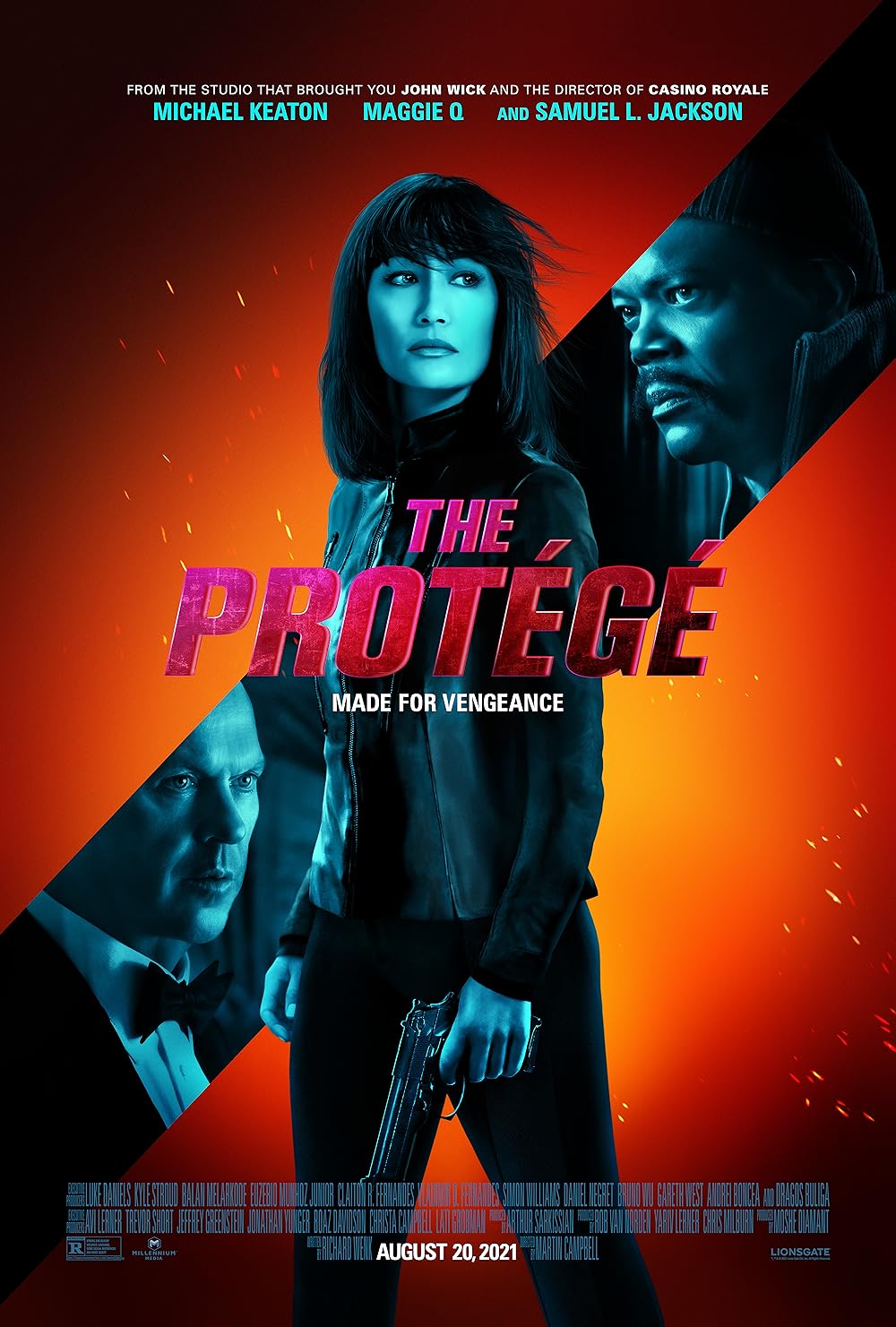
Quick thoughts – Grade – B+ – The Protégé works because of the committed cast, fun action scenes, and assured direction from Martin Campbell (Goldeneye, Casino Royale). It isn’t afraid to have fun, and has a lot to offer audiences looking for an entertaining action film.
What makes The Protégé so enjoyable is that it knows exactly what it is, and has an A-list cast of actors who are fully committed to the fun action. Normally, revenge thrillers, or similar action films play super seriously, and feel overly dour in between the action beats. This isn’t an issue with The Protégé as Maggie Q, Samuel L. Jackson, Michael Keaton and Robert Patrick seem like they are enjoying themselves, and you’ll most likely fall in love with it after you watch Michael Keaton engage in two well-executed kitchen fights. When watching it, don’t expect Atomic Blonde, John Wick or The Raid levels of violence, as it was never meant to be those movies, and instead look forward to likable characters, and inspired action moments that utilize the actors well.
On the surface, The Protégé feels like an age-old tale of revenge, that features an assassin out to avenge the death of their mentor. However, the script by Richard Wenk (The Equalizer, The Expendables 2, 16 Blocks) offers some inspired twists and turns, and takes the story to unexpected places that never feel shoehorned in. The story revolves around world class assassin Anna (Maggie Q), traveling the globe in an effort to find out who killed her mentor/father figure Moody (Samuel L. Jackson). During her quest, she comes across the mysterious Rembrandt (Michael Keaton), who tries to stop her from killing her way up the chain of command. In between the action scenes, Wenk’s script treats the viewer to conversations about expensive books, cheeky reactions, and an entertaining dinner between Anna and Rembrandt, that showcases the excellent chemistry between the two actors.
It’s no surprise that The Protégé is enjoyable because it’s directed by Martin Campbell (Goldeneye, Casino Royale, The Mask of Zorro, Vertical Limit), who understands the genre, and has directed some of the most popular action films of recent memory. In Casino Royale and The Mask of Zorro, he excelled at getting excellent chemistry from his actors, and the relationships between Daniel Craig/Eva Green and Antonio Banderas/Catherine Zeta-Jones, are big reasons why the two films are adored. Campbell does the same thing with The Protégé, as Maggie Q and Michael Keaton clearly seem to enjoy acting against each other, and the mentor relationship between Maggie Q and Samuel L. Jackson feels lived in and believable. It’s easy to understand why Anna would go on a rampage after losing Moody, as they have an understanding of each other, and they both seem to enjoy being in each other’s company.
Final Thoughts – It’s a shame the movie didn’t do well in theaters, because it’s an inspired and well-executed action film.


 Movies, Films & Flix