Zodiac: Still Going Strong After 10 Years

Written by Zachary Beckler – He is a film professor and director of the award winning horror film Interior. Subscribe to his wonderful letterboxd page.
The camera moves impossibly. In Zodiac, Fincher’s first digital foray, he solidifies his experimentations with uncanny camera movement in Panic Room and Fight Club. In the opening shots, we soar omnisciently over the city of Vallejo, California as fireworks are set off in the distance. The movement is too smooth; perfect and unnerving, but not showy. It is contrasted by Three Dog Night singing “Easy To Be Hard”, an easygoing love ballad with dark undertones (“How can people be so heartless? How can people be so cruel?”). The next shot moves to the interior of a car driving through a neighborhood. The camera is fixed out the passenger side window, passing perfect scenes of houses and distant fireworks. The production removed the tires and put the car on a dolly track, sustaining this eerie stillness of movement. In a film about investigation, Fincher shows us only what he wants us to see.
There are only three murder scenes in Zodiac, all appearing within the first 30 minutes of a nearly 3-hour runtime. In real life, the public’s fascination with the Zodiac killer had less to do with the victims and more to do with a general sense of terror; of the possibility of becoming a victim. Who is this Zodiac? What kind of monster must he be? The less we know about him, the bigger it becomes in our minds. In essence, the film is about a collective fear of and fascination with this unknown, but also its demystification; the film’s true success is showing the monster can really be a man, and how much more unsettling that can be.
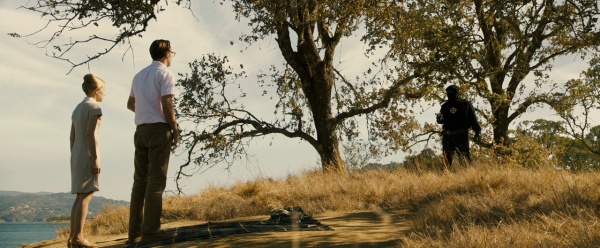
The Lake Berryessa Murder is the most famous and disturbing scene in the film. Fincher plots it almost as a spin on every slasher movie you have ever seen; a masked man murdering teens at a lake (the Zodiac killings slightly pre-date the genesis of the American slasher movement). The awkwardness of the exchanges, in particular the voice of the killer, lulls us into a sense of safety. If they (we) just do what he says, everything will be ok. Of course we know it will not, and that tension underscores every humorous moment. The imagery of this scene, from the empty landscape captured in perfectly composed wide shots, to the blades of grass out of focus in the foreground (added entirely in post), bring us a sense of both isolation and voyeurism, as if from the point of view of a snake in the grass.
.
There are two moments that stand out firmly in my mind: First, the woman’s point of view shot as the Zodiac walks up, dressed as death. It is so matter-of-fact and un-cinematic but feels more immediate than any slasher film and all without any formalistic build up. The second, of course, is the actual murder. We have never seen a knife go into living person’s flesh like this. Fincher presents this moment how it actually must have happened, with the utmost craft and respect, and in the process makes it more horrific than every slasher murder before it.
Fincher’s camera captures every detail of this period in an explicitly constructed way, originating techniques he would later refine with films like The Social Network and The Girl With The Dragon Tattoo. Filming on the Viper Camera, one of the first digital camera systems that captured uncompressed 4:4:4 digital video, Fincher’s post-production team had a full range of visual information to play with. Dialogue scenes were primarily filmed in stationary angles to allow split-screening of the frames and performances, to control reactions and over-the-shoulder shots. In the special features of the DVD, we see Fincher make Jake Gyllenhaal drop his sketchbook over 30 times so as to land in a precisely framed way. This is no different from the level of control filmmakers like Kubrick or Hitchcock imposed, and Fincher’s purpose is just as vital to his own work. He constructs this world to his specifications and limits your perspective to his worldview. The murder scenes are the flashiest examples, like the cab turning a corner and never changing its size or placement. The world moves around what becomes a stationary object.
Environments shift and change around our characters as well, whether it be digital time-lapse construction shots of a San Francisco building, or in the director’s cut where several years pass on a black screen simply through audio. Time, in a way, is the films main antagonist. The further our characters get away from the murders, the less evidence becomes available and the more mythic the killer becomes. “You’re going to catch him,” Gyllenhaal’s Robert Graysmith says to Mark Ruffalo’s Detective Toschi after a screening of Dirty Harry. “Pal,” he responds, “they’re already making movies about it.” Space is the other enemy, as all of the murders happen across city lines, forcing detectives in other counties to work together with analog technologies. A scene in which Inspector Armstrong, played by Anthony Edwards, has to coordinate over the phone with every county in order to consolidate the evidence shows just what a miracle the solving of any murder really was. But space is depicted sonically as well, the characters’ voices almost always mixed with heavy post-production reverb and reflection, like in a key interrogation scene inside a factory’s break room. This consistent echo creates the illusion of a larger space, isolating the characters further within a world far bigger than the methodical framings they are confined to.
The film follows three real-life Zodiac obsessives: Robert Graysmith, Detective Dave Toschi, and Paul Avery, played hilariously by Robert Downey Jr. one year before his Iron Man breakout. While Fincher keeps these figures under his camera’s precise framings and movements (to the point that Downey would leave jars of piss on set out of protest to the director’s relentless digital shooting schedule) the actors are still given every opportunity to create vivid, engaging characterizations and interactions. One the funniest throwaway moments in the film has Graysmith telling Avery, “I’ve been thinking… someone should write a book,” to which Avery responds instantly and carelessly, “Someone should write a fuckin’ book, that’s for sure… About what?” In Tony Zhou’s fantastic “Every Frame A Painting” video essay, he states that within Fincher’s worlds, “drama happens when a character learns a new piece of information. How does it fit with everything they already know? And how do they react to learning a little bit more of the truth?”
.
This is the essence of Fincher’s scene construction, which a lot of times is expository. Yet he is always able to make inherently “uncinematic” scenes (i.e. dialogue, shot/reverse shot) graphically engaging by focusing his camera on what his sound designer Ren Klyce would call “specifics”. These are moments of focused attention, be it visual or sonic, that accentuate the drama and/or purpose of the scene. It is yet another level of exacting construction he is able to use from scene to scene, and the effect creates a more active engagement of the subject. No matter how controlled they are visually, these moments open the characters up dramatically, like Toschi’s eyes noticing Arthur Leigh Allen, the films presumed Zodiac killer, wearing a “zodiac” watch in a piece of singular coverage.
“There is more than one way to loose your life to a killer,” read the ad campaign. If the first act was establishing the horror, the rest of the film simply sets up the next victims. Zodiac is a film that details an investigation without ending. Sure, Graysmith points his finger to Allen, but nothing is “solved”. The resolution is a personal satisfaction rather than justice being served. This is because the culture around the Zodiac killer and its mystery is far more interesting than whoever the man was, depicted here as essentially a murderous pre-internet troll. The Zodiac is different things to different people. To Toschi, it is simply a nagging unsolved murder. In some cases, the idea fulfills a need. To Avery, its an excuse to succumb into alcoholism and despair. To Graysmith, it was the one time in his career that something interesting happened and anyone took him seriously. To Mike Mageau, however, it was the most terrifying experience of his life. Mike is the surviving victim of the opening murder scene, and it is fitting the film ends on him some 20 years later, still having to be questioned, never being able to put the incident behind him. Shown a series of mugshots, he picks Arthur Leigh Allen’s picture. Though not 100% sure, he nevertheless states, “The last time I saw this face was July 4th, 1969. I am very sure that’s the man who shot me.” The opening strums of Donovan’s “Hurdy Gurdy Man” creep into the soundtrack. The effect is frightening. This was the man who did these terrible things. He will never “pay” for these crimes. And we will never know for sure if he is truly gone. To some, he never will be. In this way, he got away with more than just murder.
But to Fincher, even if it wasn’t Allen, the Zodiac Myth is resolved. The finger has been pointed, the Zodiac’s power drained. It was always going to just be a man. Why construct ourselves as his victims?
“Histories of ages past
Unenlightened shadows cast
Down through all eternity
The crying of humanity
‘Tis then when the Hurdy Gurdy Man
Comes singing songs of love
Then when the Hurdy Gurdy Man
Comes singing songs of love”
Share this post:

MFF Special: Bill Paxton = Awesome
Bill Paxton has always been one of my favorite actors and between Tombstone, Aliens, Near Dark, A Simple Plan, Edge of Tomorrow, Frailty, Apollo 13, Twister, Weird Science, Club Dread and Edge of Tomorrow he has been in some fantastic films that I can watch over and over. When the news broke that he passed away I started thinking about his filmography and how great it was. The following post praises all things Paxton and hopefully introduces you to his wonderful filmography.
1. Frailty is the Bomb
Frailty is a fantastic horror film that is totally earnest and powerful. I love that it has built up an audience and some are claiming it is an unheralded cult classic. If you are looking for a powerful movie that was directed with love by Bill Paxton you need to see Frailty. I was going to write more about it but Roger Ebert summed it up perfectly:
Perhaps only a first-time director, an actor who does not depend on directing for his next job, would have had the nerve to make this movie. It is uncompromised. It follows its logic right down into hell. We love movies that play and toy with the supernatural, but are we prepared for one that is an unblinking look at where the logic of the true believer can lead? There was just a glimpse of this mentality on the day after 9/11, when certain TV preachers described it as God’s punishment for our sins, before backpedaling when they found such frankness eroded their popularity base.
On the basis of this film, Paxton is a gifted director; he and his collaborators, writer Brent Hanley, cinematographer Bill Butler and editor Arnold Glassman, have made a complex film that grips us with the intensity of a simple one. We’re with it every step of the way, and discover we hardly suspect where it is going.
Check out this Frailty clip. You will see Paxton did a great job of acting and directing.
.
2. He Had to Deal With a Predator, a Terminator and a Lot of Aliens.
Bill Paxton didn’t have much luck against angry creatures or robots. He met his end against a Predator (Predator 2), a Xenomorph (Aliens), a Groundhog Day alien (Edge of Tomorrow) and most likely suffered a concussion from a badass robot (Terminator). However, the role that he is most remembered for is Hudson in Aliens. What makes Hudson works so well is how he is justifiably freaked out by the xenomorphs. If I was stuck in a life-or-death battle with aliens with acid blood I would become a realist like Hudson too. However, he hung tough to the very end and I love that he went down swinging.
3. Coconut Pete is the Best
Sonuva, sonuva bitch. Mother, mother, f**ker
I am one of the few people on this planet who still fights for Club Dread. It is immensely watchable and Bill Paxton is a big reason why it is so fun. His Coconut Pete character is a somehwat famous musician who has always been overshadowed by Jimmy Buffet. You could tell that Paxton loved every second of playing Coconut Pete and that is why the performance just gets better and better. I love Coconut Pete’s songs and hopefully people will know what I’m talking about when I quote Pina Coladaburg.
4. Dude Was a Great Slimeball (True Lies), Jerk (Weird Science), Dirtball (Nightcrawler) and Jerky Vampire (Near Dark)
I love that Bill Paxton could play a whole lot of dirtbags differently. He could grow a sweet flatop and be a massive jerk in Weird Science, or he could somehow slime Jamie Lee Curtis away from the massive Arnold Schwarzenegger in True Lies. Bill Paxton’s slimy characters will never not be awesome and you will keep finding more and more layers to his jerkness. If you haven’t watched Near Dark or Nightcrawler I totally recommend you check them out. You won’t be disappointed.
.
5. A Simple Plan is a Perfect Thriller
Thrillers don’t get any better than A Simple Plan. Sam Raimi’s noir is damn near perfect and Bill Paxton’s descent into violence was excellent. I love how blue-collar it is and you can’t help but feeling terrible for all the characters. Once again Roger Ebert wrote a great review about the film and I had to quote it.
“A Simple Plan” is one of the year’s best films for a lot of reasons, including its ability to involve the audience almost breathlessly in a story of mounting tragedy. Like the reprehensible “Very Bad Things,” it is about friends stumbling into crime and then stumbling into bigger crimes in an attempt to conceal their guilt. One difference between the two films is that “A Simple Plan” faces its moral implications, instead of mocking them. We are not allowed to stand outside the story and feel superior to it; we are drawn along, step by step, as the characters make compromises that lead to unimaginable consequences.
The performances can be described only as flawless: I could not see a single error of tone or feeling. Paxton, Thornton, Fonda and Briscoe don’t reach, don’t strain and don’t signal. They simply embody their characters, in performances based on a clear emotional logic that carries us along from the beginning to the end. Like Richard Brooks’ “In Cold Blood” (1968), this is a film about ordinary people capable of monstrous deeds.
Check out this awesome interview between Ebert and Paxton and watch the clip below. You will love it.
Share this post:

War on Everyone: Vulgar, Smart, Random and More Vulgar

.
War on Everyone is a mean little thing that creates a world full of terrible people, horrible deaths and vulgar dialogue. Initially, it keeps you at a distance with its adherence to profanity but as it moves along you begin to the sync with the nastiness and it becomes a lot of fun. Director/writer John Michael McDonagh (The Guard, Calvary) is one of my favorite directors I love how his comedies are pitch black but feature heart amidst the nihilism. The Guard, Calvary and War on Everyone are 100% unsafe and McDonagh has proven himself to be a writer who hunts out controversy and makes it palatable. I don’t think that War on Everyone comes anywhere near McDonagh’s first two films but it proves he is willing to step out of his wheelhouse and find coherence in chaos. I love what David Fear of Rolling Stone had to say about the movie and its comparison to 1990’s Tarantino:
This is not just a superior knock-off but a literate refinement of a formula, one that the director can tweak enough to organically include sex, drugs and namedropping André Breton, Yukio Mishima, Simone de Beauvoir and Pythagoras.

.
War on Everyone focuses on two New Mexico cops Bob Bolano (Michael Pena) and Terry Monroe (Alexander Skarsgard) who spend their days hurting people, doing drugs and hitting mimes with their 1970’s muscle car. They eventually find themselves on the losing end of a million dollar heist and proceed to get their money back. The problem is they are in over their heads and things get more dangerous and ludicrous as they make their way up the criminal food chain. The journey into the criminal underground eventually pits them against dangerous British Lord/pornography king James Mangan (Theo James) and his squirrelly bodyguard Birdwell (Caleb Landry Jones). From there, things get weird, violent and overly reliant on Glen Campbell music.
War on Everyone is a unique movie that features an oddball rhythm and many tonal shifts. You could break it down in several sentences but that synopsis wouldn’t do it justice. I’ll admit I was nervous during the first 15 minutes but I began to relax and embrace the insanity of a film that sends it heroes to Iceland for one hilarious sight gag. I appreciated how everyone involved dived headlong into the insanity and trusted McDonagh to not make them look terrible. Michael Pena works wonder with McDonagh’s rapid fire dialogue and Skarsgard manages to blend melancholy with rage and showcase skills you didn’t know he had.
If you are looking for a vulgar and chaotic experience I totally recommend War on Everyone.
Share this post:

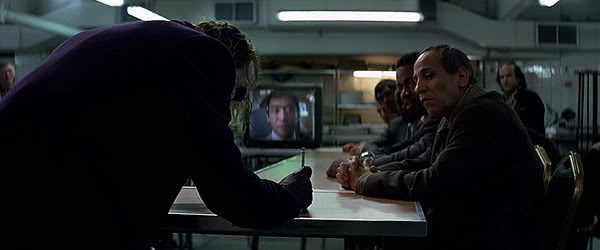
I love random statistics that have zero correlation or causation. Whether they be about jet ski action scenes, explosions on movie posters or Nicholas Sparks movies I can’t help compiling data that means little in the long run. The following post examines the data of films that feature pencils used as weapons. I just watched John Wick: Chapter Two and was very impressed with the violence that John was able to inflict on his foes with a pencil. The film influenced me to gather the Rotten Tomatoes critic scores, IMDb user scores and domestic box office/budgets of pencil weapon movies in order to see how they add up. The films Gremlins 2: The New Batch, The Faculty, Evil Dead, The Dark Knight, RocknRolla, From Dusk Till Dawn, Sleeperwalkers, Fright Night and Stoker all feature some fantastic pencil work and the results were surprising.
Sidenote: If you are looking for “pen action scene” data you are gonna have to go somewhere else. Sorry Casino, The Bourne Identity and The Running Man. Also, the films Tormented and Pencil do not have enough data to be included in the post. I didn’t include the box office of John Wick: Chapter Two because it just came out.
The Average Rotten Tomatoes Critic Score is 69.8%
I was really impressed with the “fresh” 69.8% average. My best guess as to why they are fresh is because they thought outside the box and went creative with the violence. Nobody expects pencils and the results are always surprising and cringeworthy. The fresh average was buoyed by The Dark Knight, (94) John Wick 2 (90), Evil Dead (95) and Fright Night (91). These four films carried Sleepwalkers (15), The Faculty (54), and RocknRolla (59) on their backs and gave cinematic pencil violence a good name.
The Average Budget is $47 Million
$47 million is relatively low nowadays for movies that get theatrical releases. The budgets were kept low via the horror films on the list. The Faculty, Evil Dead, Fright Night, Stoker and From Dusk Till Dawn all have budgets below $30 million. The Dark Knight and its $205 million budget are what kept the budgets in the 40s. The biggest surprise was the $92 million (with inflation) budget of Gremlins 2: The New Batch. Key and Peele were right, G2 is a crazy film.
.
The Average Inflated Domestic Box Office is $98,927,434
$98,927,434 is nothing to sneeze at. I was very impressed with the tally and it made jet ski action scene movies look bad in comparison ($49 million). The Dark Knight jacked up the average with its $593 million, but Gremlins 2, The Faculty, Fright Night and Sleepwalkers all collected over $50 million at the box office (with inflation) and helped out as well. The only film that super tanked was the very good Stoker ($1.7 million).
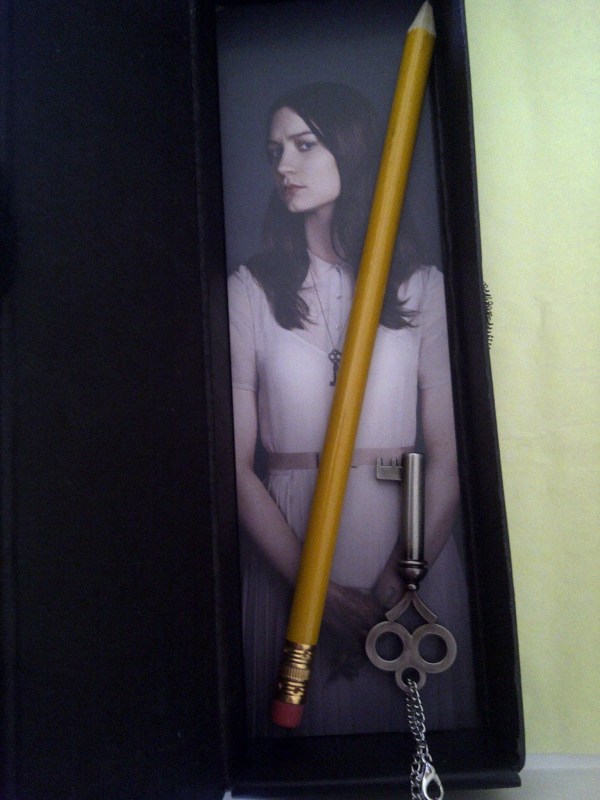
Watch Stoker now.
The Average IMDb User Score is 7.14
The 7.14 average proves that IMDb users like pencil violence more than critics (I can’t back this up). I was surprised to see the 7.14 average because it is really quite high. The Dark Knight (9) and John Wick 2 (8.5) boosted the scores while Evil Dead (7.6), RocknRolla (7.3) and The Faculty (7.3) helped combat the lower ratings.
Conclusion: These averages prove nothing of importance. However, movies that feature pencil violence easily defeated movies that feature jet ski actions scenes and that makes me happy.
Share this post:

The MFF Podcast #91: Everybody Wants Some More John Wick!

Download the pod on iTunes, PodBean, or LISTEN TO THE POD ON BLOG TALK RADIO.
If you get a chance please make sure to review, rate and share. You are awesome!
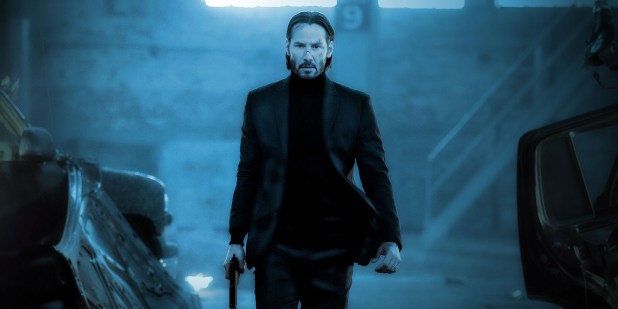
Summary: We discuss two films so outstanding that, immediately after they ended, we already wanted to watch them AGAIN: John Wick 2 (2017, starring Keanu Reeves) and Everybody Wants Some!! (2016). Despite being incredibly dissimilar films, both apply fine attention to memorable minor characters, stylish walking, persistence in the face of adversity, and unique wardrobes.

We answer the tough questions in this podcast! For example…
“Do any villains have valid motives anymore?”
“Is that Morpheus…and is he the leader of the underground again?”
“Is it a good thing to get Caviezeled or Pescied?”
“What were the best and most painful depictions of pencils in film?”
“Just how many people work for The Company?”


LISTEN TO THE POD ON BLOG TALK RADIO,
or head over PodBean or iTunes, and if you get a chance please SUBSCRIBE, REVIEW, RATE and SHARE the pod!
Share this post:

John Wick: Chapter 2: An Exhilarating and Monumental Achievement in Action Filmmaking.
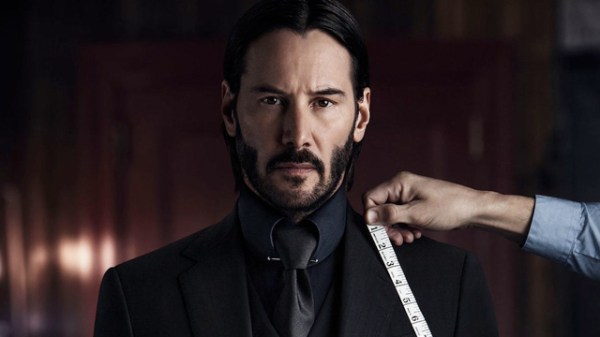
Review by Zach Beckler (Film Professor, Director, Great dude. Check out his award-winning film Interior)
John Wick: Chapter 2 is first and foremost an exhilarating and monumental achievement in action filmmaking. That is where I think it will succeed for most people who watch it. In the day since it screened, I haven’t been able to shake what is, on its surface at least, a stylish movie about hitmen navigating through an underworld. By the end, the film becomes one of the most politically rebellious genre films since They Live. Maybe even The French Connection.
You need to watch The French Connection.
Carpenter’s film shares many traits with John Wick 2, not the least being a fist fight so long it blossoms into out of body abstraction. All three films are about men caught in the gears of powerful and possibly ancient systems. Among the first of John Wick’s strengths is the fascinating world building, taking a standard revenge narrative to a place of underground mythology. John Wick 2 expands on this in ways both expected and unexpected. It adds more elements without sacrificing the mystery.
The story is light and efficient. Wick, retired for good, is brought back by an old acquaintance who, according to the tradition, has a kind of “unbreakable vow” over him. Wick is forced by these underworld customs to kill a high ranking member. When he is expectedly betrayed, a price is put on his head throughout the entire worldwide syndicate. This is where the film truly finds its voice.
In the first John Wick, this underworld is presumed to be just that. Here, we see the terrifying reach of it all, where anyone at anytime can pull a weapon and engage, including a wonderful moment in which Wick and another hitman have a secret gunfight in a crowd of people. John Wick is a man who went through unspeakable hell to get himself out, and through a series of unfortunate events, finds himself unable to escape it again. The film cannot end with him simply taking up the mantle of unstoppable killer again, as that would be the most unchallenging way to tell this story. Thankfully, the film is far too smart for that. Throughout, Wick makes a conscious effort not to kill unless engaged, shown explicitly in the opening action sequence in which Wick uses everything BUT his guns to get his car back. Do not get me wrong, the carnage on display is palpable, but there is a clear design and purpose to all of it, while not shying away from the physicality and brutality of murder (there is one scene involving a pencil…)
John Wick 2 wears its influences on its sleeve, from Sherlock Jr projected large on the side of a building in the opening shot, to the casting of Laurence Fishburne as the leader of an underground society of homeless that work adjacent to the main crime syndicate (a matrix within a matrix!). The films fascination with the mechanics of this world and the seclusion with which it works brought to mind William Friedkin’s The French Connection. There was never a police procedural that looked like it before, focused on the intricacies and details of police work within the sheltered worldview of Popeye Doyle. It also contains the definitive car chase, though it was not the first of its kind. Borrowing heavily from Bullitt, it amped up the intensity and, for the first time, took Doyle outside of his world in terrifying ways. John Wick has a sequence that great toward the end, escalating the room of mirrors scene from Enter The Dragon and putting Wick face to face with multiple versions of himself as he shoots into countless henchmen and abstractions of his own image. It is the film in microcosm and leads a powerful act of rebellion.
::spoilers::
You’ve been warned
Wick follows our main bad guy into the bar of the Continental, a safe haven for all criminals. In this bar, against all established rules of conduct, John Wick shoots him point blank in the head. In a film with countless head shots, this is the most shocking act of violence. It is an affront to the social order. This act assures his excommunication from this world. All of his currency is void, all services offered no longer available, all safe havens closed. This leads to the most terrifying scene in the film, in which Ian McShane’s Winston shows Wick just how vast the empire is. This is no underworld. This is our world. We are all cogs in the wheels of enterprise. And we are participants in every criminal act.
The French Connection ends famously with Doyle, having accidentally shot a cop, running selfishly into the darkness, leaving behind any reason he ever may have had for donning the badge. It was made in an era that was attempting to inject explicit realism into every genre form. John Wick is not based in any recognizable reality, and is all the better for it. It reflects the culture it was released in. This film ends with Wick literally on the run. Unlike Doyle, Wick has broken free. A man and his dog, moving through a world that is no longer there for them. They cannot be allowed to live. Rebellion must be suppressed. Order must be restored. Industry must thrive. But if they come for John Wick… he will kill them all. But only if they engage.
Share this post:

The MFF 2017 Valentine’s Day Viewing Guide

I had to begin this post with a picture from Beginners.
Life is short and Valentine’s Day is speeding towards us like one of Cupid’s arrows. You probably don’t have time to spend researching romantic films that you can watch after you’ve spent too much money on dinner. So, I scoured the streaming sites and found some films that won’t disappoint and offer something for everyone. Hopefully, this post will prevent you from spending time scrolling through Netflix/Hulu/Amazon Prime and checking the corresponding Rotten Tomatoes scores while your date sits patiently next to you.
The following posts features 10 categories that have a main option and a backup in case you don’t like the first recommendation. Hopefully you can find something you will enjoy.
If you are in the mood for…..
A Fantasy Film That Will Put a Smile on Your Face
Stardust (Netflix)is a wonderful little movie that is equals parts fantasy and romance. If you don’t like the charms of Stardust you might be dead inside (or simply in a bad mood or tired).
- If you aren’t interested – Kate & Leopold (Netflix)- First and foremost I’m not saying K&L is a classic. However, it is a nice little thing that foreshadowed Hugh Jackman’s career as Wolverine.
.
Great Music and First Loves
Sing Street (Netflix) combines music with first love and the results will make you love the movie and the music. Director John Carney (Once) does a fine job of leaving a smile on your face and making you immediately buy the soundtrack after the film has ended.
- If you are interested – Begin Again (Netflix) – John Carney’s follow up to Once is a charming little thing that features solid music and Mark Ruffalo turning in another stellar performance.
.
A French Masterpiece
Blue is the Warmest Color (Netflix) is legitimate cinema and totally absorbing. It might break your heart but it will leave you feeling like you just watched something special.
- If you aren’t interested – Upstream Color (Netflix)- The two movies have nothing in common aside from the word “color.” However, Upstream Color and Blue is the Warmest Color are both very good films that lit up the indie world.
.
A Thriller Stuffed With Romance
To Catch a Thief (Netflix) is a breezy caper that was directed to perfection by Alfred Hitchcock. I recommend you watch it because it is a nice gateway to Hitchcock and will introduce you to Grace Kelly and Cary Grant.
- If you aren’t interested – Grosse Pointe Blank (Netflix) tells the story a hitman going to his 10-year high school reunion and reconnecting with his first love. John Cusack and Minnie Driver have fantastic chemistry and I guarantee you will appreciate every moment this Romantic Comedy Action Thriller (AKA RCAT).
.
A Familiar Classic That Never Gets Old
If you haven’t watched The Princess Bride (Netflix) do it now. If you’ve watched The Princes Bride, watch it again.
- If you aren’t interested – If you haven’t watched Grease (Netflix) do it now. You might as well scratch it off your list.
.
Hipsters Learning Life Lessons and a Whole Lot More
I like Beginners (Netflix) because it does something different in the romance genre. It tells the story of people who finally make a massive decision that will change their lives. However, their beginning comes when they hunker down and stay in a “meet cute” relationship when things get hard.
- If you aren’t interested – Y Tu Mama Tambien (Hulu) is a sexy little thing that plays like a road-trip comedy met a melancholy coming of age film. Alfonso Cuar0n made a name for himself with Y Tu Mama Tambien and I still think it is his best film.
.
A Charming and Cheeky Romantic Comedy
Amelie (Netflix) is an absolute delight. It will put a smile on your face and make you fall in love with everything around you (I’m not sure what that means but you will understand).
- If you aren’t interested – Clueless (Netflix) and Amelie are totally different but they both leave you smiling. Alicia Silverstone and Paul Rudd are great together and you will be surprised by how well Clueless holds up.
.
Two People Being Charming
Serendipity (Netflix) is a nice little movie that I love. John Cusack and Kate Beckinsale have great chemistry and their performances elevate standard tropes and make your hope their good looking characters will fall in love.
- If you aren’t interested – Love & Friendship (Amazon Prime) proves that Kate Beckinsale is an amazing actress and her talents have been wasted in the Underworld films. Love and Freindship was one of my favorite 2016 films and you will be amazed by her performance.
.
A Bona Fide Classic
Sabrina (Netflix) – Audrey Hepburn + Humphrey Bogart = Awesomeness. You need them in your life.
- If you aren’t interested – Sabrina (Amazon Prime) – You should watch Sabrina but if you don’t want to watch Sabrina you should watch Sabrina. The best thing about the remake is watching Harrison Ford look like he is actually enjoying himself in a film.
.
A Friendship That Becomes a Romance
When Harry Met Sally (Hulu) is a romantic comedy classic that never ages and still charms. It you want to laugh, cry and laugh more you will love When Harry Met Sally.
- If you aren’t interested: Man Up (Netflix) tells the story of a blind date gone awry that eventually leads to love. Simon Pegg and Lake Bell are very likable and their shtick owes a lot to When Harry Met Sally.
.
The Number 10
10 things I Hate About You (Netflix)- I love a good modernized Shakespeare adaptation that features a solid cast. 10 Things I Hate About You is wildly charming and features Heath Ledger being very charming.
- If you aren’t interested – How to Lose a Guy in 10 Days (Netflix) works because Kate Hudson and Matthew McConaughey have legit chemistry. iI is pure romantic comedy nonsense that works because it is aware of all the stock tropes.
Share this post:

John’s Horror Corner: Warlock 2: The Armageddon (1993), yet another gooey horror sequel that pays no mind to its predecessor.
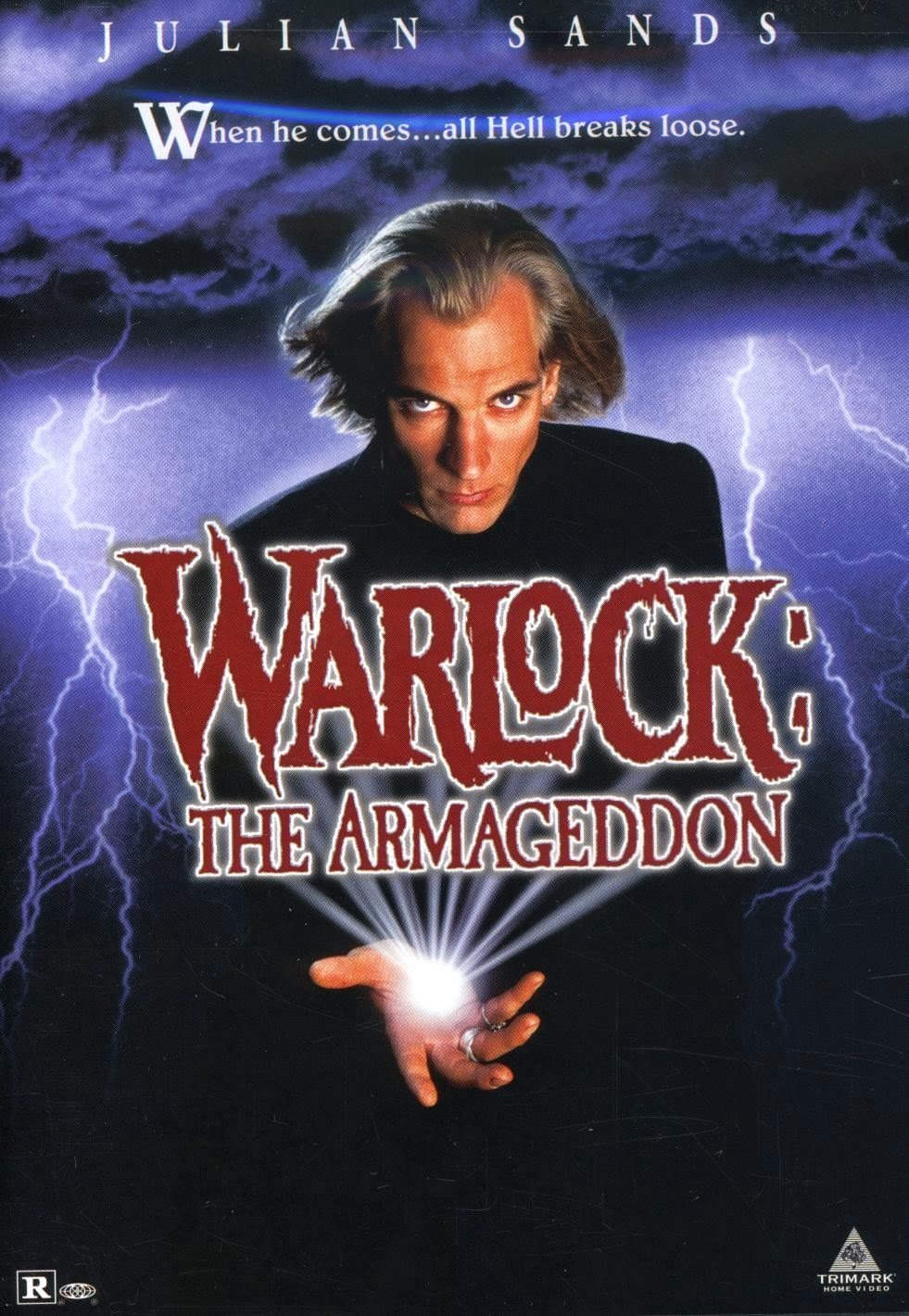
MY CALL: Much more hokey and corny than part 1, this senselessly discontinuous sequel remains a gory, gooey B-movie pleasure. MORE MOVIES LIKE Warlock 2: Well, of course, Warlock (1989). Some other “part 2s” that are decidedly zanier and gooier than their predecessors include Wishmaster 2 (1999), Gremlins 2 (1990), Leprechaun 2 (1994) and Hellbound: Hellraiser II (1988).
Director Anthony Hickox (Waxwork, Hellraiser III: Hell on Earth) opens this sequel with some on-screen text providing the exposition that the writing and direction evidently could not. Allow me to paraphrase: “Druids have protected us from evil forever…blah, blah, blah…and once every thousand years they perform some magic ritual to prevent the birth of the son of Satan.” In the subsequent scene these druids align their rune stones or whatever and—don’t panic…relax! They stopped evil from overtaking the world.
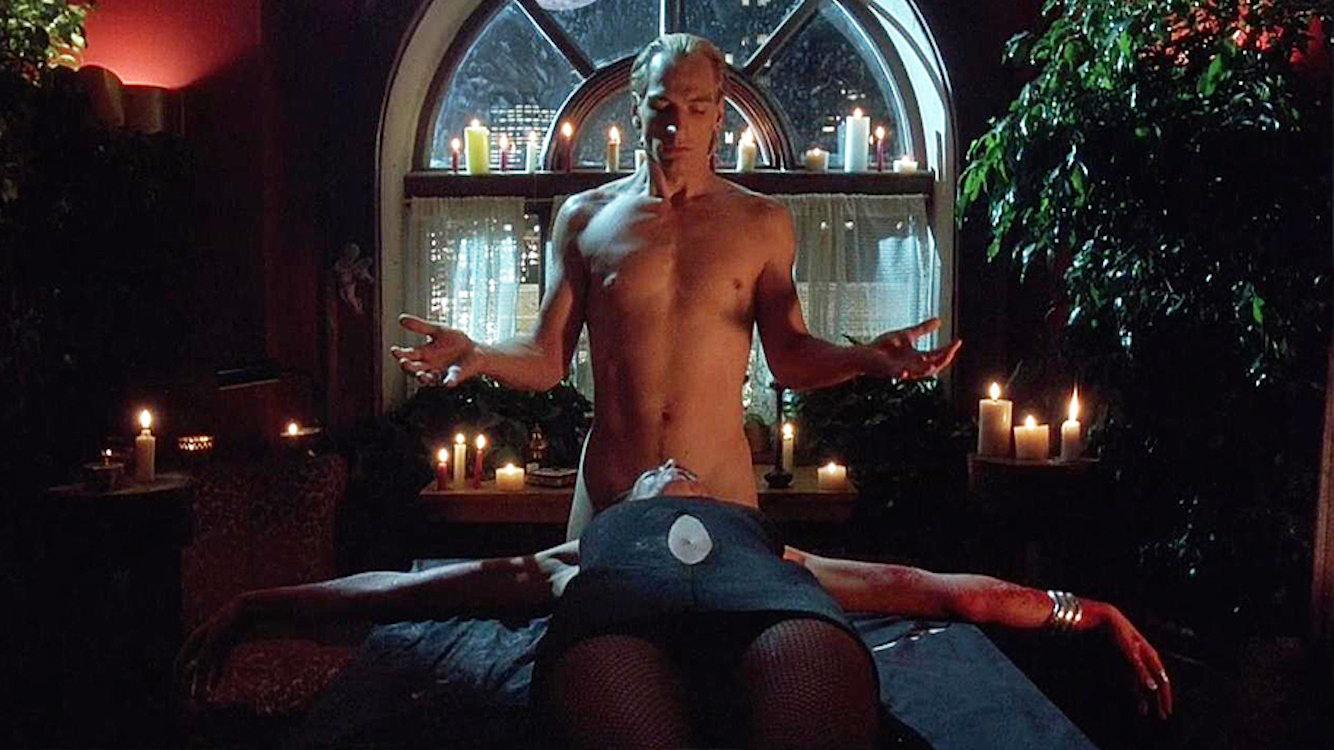
But now, with another thousand years behind us, the threat resurges. The moon eclipses as a young woman puts on a rune stone necklace preparing for a date. Gazing at the dwindling moonlight, she is overtaken by a spectral force (as in the entirely non-consensual The Entity), her abdomen erupts in instantaneous pregnancy, and a brain-like creature is messily birthed. The mass of slime-covered organs pulsates, kills the woman’s Pomeranian, and from it—as if from a cocoon—emerges a naked newborn witch (Julian Sands; Warlock, Gothic) fully grown, exposing his man bits, and covered in goo. The effects remind me a bit of Wishmaster 2 (1999) or when all the gremlins are melting in Gremlins 2 (1990)—it’s awesomely gross and the most memorable part of the movie.


The medieval action scenes were so not good; boring, in fact. But it’s just here to set the stage for present day, when things get appropriately gory. The birth scene was pretty cool if you like sloppy gory messes—which I do! Our male witch also inserts his hand into a woman’s head, cooks a map onto his unwilling mother’s flesh and peels it from her stomach, tears the entire scalp off a hooker, and causes some gory death scenes. Unfortunately, most effects-driven scenes fall flat except for the birth scene. Brief cameos by Zach Galligan (Gremlins 1-2, Waxwork 1-2) and Joanna Pacula (The Kiss, Virus) add some entertaining turns to this ride, perhaps asking some forgiveness for the weak kills.
Much as how our spellcaster sought the pages of the Grand Grimoire spread across the country in Warlock (1989), in this sequel the Devil tasks him with finding the six rune stones in six days. Naturally we’ll need some protagonists, so Samantha (Paula Marshall; Hellraiser III: Hell on Earth, Nip/Tuck) and her boyfriend Kenny are destined to save the world.
Kenny’s father Will (Steve Kahan; Lethal Weapon 1-4, Predator 2, Demolition Man) senses that something is amiss after witnessing an omen, and gathers his local buddies (R. G. Armstrong; Children of the Corn, Predator; and Charles Hallahan; The Thing, The Twilight Zone: The Movie) who are all apparently part of some modern druid society that expected the Warlock’s arrival and has the magical cockroach-powered compass (from part 1) to hunt him.
Quite self-aware, the movie playfully mentions Merlin and Faust. But these cheeky moments, not even in combination with the aforementioned cameos, in no way compensate for all the bad that was jammed into this hokey sequel. At times this movie is trying so hard to be serious, but more often than not it fails. But please be reminded, as a “bad horror movie” I rather enjoyed it.
The rushed pacing diminishes the effect of many death scenes and gore. They may draw grins, but they won’t impress (except for the opening and closing gore scenes). Many of the kills were totally phoned in, and with no real build-up or sense of consequence. After all, this witch intends to bring about the Armageddon. I feel like the movie forgets this apocalyptic ambition after the first few scenes. Warlock (1989) had a story to tell, but this sequel seems to add far more silliness than substance. It has its gory victories, but overall this not a good film (I’d go so far as to call it a B-movie). Quite bad actually, and more so towards the end.

Ultimately the warlock, the Armageddon and the Devil himself were thwarted with a Jeep’s floodlights (yes, I’m totally serious and it’s easily as boring as it sounds), followed by an unspeakably bad magical duel involving a CGI dagger (not exactly the most exciting way to prevent Armageddon). Lame! But at least we close on a gooey gory note as the Warlock rots and melts away.
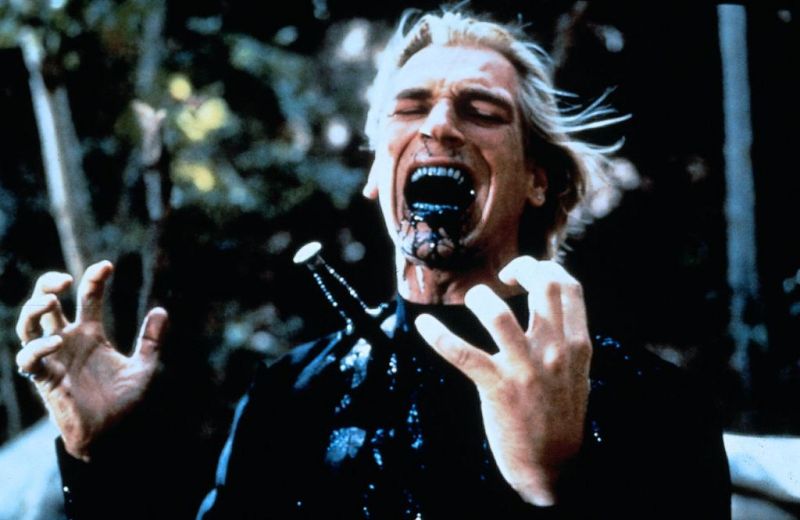

SIDEBAR about Franchise Continuity: Did this movie completely ignore that the events of part 1 even happened!?!?!?! They seem 100% unrelated. The first Warlock (1989) was sent to the future to assemble a book that would provide access to Earth for Satan. So where did this new Warlock come from? Also another time? Was this just a second time travel attempt from 1800s Salem that went unmentioned? And if so, why now crystals and druids instead of the pages of the Grand Grimoire? Or is this more like the Leprechaun franchise theory that each movie featured a completely different Leprechaun (despite being played with the same personality and by the same actor)? Perhaps, and if so, then there are numerous different prophecies which can bring Hell on Earth and for each prophecy a Julian Sands look-alike to expedite it. Seems farfetched.
Share this post:

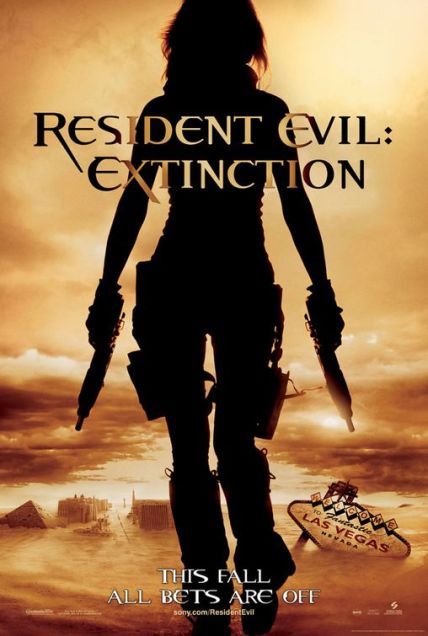
John’s Horror Corner: Resident Evil: Extinction (2007), Milla Jovovich evolves with the T-virus in this entertaining Zombiegeddon franchise.

MY CALL: Better written than part 2 and just as fun as both its predecessors, Extinction offers a fun thrill-ride of mutant zombie action for Millaphiles as the franchise story continues to evolve with the T-virus. MORE MOVIES LIKE Resident Evil: Resident Evil (2002), Resident Evil: Apocalypse (2004), Doom (2005), the Silent Hill movies (2006, 2012) and the Underworld franchise (2003-2017) come to mind. For a fine ratings vs earnings comparison of the Resident Evil and Underworld franchises check this feisty article out.

So, as we enter the third installment in Alice’s (Milla Jovovich; The Fifth Element, Resident Evil 1-2, Ultraviolet) virus-geddon apocalypse saga, she strangely wakes up EXACTLY as she did in part 1, in the same shower, puts on the same dress, encounters the same death-laser hallway and some other high-tech boobie-traps…but wait…then…she dies!?!?!?! And then Dr. Isaacs (Iain Glen; Game of Thrones, Darkness, Resident Evil: Apocalypse), in a routine tone, gives an order to dispose of the body…?
Director Russell Mulcahy (Razorback, Highlander 1-2) swings for the fences, accelerating our zombie apocalypse into the desolate wasteland phase. Alice narrates a brief flashback introduction to catch us up with the story, which picks up a bit after where it left off in 2004—with Alice wandering the apocoscape of the now Walking Dead-ified world in which people will do anything to survive. Moreover, the zombie-action feels more like a zombie movie at the times when it should (i.e., the zombie aspect doesn’t suck like it did in than parts 1-2)—even the zombie “setting” felt more zombie-appropriate. This is the first of the series to get zombies right and the swarming murder of zombie crows was a nice touch that yielded high impact.
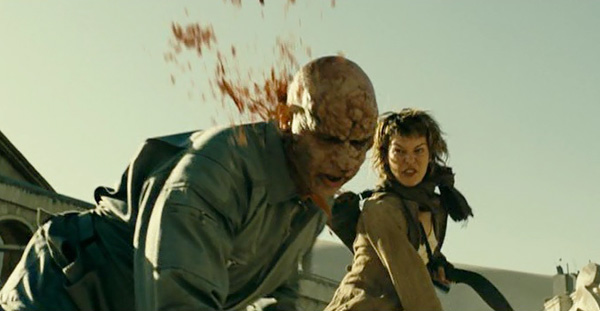
The Resident Evil films—regardless of their lack of critical claim—consistently deliver creative shots. Here, the grand sweeping scale of the futuristic sandy Hellscape speckled with plague-swarms of undead birds crisply contrasting the sky compounds this measure powerfully. Watch this in HD or 4K if you can. As our survivors combat winged pestilence with flame-throwers the beautiful crispness smacks of a less refined Mad Max: Fury Road (2015), even if only for a minute. It is a spectacle, that fire against the sky. Comparable scenes include brilliant lighting in the laser-trap hallway (2002) and the closing scenes during Alice’s escape (2004).

New to the Zompocalypse crew, Claire (Ali Larter; House on Haunted Hill, Final Destination 1-2, Heroes) joins Carlos (Oded Fehr; The Mummy, Resident Evil: Apocalypse) and others from part 2 as a team of nomadic Zombiegeddon survivalists. And in this third installment, the Zombiegeddon world-building is in full force. We get a solid feel for the scavenging, odd skill sets, and limiting resources very quickly.
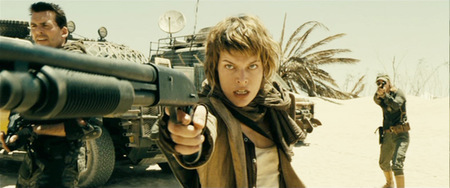
I feel like the stunts in this sequel eclipse those of parts 1-2 (in which they felt totally phoned in). I also remain grateful for the zombie dogs which are consistently done with practical effects in parts 1-3. The zombie dog gore was simple, but worked very well. And the superhuman jumps were less Crouching Tiger (as in slower) and more Blade II (i.e., more dynamic).
Alice has become something different than before. We have watched he evolve from highly trained (2002) to a virus-fueled superhuman (2004), and now develop telekinetic psychic powers worthy of the X-Men. But despite this, from her demeanor to her fight choreography, I find Alice a more credible heroine now than ever. Perhaps helping her credibility is that in this third installment she may be naked, but she affords eager viewers no nudity this time around. Although she does continue to wear thin shirts and no bra. You know, just keepin’ it classy. LOL.
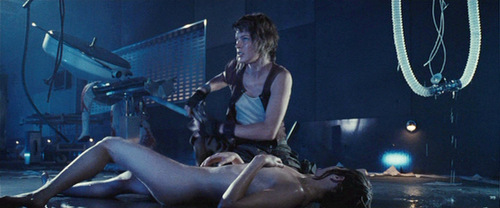
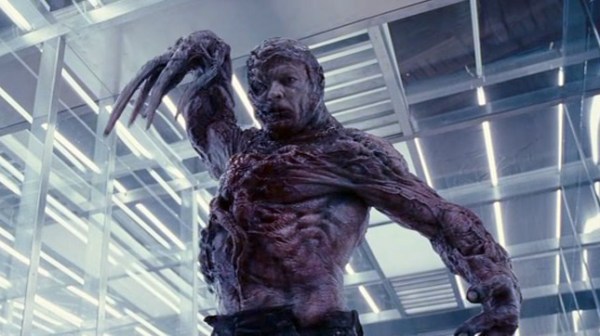
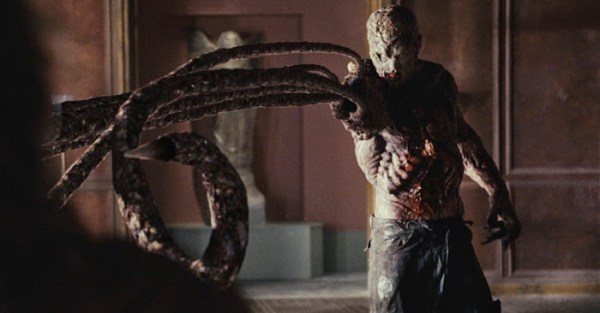
Our final boss bad guy in this installment is easily the most satisfying of these first three movies. The CGI still clearly appears dated, but this creature looks far more interesting and twisted and the final fight doesn’t suck for a change. When our favorite mad scientist becomes infected and mutates, he becomes a fungus-like tentacle monster. It’s fun. In fact, the whole movie is. I’m quite surprised this one gets so much flack. I loved it. I’ve loved rewatching the series so far and I think their entertainment value holds up quite well.

Just as each movie began where the last ended and clearly indicated that a sequel was on the way, so does Alice here announce her intentions to murderously climb up the corporate ladder for the higher-up Umbrella execs who seek her blood which is apparently the key; the next evolution of the T-virus. Stay tuned to see how part 4 (Afterlife) holds up…
Share this post:

The MFF Podcast #90: The Perfect Bookshelf Movie Collection
Hello all. Mark here.

You can download the pod on Itunes or LISTEN TO THE POD ON BLOG TALK RADIO.
If you get a chance please make sure to review, rate and share. You are awesome!
The MFF podcast is back and we are building the perfect bookshelf collection. Las, Leavengood and I each picked four films in an effort to create the most eclectic collection of movies on a bookshelf. We decided to create the “MFF Podcast Bookshelf” after I unleashed a post about my perfect 10 film collection of randomness and pretentiousness. It was a lot of fun to put together and sparked a whole lot of conversations in which people either went with the obvious or went so far into left field they included Deep Blue Sea.
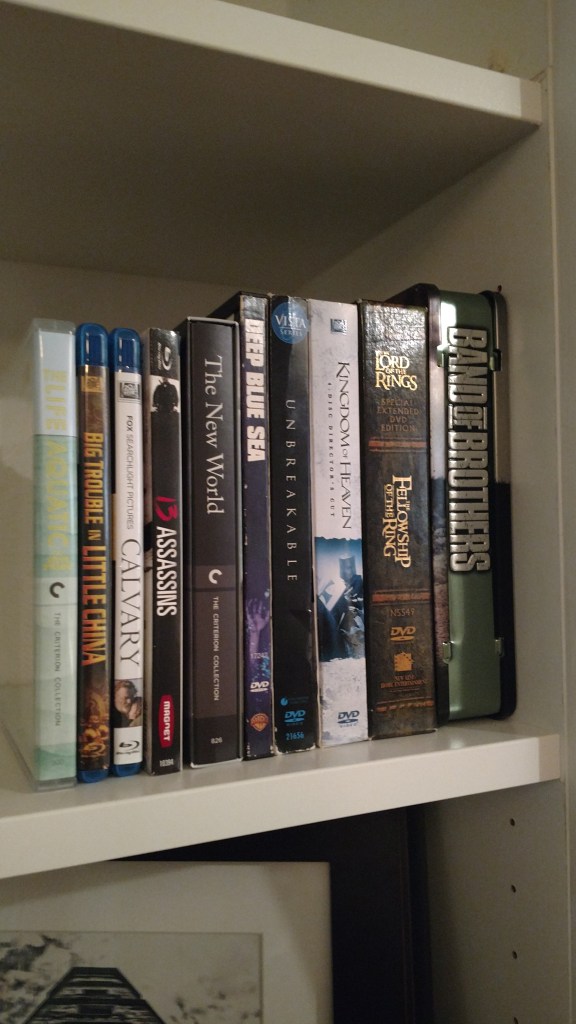
My list is awesome!
As always we answer random listener questions and ponder how Michael Myers became immortal. If you a fan of the podcast make sure to send in some random listener questions so we can do our best to not answer them correctly. We thank you for listening and hope you enjoy the MFF bookshelf!
You can download the pod on Itunes or LISTEN TO THE POD ON BLOG TALK RADIO.
If you get a chance please make sure to review, rate and share. You are awesome!


 Movies, Films & Flix