The MFF Podcast #175: The Legendary Captain Ron

You can download or stream the pod on Spotify, Itunes, Stitcher, Tune In, Podbean, or LISTEN TO THE POD ON BLOG TALK RADIO.
You voted for it, and we delivered! The MFF podcast is back, and we’re celebrating our 175th episode by talking about the 1992 cult classic Captain Ron. We’ve made it a new habit to talk about a Kurt Russell movie on every 25th episode (starting with Big Trouble in Little China on our 150th episode) and we had a great time talking about Ted’s Island, chili dogs and the importance of enunciating when saying “guerrillas.” In this podcast, we answered every listener question we received and dug through all the facts about Ron to figure out who exactly he is (We’re still not sure who he really is). If you are a fan of Captain Ron you will love this podcast.
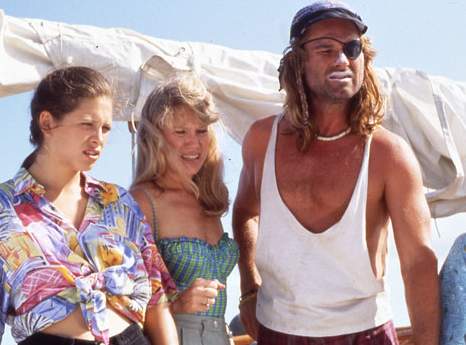
Captain Ron is the best.
If you are a fan of the podcast make sure to send in some random listener questions so we can do our best to not answer them correctly. We thank you for listening and hope you enjoy the pod!
You can download or stream the pod on Spotify, Itunes, Stitcher, Tune In, Podbean, or LISTEN TO THE POD ON BLOG TALK RADIO.
If you get a chance please make sure to review, rate and share. You are awesome!
Share this post:

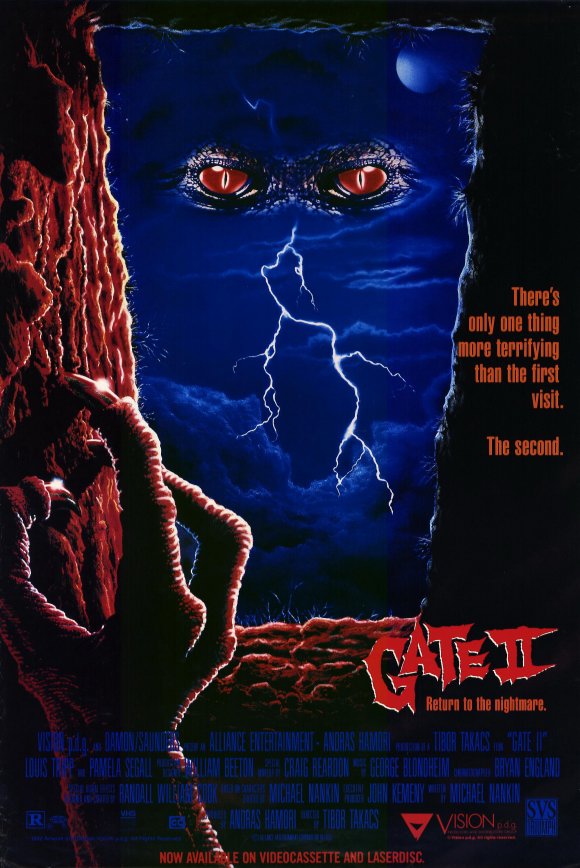
MY CALL: A perfectly enjoyable sequel rich with a diversity of special effects and demons, weighing in with just enough bad words to earn an R-rating. Inferior in premise, writing and impact compared to The Gate (1987), but that’s what often happens with horror sequels. MORE MOVIES LIKE The Gate 2: Trespassers: The Gate (1987), of course! Other films featuring folks who summon power-granting evils they cannot control include Evilspeak (1981) and Wishmaster (1997).
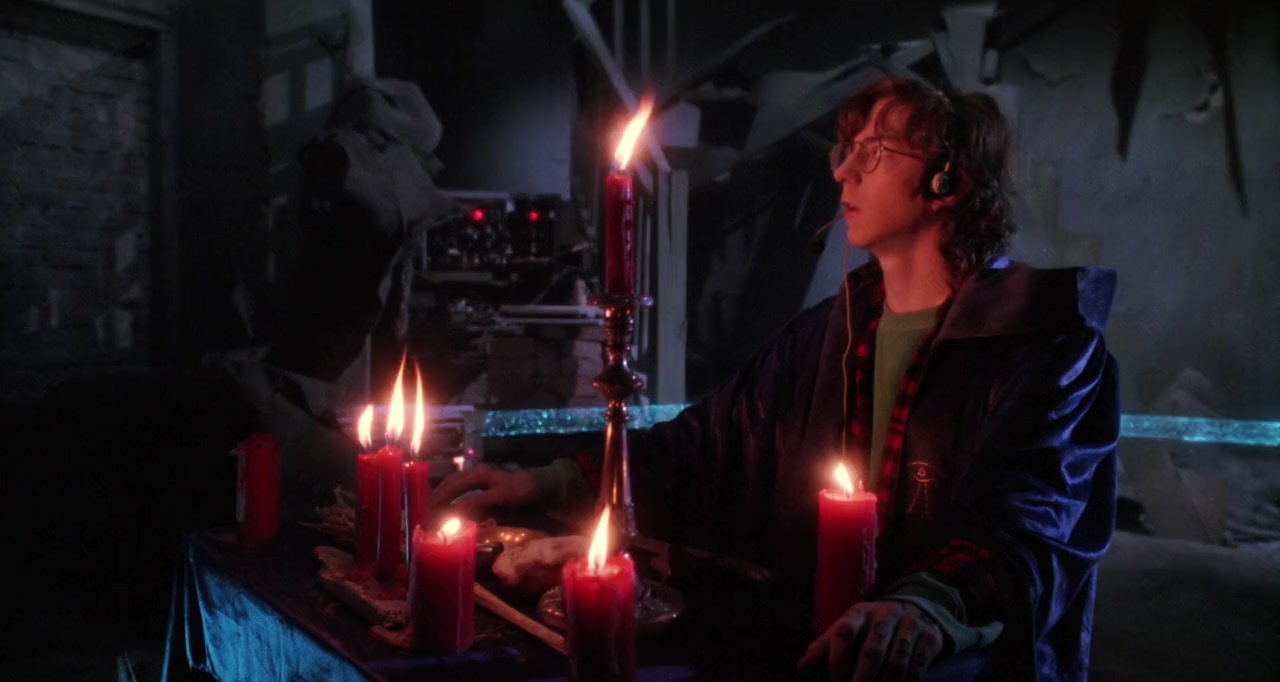
Just a few years after the what should have been the most traumatic event he’d ever experience, Terry (Louis Tripp; The Gate) looks back at his past foray in demon summoning not as something that shouldn’t have ever been done, but instead as something that should have been done right. With occult Sumerian calligraphy scribed across his arms and hands, he returns to Glen’s now abandoned house (the site of part 1) to call upon the Old Gods when he is interrupted by Moe (Simon Reynolds; Saw IV, The Skulls II, Cold Creek Manor, P2), John (James Villemaire; Zombie 5: Killing Birds, Matinee) and Liz (Pamela Adlon; Vampire Hunter D: Bloodlust, Louie), the three of whom Terry tutors in demonology so they may all wish their hearts’ desires.
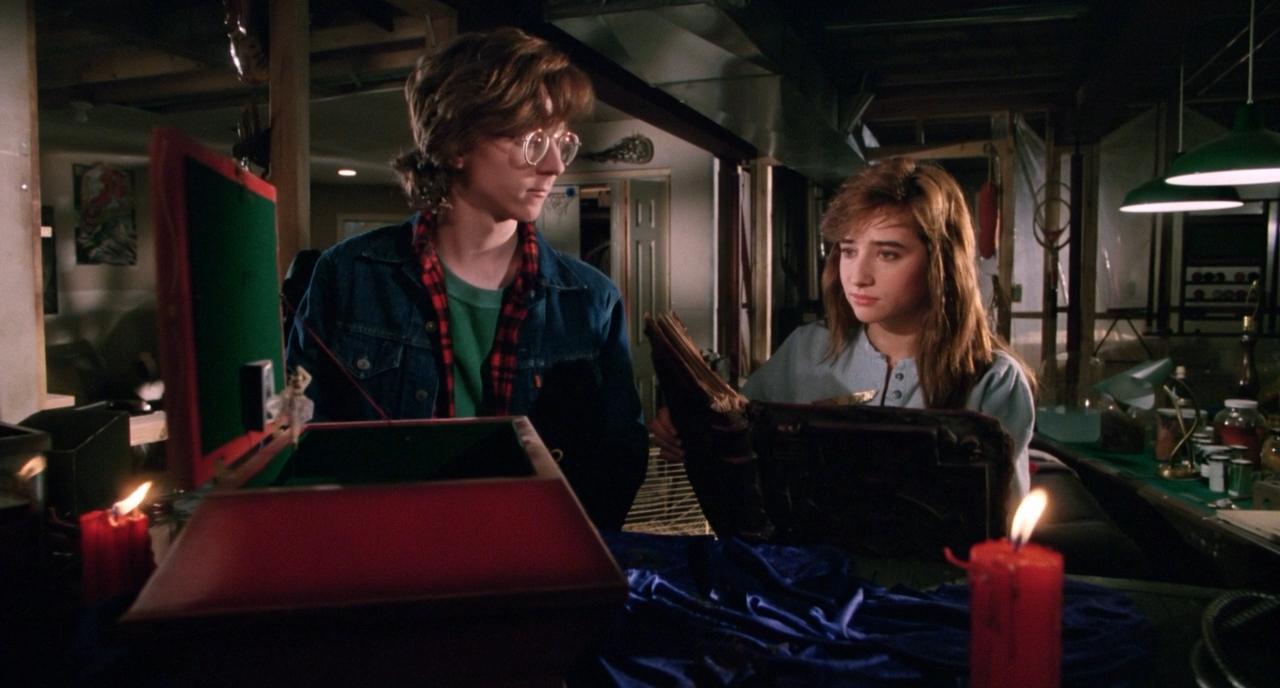

They conjure a diminutive demon from The Other Side and shortly thereafter, their wishes seem to come true—cars, money, Terry’s dad gets a good job after a long stint of alcoholic unemployment. Only, with time, their wishes may not turn out exactly as expected.

It’s kinda’ hokey, but I love the scene where Terry has to wrangle the escaped demon in his bedroom. This little demon has a lot of personality—he enjoys a birdcage swing, hisses at the naming of his demon lords, and prances around for attention. Writer Michael Nankin (The Gate) and director Tibor Takács (I Madman, The Gate, The Outer Limits, Mansquito) both return to bring us this sequel to my childhood favorite The Gate (1987) and, along with the now older and more mature fans of part 1, they bring an R-rated sequel. Despite being rated-R, this sequel feels less serious than its predecessor. It’s more feisty and sophomoric, and I honestly struggle to see why this is R and the other is PG-13 outside of maybe profanity.

As their wishes are bastardized, it’s almost silly (one might even say “crappy”). And one seriously bitten by the minion undergoes some gooey changes; essentially a lot of gooey awfulness goes down in a men’s room stall as John’s skin melts and ummm “excretes” from his body.
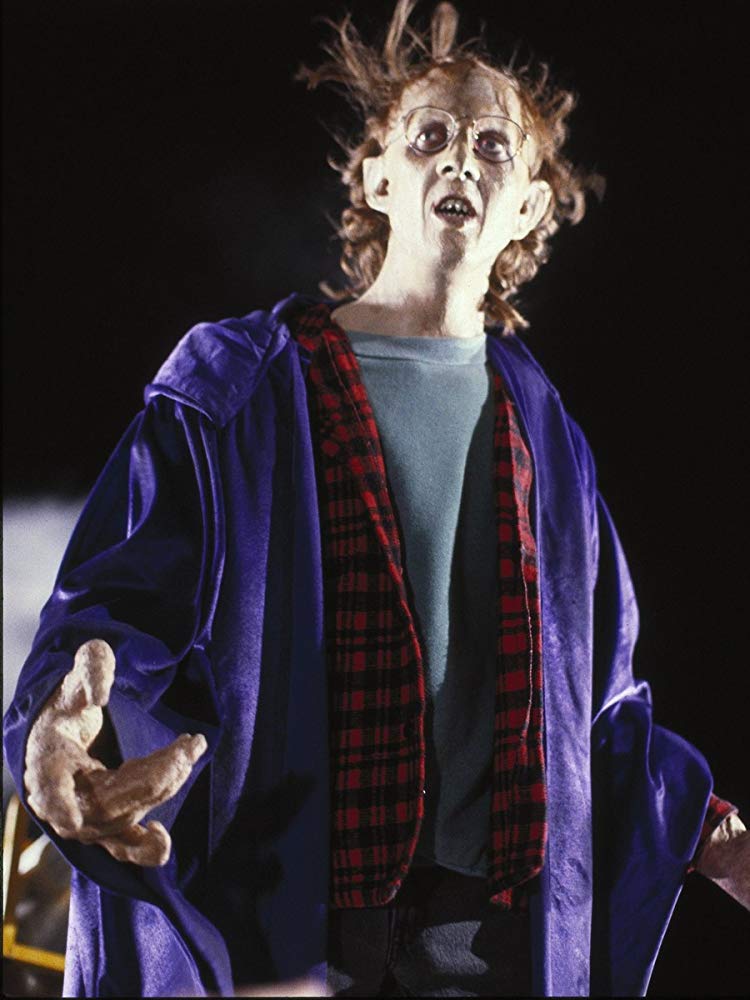
Besides the gooey effects, we enjoy a lot of the tiny minion demon and some stop-motion animation for the fully transformed John-demon. We actually end up with more than one man-sized demon, the effects of which are mixed from “okay” to pretty good with one stop-motion demon, one body suit monster effect, and one latex and prosthetics. It’s a nice mix of effects. The Other Side—likely named after Poltergeist II (1986) and conceptually designed considering Phantasm I-II (1982, 1986)—offers a neat other-worldly altar for the final confrontation.
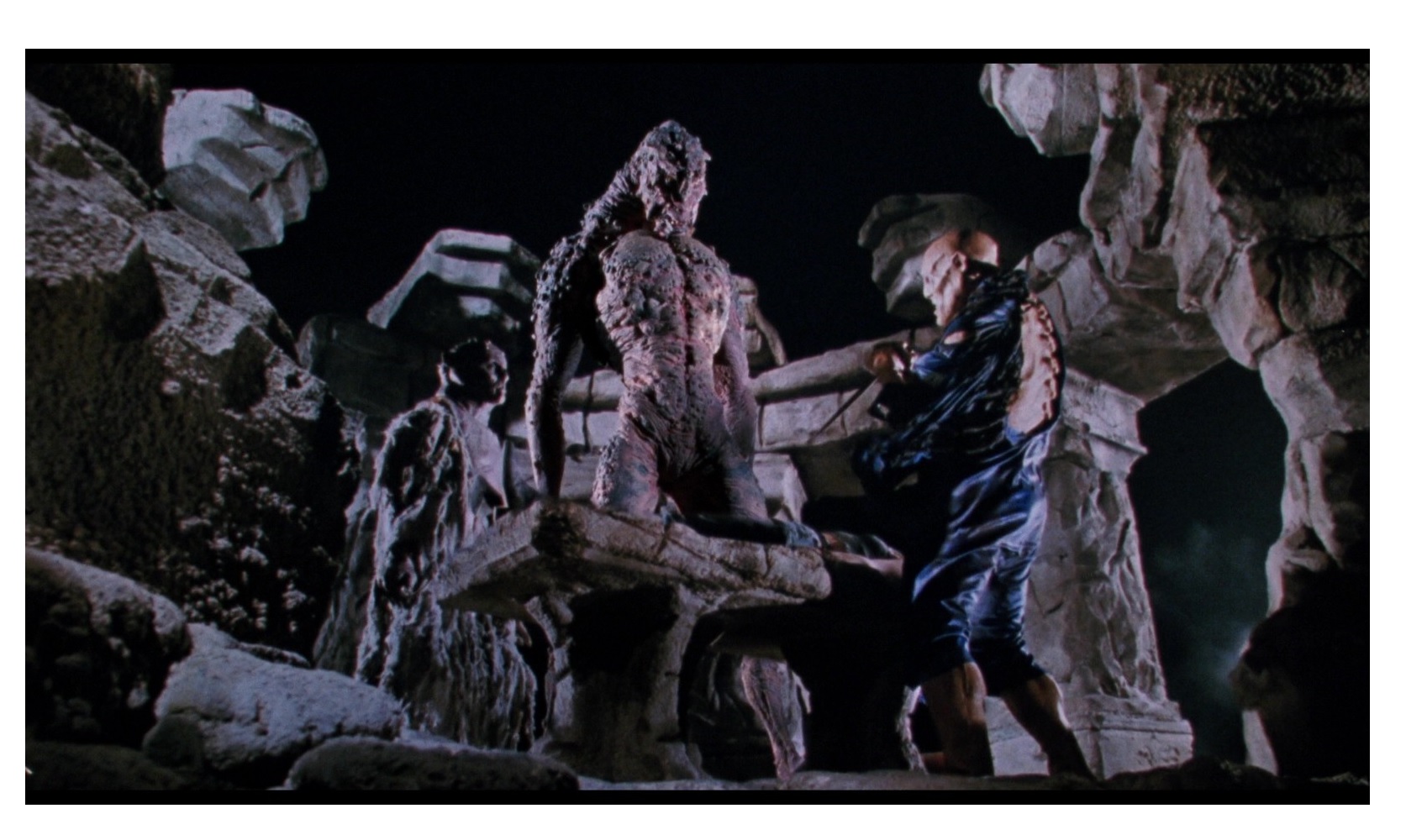
When comparing to part 1, I’d say the characters here are more shallow and it was hard to invest in them. Even Terry—the teenager who once summoned demons in 1987 and died a horrible traumatic death but was somehow spared in the end—decided to summon demons again!!!! While this does honestly makes for a “fun” horror movie, it doesn’t make for a sympathetic protagonist. But, like part 1, the pacing has no slow parts as we jump right into the action and keep it coming. I’d say this is a fun watch, but probably not nearly as rewatchable was part 1.

In the end, I’d highly recommend this to fans of The Gate (1987) for at least a one-time watch, fans of bad 80s-era horror would likely enjoy this for the range in effects and good pacing, but anyone looking for a good horror “film” should look elsewhere.
Share this post:

John’s Horror Corner: Final Destination 2 (2003), bringing more humor, more splattering gore, and more elaborate death scenes.

MY CALL: Much more gore and bloody excitement, as sequels tend to deliver. Every bit as fun as FD1 but somehow it feels like less of a masterpiece a more of an awesome rollercoaster I want to ride over and over again. MORE MOVIES LIKE Final Destination: All the Final Destination sequels except for maybe part 4 (The Final Destination) starting with Final Destination (2000), and the Saw films (2004-2017) if you’re up for much more brutal death scenes.
Franchise SIDEBAR: Final Destination (2000) ended strong with Alex (Devon Sawa; Idle Hands, The Exorcism of Molly Hartley), Clear (Ali Larter; House on Haunted Hill, Resident Evil 3/4/6) and Carter (Kerr Smith; My Bloody Valentine, The Forsaken) having beaten Death’s design and finally enjoying a drink in Paris… that is, until they realize they made one mistake (in Alex’s seat diagram analysis) as death takes Carter and the screen goes black! When FD2 opens, we learn that the survivors of Flight 180 all ultimately died mysterious deaths except for Clear.
Exactly one year after the incident of Flight 180, on their way to Daytona Beach, Kimberly (A.J. Cook; Wer, Wishmaster 3), Dano (Alejandro Rae; The Thaw), Frankie (Shaun Sipos; Texas Chainsaw 3D, The Grudge 2, The Skulls 3) and Shaina (Sarah Carter; Skinwalkers, Wishmaster 3) have pulled onto the interstate. As if director David R. Ellis’ (Asylum, Shark Night 3D, The Final Destination) sole purpose in life was to one-up the opening kill sequence in Final Destination (2000), we enjoy an outstanding pile-up extravaganza complete with lumber harpooning through windshields and bodies, cars doing 75mph-cartwheels toward other cars, trucks plowing through exploding cars packed with horrified drivers’ faces, and a man burning in agony as a truck rends its way through his shrapnel. It’s the kind of scene you’ll find yourself rewinding because it’s loaded with nuance contributing to the tragedy. Bravo, Mr. Director. Over 120 seconds of pandemonium onslaught. You definitely have my attention. [hitting REW button now]


But fear not, it was just a daydream, right? Well, not for Kim, who prevents all the other cars from her pile-up premonition from getting on the interstate. A police officer (Michael Landes; Shot Caller) gathers all the survivors to exchange information—Kim along with Evan (David Paetkau; Disturbing Behavior), Tim (James Kirk; Final Destination), Kat (Keegan Connor Tracy; White Noise), Rory (Jonathan Cherry; House of the Dead, Another Wolfcop), Eugene (Terrence ‘T.C.’ Carson; Stan Against Evil), Isabella (Justina Machado; The Purge: Anarchy) and Nora (Lynda Boyd). They part ways, and now it’s time for Death to correct the “mistake.”

The “crappy apartment lottery winner” death scene is a treat. As Evan prepares a disgusting meal, Death peppers red herrings across the screen from stray squirts of oil near the flames to accidental magnets in microwaves. As if being punished for his taste in frozen fish sticks, a kitchen oil fire starts as his hand is stuck in the sink drain and the microwave threatens to explode at him. Even after escaping his exploding apartment, he is killed by way of his own filthy littering habit. Take that!

In this sequel we have two different informative characters: Clear (Ali Larter) explains to Kim how to detect the presence of Death and to recognize the signs, and the mystically prophetic coroner (Tony Todd; Candyman, Night of the Living Dead, Final Destination 1-3/5, Wishmaster, Hatchet II) chews the scenery as he offers advice on how to defeat Death… with a smile! In just two films, Todd has created perhaps my favorite recurring exposition cameo character in a franchise.

Moving on, the “dentist office death scene” is another joyous confluence of red herrings. A fish tank leaks and shorts out an outlet, window-slamming birds startle the dentist (and us!) as he picks and injects and drills his patient, building to the ultimate splattertastic death.


Shifting from a rollercoaster of feisty red herrings to a more uneasy scenario is the “elevator prosthesis” death scene, which forces us to endure a haphazardly fast cultivation of dread as a terrified victim suffers a brutal death. But not all of the deaths are elaborate. FD1 had the shockingly abrupt bus death scene, and now FD2 has the “air bag death scene”—a scene which make me cackle—and the “barb wire fence” death scene—which was… just… just check out this epic GIF!


At this point we should address that all CGI effects and stunts exceed anything we saw in FD1. Not only are the effects vastly superior, but the gore has been amplified as victims are impaled through the head, torsos practically explode from projectile lumber impact, blood spurting decapitation, full body splatter liquification, compound insta-slicing dismemberment, and chunky salsa gory explosions.

So the effects are much better and the death scenes perhaps more interesting. How about the characters? Following FD1 suit, our slightly older cross-section of survivors starts out with a bit more skepticism than our FD1 teen ensemble. But as they learn to work together and figure out what they’re facing, their interactions grow more interesting, their characters co-develop, and we invest in them. The most demonstrably endearing (yet funny) example was when Rory, assuming he’d die before her, asked Kim to clean the porn and drugs out of his apartment (if he died) so that his mother wouldn’t find anything that would break her heart. It’s… yeah, I know we’re talking about porn and drugs, but it’s kinda’… sweet. Yet another positive, this sequel offers more humor than FD1. A lot more. Sure, that can mean less dread. But the movie ends with a closing scene every bit as goretastically silly as you’d find in Dead Snow 2 (2014) or Tucker and Dale versus Evil (2010).
All told, this sequel made me jump less but giggle more, with a similar amount of OMG shock. FD1 is clearly the better film in my eyes, but FD2 is more rewatchable. Both are highly recommended by this fan!
Share this post:

John’s Horror Corner: Grace (2009), a “baby horror” film about a blood-feeding infant.

MY CALL: Although certainly not for recent parents of infants, this explores the psychosis of raising a monster—all be it at a slow pace. Not much horror action, but still somewhat interesting. MOVIES LIKE Still/Born: For more pregnancy/baby horror, try Rosemary’s Baby (1968), The Unborn (1991), The Unborn (2009), The Night Feeder (1988), It’s Alive (1974, 2009), Inside (2016), Inside (2007), Still/Born (2017) and Good Manners (2017; As Boas Maneiras).
Some couples do everything right in order to have a healthy baby. Follow a schedule for insemination, perhaps fertility drugs, major adjustments to trendy diets, even environmentally conscious car purchases considering the future their children may inherit. Maddy and Michael (Stephen Park; Slither) are that couple. They drive a hybrid, drink soy milk, and seek alternative methods of childbirth.
After a car crash causes the death of her husband and her unborn child in the womb, Madeline (Jordan Ladd; Cabin Fever, Hostel II, Club Dread) carries her (deceased) baby to term. The birth scene is a scream fest complete with blood-clouded water and a macabre fetus. But impossibly, her child—covered in necrotic wounds—comes to life!

Maddy’s baby seems perfectly healthy… for a while. Eventually, her little baby Grace starts to smell, suspiciously attracts flies, and breastfeeding turns into blood-feeding. Maddy experiments with blood-filled baby bottles. When the livestock blood won’t do, she offers her own—and it eventually takes its toll on Maddy. So, desperate, Maddy approaches the next level: human victims to feed her child.

Far from any high-octane, energized horror, the blood is abundant, but “gore” per se is limited to lacerations (but they look good). This is not a “death scene” movie. The true horror in all this is Maddy’s own mania and the crazy mother-in-law (Gabrielle Rose; Jennifer’s Body, Beneath, The Stepfather), despite not being the focus of the film.

The writing, dialogue, acting and line delivery fell short of my theatrical hopes and ranged comfortably average to maaaaybe above average for a direct-to-DVD horror film that takes itself seriously. This film lacks the style or filmmaking acumen of its contemporaries. But it’s fine; entertaining; a bit slow(ish) but not boring. I can’t say I’m overly excited for whatever Paul Solet (Tales of Halloween) does next.

The end packed the best momentary visual shock but, in terms of story, it was a bit hokey-cliché. The nature of the film leads me to advise that parents of infants probably shouldn’t watch this. Otherwise, I’d lightly recommend this broadly to horror fans willing to take a chance.

Share this post:

The MFF Podcast #174: Batman Forever and Sandwiches
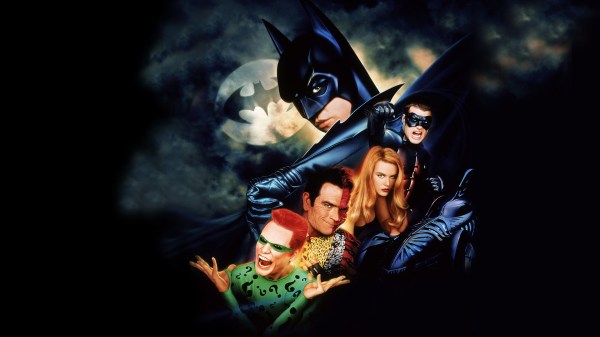
We love this poster.
You can download or stream the pod on Spotify, Itunes, Stitcher, Tune In, Podbean, or LISTEN TO THE POD ON BLOG TALK RADIO.
The MFF podcast is back, and this week we’re talking about Joel Schumacher’s 1995 superhero movie Batman Forever. Batman Forever is a bonkers film that features lots of neon, overacting and insane action scenes involving incredibly long grappling hooks. We love how wild this movie is, and appreciate how Tommy Lee Jones, Jim Carrey, Val Kilmer and Nicole Kidman embraced the insanity and produced all-in performances that have left us with many questions and theories. In this podcast, you will hear us talk about pre-battle sandwiches, black light gangs and the security at Wayne Manor. If you are a fan of Batman Forever you will love this podcast.
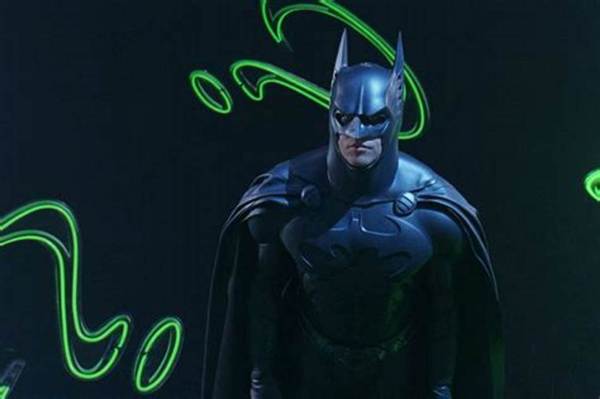
So much neon…
If you are a fan of the podcast make sure to send in some random listener questions so we can do our best to not answer them correctly. We thank you for listening and hope you enjoy the pod!
You can download or stream the pod on Spotify, Itunes, Stitcher, Tune In, Podbean, or LISTEN TO THE POD ON BLOG TALK RADIO.
If you get a chance please make sure to review, rate and share. You are awesome!
Share this post:

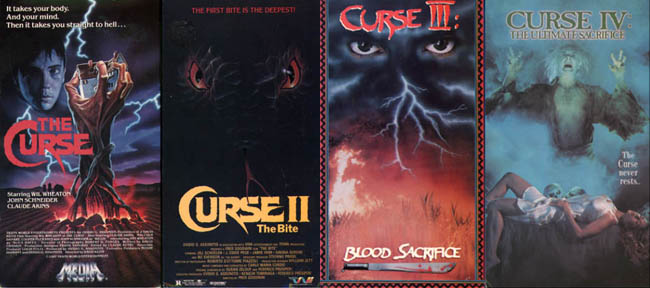
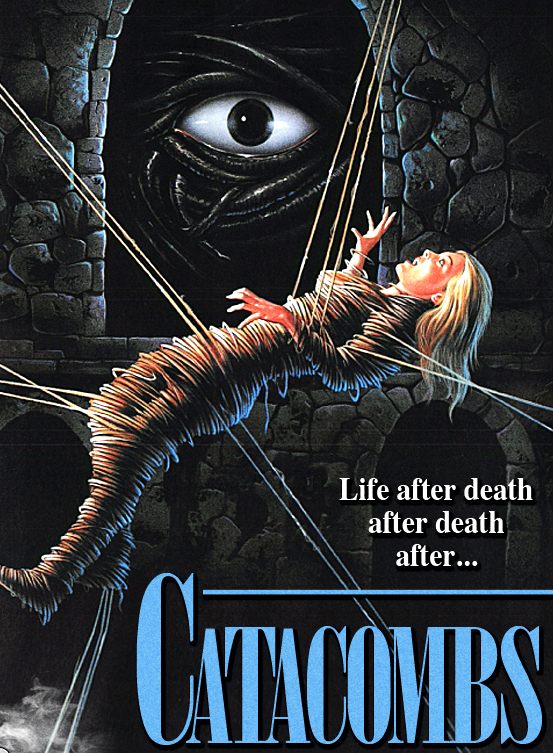
John’s Horror Corner: Curse IV: The Ultimate Sacrifice (1988; aka, Catacombs), a B-movie that clearly has nothing to do with any other “Curse” movies.

MY CALL: This film features some nice shots and set design, but is otherwise rather boring in terms of horror, scares, effects, action, death scenes… pretty much everything that makes a horror movie “fun.” IF YOU LIKE THIS WATCH: Well, The Curse (1987) and Curse II: The Bite (1989), then maaaaybe even Curse III: Blood Sacrifice (1991; aka Panga). I feel as if the later in the franchise you find yourself, the lower the quality of the sequel.

This is the first Curse movie to have a director whose career didn’t both start and end with a Curse film—two directors had only ever directed one film (a Curse film), and the director of part 1 only made two other films of which I’ve never heard before researching this. Director of Curse IV, David Schmoeller (Tourist Trap, Puppet Master, Netherworld) has made successful films both before and after touching the Curse franchise, which makes me hope this may be the best installment in the series—although I’d be wrong. Adding to the oddity of this film (broadly released in 1993, but made in 1988), it is “part IV” but it was produced between the releases of parts I and III.
Franchise Continuity SIDEBAR: Adapted from Lovecraft’s “The Colour out of Space”, the first “curse” (The Curse) involved melty-fleshed zombies created from an other-worldly ooze that infected the water supply from meteorite contamination (in Tennessee). Clearly having nothing to do with the first film, Curse II: The Bite (1989) followed a man infected by a radioactive snake bite and mutated into a snake-handed, snake-regurgitating monster in Arizona. Then Curse III: Blood Sacrifice (1991; aka Panga) predated the other two stories, taking place across the world in East Africa in the 1950s when an angry witch doctor summoned a Sea Demon (from the Black Lagoon) to kill a bunch of white people posing affront to his culture. There seems to be no connection between these curses at all! Our fourth cursed film brings us to a 16th century Italian abbey where a demon has long been entrapped.
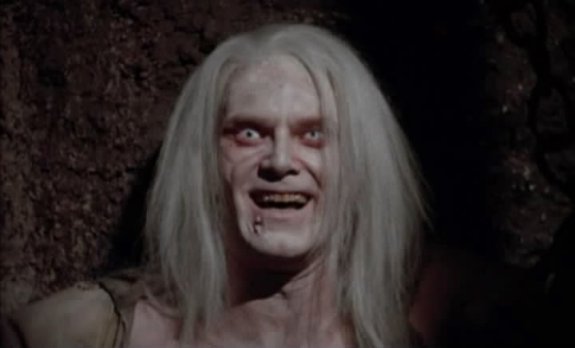
Produced by Charles Band (Puppet Master 1-13, Tourist Trap, Subspecies I-IV, Creepazoids), it should come as no surprise that this lower budget horror swings for the fences in terms of both effects and sets. Opening in a monastery in 1506, a brotherhood of monks banish a demon in the cellars. This fiend spits acidic bile and demonstrates other magical threats as it is locked away. Meanwhile, the filming sites are impressive—particularly shots of the Italian countryside and the abbey. I also enjoyed the catacombs sets; very elaborate.
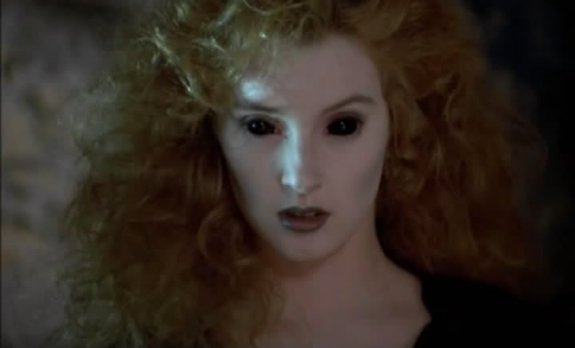
Almost 500 years later a young American woman (Laura Schaefer; Ghost Town, Freddy’s Nightmares) visits the Abbey for her studies. As soon as she arrives the entrapped demon begins to influence its surroundings and a monk is dragged into a grave a buried alive.
At this point, it’s not uncommon to endure a slow 45-60 minutes of exposition and this film is no exception. However, we do enjoy cool shots of catacombs and the abbey throughout leading to the monks discovering that the entrapped evil long considered fiction, is real!
This is when things would normally get fun in 80s horror. The ancient evil animates Christ on the cross, which kills a monk with the nail pulled from his feet! But alas, that might be the only scene worth our time. Next it possesses a woman and uses really dumb telekinesis to beat up monks before it reveals its ugly self and just does more of the same. Hardly any blood, basically no gore, and barely anything coming close to a worthy jumpscare (or real scare). Disappointingly, the finale wasn’t worth the wait. A totally boring final fight with a lame ancient evil. Sigh.
This was all sorts of not good and, for horror and effects, I’d rank it the worst of the Curse series. At least Curse II (1989) tried to show off its lousy effects as much as it could, and The Curse (1987) was a B-movie delight! I’d go watch them instead.
Share this post:

John’s Horror Corner: Final Destination (2000), reflecting on a brilliant movie designed entirely around elaborate death scenes.

MY CALL: This film turned death scenes into a celebration of fun jumpy anxiety and it did so with a good story and great intertwined characters. The fact that this death scene-driven horror film relies little on special effects and gore, and more on timing and teasing our nerves, makes it timeless! MORE MOVIES LIKE Final Destination: All the Final Destination sequels except for part 4 (The Final Destination), and the Saw films (2004-2017) if you’re up for much more brutal death scenes.
A high school French class is about to depart for Paris on Flight 180, but they’re in for more of an experience than baguettes and cathedrals…

Director James Wong (Final Destination 3) has a knack for cultivating teen drama, immature angst, and amusing ironic tension. From the moment high schooler Alex (Devon Sawa; Idle Hands, The Exorcism of Molly Hartley) boards the plane he notices scratch-like damage at the plane’s door, scuff marks on the wing, and even his food tray has a malfunction. After a terrifying dream of the plane losing cabin pressure and exploding, Alex freaks out and screams that the plane is going to explode, getting himself, several grumpy classmates and one of their teacher chaperones (Kristen Cloke; Black Christmas) forcibly removed from the flight. Naturally, when the plane actually does explode, Alex has to answer a few questions along with his surviving classmates: Billy (Seann William Scott; Road Trip, American Pie), Tod (Chad Donella; Disturbing Behavior, Saw 3D), Carter (Kerr Smith; My Bloody Valentine, The Forsaken), Terry (Amanda Detmer; Drop Dead Gorgeous, Boys and Girls) and Clear (Ali Larter; House on Haunted Hill, Final Destination 2, Resident Evil 3/4/6).

So what is it about the Final Destination films that make them work? Sure, building a movie around clever death scenes sounds like a good gimmick, but what multi-victim horror movies aren’t also doing that without relying on it as a premise? The Saw franchise did something similar, but it felt totally different. I’d say the Saw films worked because of excellent writing in terms of story and development, whereas the Final Destination films thrive on how well written the characters are. Their fates are all interconnected so they have more “real” interactions with each other fleshing them out. We see this as the students are boarding the plane, after they are ousted from the plane, at the memorial service for the students that were lost… Sean William Scott’s character asking questions about asking a girl out as if Alex was some sort of prophet illustrated a lot about the character. All of the characters are rich, and they become richer as their fear mounts and they learn more about what’s happening to them. Even the FBI agents have their cheeky moment.

The bathroom death scene (Chad Donella) was so elaborate, with excellent camerawork zooming in on a leaky toilet valve, the water menacingly and unnaturally creeping closer to the victim as we anticipate a horrible slip while he’s shaving or trimming nose hairs, and then WHAM! A shocking, well-executed death that we didn’t see coming! This first death scene set the standard for the film and taught the audience that we’d endure one red herring after another, and to expect the unexpected in the spirit of fun.
Reinforcing these expectations, the city coroner (Tony Todd; Candyman, Night of the Living Dead, Final Destination 1-3/5, Wishmaster, Hatchet II) explains the rules, that Death is indeed coming for them and he will have his due. Tony Todd chews the scenery, but in a most inviting manner for horror fans. Now it’s up to Alex and Clear to try to “beat” Death and save the remaining survivors of Flight 180.

This film is good at shocking us in ways that make us jump, and then giggle (assuming you laugh, even if awkwardly, at death scenes). The bus death scene is abrupt, well-timed, and I yelled with a smile at the screen. So now between surprise death scenes and hyper-elaborate schools of red herrings swimming by, we’re paying attention to every prop and moving object on screen searching for the next cause of death. The kitchen death scene presents just such a rollercoaster of anticipation. Now, we know a death is about to happen, and who is going to die. But this spoils nothing. That is the fun of this movie! We see a knife block, a tricky gas burner, leaks near electronics, sharp objects here and there, and that’s just the start to another chain of events in the next big death scene.
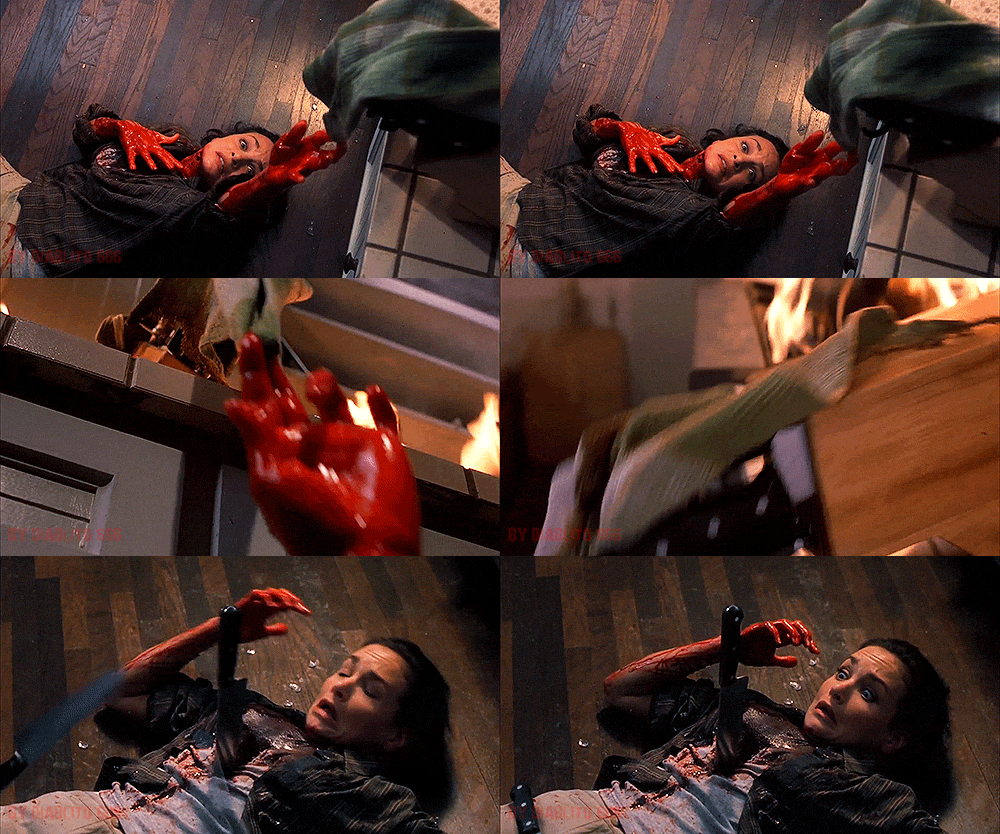
What other movies ever did this before 2000? Often the Saw films are attributed to the influence of Cube (1997) and Se7en (1995), but I feel that Final Destination deserves a bit of credit as well for bringing a more elaborate art to the death scene. The primary difference is that Final Destination focuses on the actual “chase” of the death scene after its victims whereas Saw focuses on the suffering (and often brutal physical and psychological torturing) of the victim already trapped.


The CGI effects may be a bit wonky by current standards, but the imagery is effective nonetheless. On the plane victims are engulfed in fire and jettisoned out of an opening from the explosion, seats and all. However, the bloodwork is solid and there is an outstanding decapitation! But truth be told, this death scene-driven horror film relies little on special effects and gore, and more on timing and teasing our nerves. And for that, this film is timeless.
Share this post:

John’s Horror Corner: Still/Born (2017), a postpartum horror about a baby-stealing demon.

MY CALL: Although certainly not for parents of infants, this was a finely crafted film addressing psychosis, parenthood paranoia, and postpartum demons featuring some jolting scares. MOVIES LIKE Still/Born: For more pregnancy horror, try Rosemary’s Baby (1968), The Unborn (1991), The Unborn (2009), Grace (2009), Inside (2016), Inside (2007) and Good Manners (2017; As Boas Maneiras).
Mary (Christie Burke; Ascension, Falling Skies) gives birth to twins: one perfectly healthy, the other stillborn. Despite this tragedy, things at home are good. She has a healthy marriage in which both are lovingly understanding of each other’s shortcomings in the kitchen, a gorgeous house in the suburbs with nice neighbors, and just a little difficulty training baby Adam to breastfeed. But this difficulty is affecting her emotional well-being, she resists removing the extra crib from the nursery, and Mary starts hearing strange things in the baby monitor.
Mary’s husband (Jesse Moss; Tucker and Dale vs Evil, Extraterrestrial, Wolfcop) is supportive but thinks they need some help, her mother (enlisted to help) is a tad judgy, and her neighbor Rachel (Rebecca Olson; Killing Gunther) fuels her insecurities. Mary isn’t just hearing things on the baby monitor, but she suspects her husband’s infidelity and now she’s also seeing things… horrible things. Not surprisingly her family therapist (Michael Ironside; Watchers, Scanner, Prom Night II) diagnoses postpartum depression and prescribes medication. But her visions persist.

After installing cameras throughout the house, Mary dissects footage (more akin to Sinister than Paranormal Activity) and is convinced she sees a figure near over her child. Her own investigations reveal stories of demons (Lamashtu) stealing babies. And so augments her paranoia…
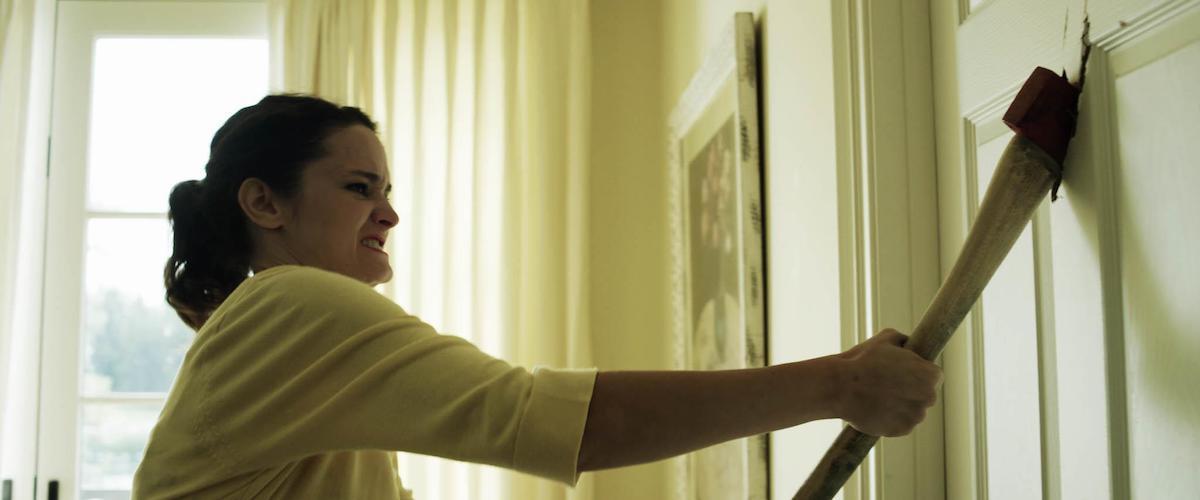
This goes against what I consider to be the more conventional contemporary “baby horror” in which the baby itself is a monster (e.g., It’s Alive, The Night Feeder, Devil’s Due), or the more prenatal “pregnancy horror” approach (e.g., Inside, Rosemary’s Baby)—although it clearly feels more like the latter than the former. And we find some tropes typical of hauntings (e.g., Poltergeist, The Changeling), such as doors slamming themselves, ghostly visages, other-worldly voices and shattering windows.
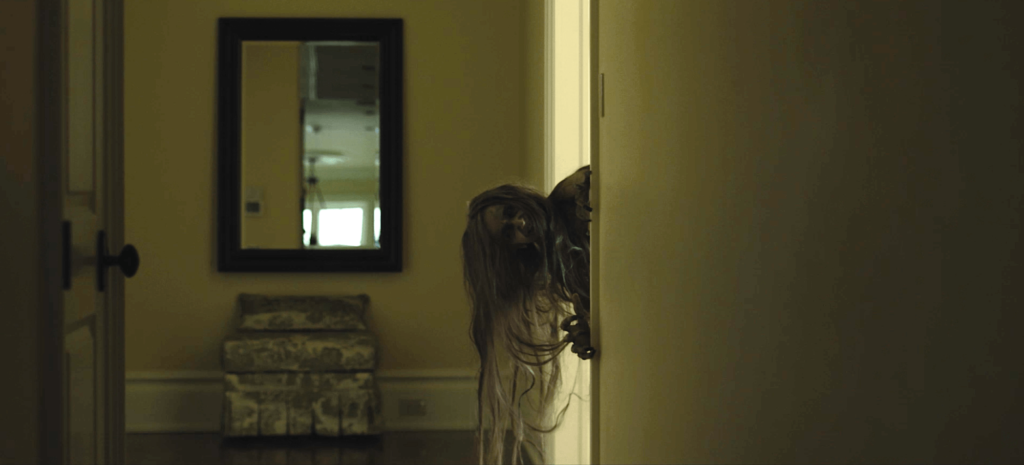
For his first feature film, director Brandon Christensen makes another fine contribution to Shudder exclusives (along with Terrified and Satan’s Slaves). The movie boasts gorgeous suburbiscape shots, sharp editing, and some tactfully startling scares. But, in my opinion, its atmospheric success is in cultivating the dreadful “need” to just actively stare at some scenes just waiting to see something move in a dark hallway or baby cam video footage. This film is highly engaging on a sensory level, which is what created fans of White Noise (2005) and Paranormal Activity (2007).
The final sequence was a bit over-the-top for me, but overall this was a solid film and Mary’s psychological descent was well-played. The nature of some situations leads me to advise that parents of infants probably shouldn’t watch this. Otherwise, I’d advise this broadly to horror fans.

Share this post:

Captain Ron (1992), a warm and quirky family adventure starring Kurt Russell’s next iteration of Jack Burton.
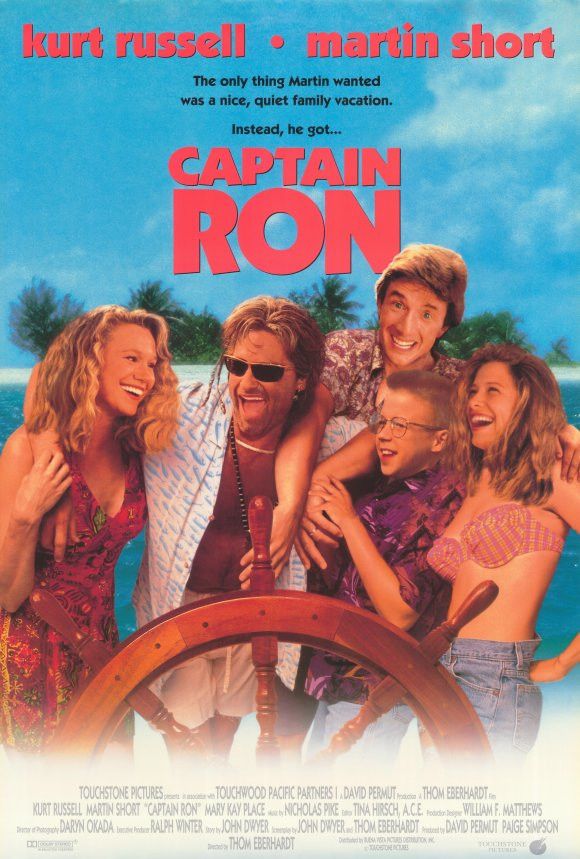
MY CALL: An outstanding comedy for Kurt Russell fans, filled with gorgeous shots, positive warm family dynamics, an energized Caribbean soundtrack and lots of contributing to the delinquency of minors. Imagine Martin Short as Clark Griswold and Kurt Russell as much smoother cousin Eddie… and they’re yachting… what could go wrong? MOVIES LIKE Captain Ron: For more Caribbean movies, go for Cocktail (1988), Club Dread (2004) and The Pirates of the Caribbean movies (2003-2017).
As Martin, Martin Short (The Prince of Egypt, Father of the Bride, Pure Luck, Innerspace) plays the typical high-strung, playing-it-safe, upper-middle class father and meeting his Chicago family feels strikingly similar to meeting the McCallisters in Home Alone (1990) as quirky husband-wife, sibling-sibling and parent-child dynamics amusingly wash the screen. When Martin inherits a beat-up yacht in the Caribbean, a company hires a captain to ferry his family to Miami so he can sell it.

Within ten minutes of meeting Captain Ron Rico (Kurt Russell; The Thing, Big Trouble in Little China) we see him haphazardly lose a car (that isn’t even is) to the ocean, learn that he sunk a boat (that also wasn’t his) on the Great Barrier Reef, find out Ron was in rehab (for something), and someone tries to kill him for adultery! And like a shifty grifter, Ron is slick. He caters to Martin’s inner man and encourages good work ethics in his son despite never doing so himself. But for all his perceived shortcomings and apparent idiocy, he’s probably the best highspeed boat-docker ever and he’s shockingly humble. “If you get lost along the way just pull in somewhere and ask directions.”
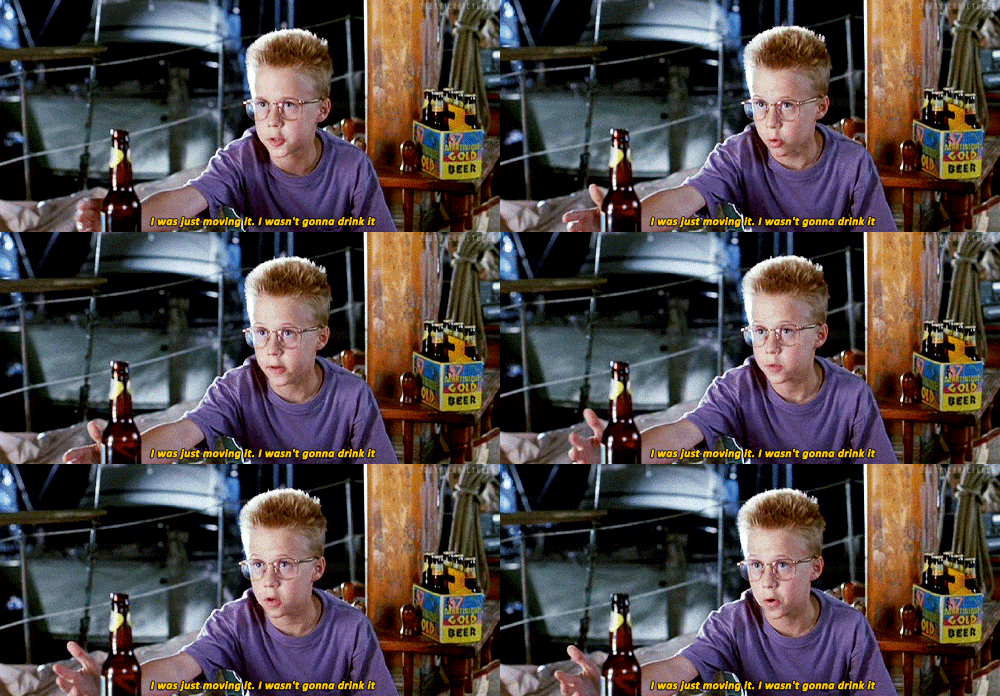
Kurt Russell breathes charm into a character that, by all means, should be despicable. Ron probably owes money to everyone he knows, he has a history of property damage and philandering and adultery, Martin catches him staring at his wife’s (Mary Kay Place; Big Love) cleavage and hitting on her with every opportunity, he accepts bribes from teenagers (Meadow Sisto; Can’t Hardly Wait) and even tries to hustle money from preteens, he encourages a ten-year-old (Benjamin Salisbury; The Nanny) to drink beer and clean guns, and (when Martin strangles Ron) he reveals that this isn’t the first time a boss of his tried to kill him! Ron clearly has a deep history and we never learn any details beyond the occasional glimmer from a random comment.

Big Trouble in Little China SIDEBAR: A frequent discussion point on the Movies, Films and Flix Podcast is the theory that Captain Ron is, in fact, the alias of Jack Burton. Once a passing joke, having watched these films again recently, evidence has mounted. Both characters are promiscuous story-telling grifters who move around a lot, enjoy gambling and, with almost supernatural luck, manage to fail their up—but additionally they both have preternatural lightning reflexes (Jack catches the bottle assault and the thrown knife; Ron catches a fly bare-handed, lets it go and catches it again), both have encountered magic (Jack fought an ancient sorcerer; Ron claims to have encountered Voodoo and Hudu), they rock tank tops and inappropriate attire (Jack in a woman’s bathrobe; Ron in his Speedo) and can’t seem to stay in the same place. Folks, they’re the same guy! Don’t believe me? Then check out podcast episode 50: Kurtchella.
Director Thom Eberhardt (Night of the Comet, Gross Anatomy) delivers a warm PG-13 family adventure complemented by gorgeous ocean shots, a warm dynamic and a lovely Caribbean soundtrack. As Martin’s family sands and polishes the yacht, Ron leads them on a series of misadventures. They completely miss Ted’s island and encounter guerillas (not gorillas), they get arrested in Puerto Rico and they get marooned in Communist Cuba after the “pirates of the Caribbean” steal their boat. It’s so endearing as we watch Ron’s off-the-cuff yacht terminology quizzes and lessons turn into the family working together to raise sails and learning to love their boat. They’re no aces at it; instead they credibly but capably fumble through the process with Ron’s direction and, you know what, they (and we) feel great when they do it.
This goofy feel-good family adventure film will paste a permanent smile on your face as you watch the oft-serious Kurt Russell kick up his feet and sip his beer during yet another adventure in his odd life. It’s a wonderful way to spend a weekend afternoon.

Share this post:

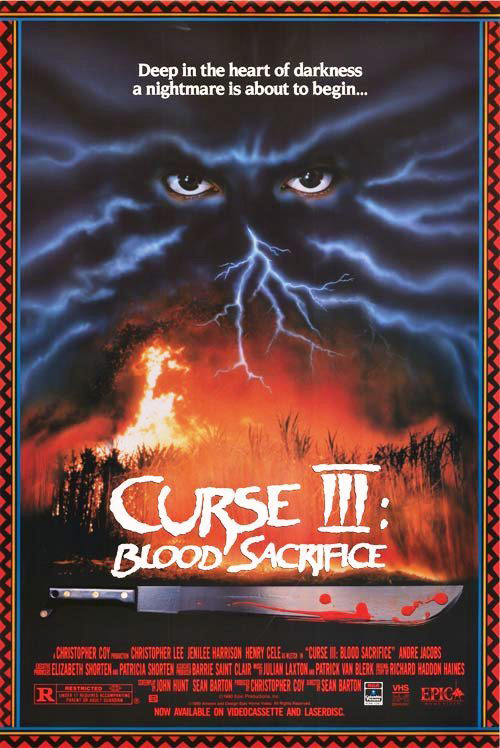
John’s Horror Corner: Curse III: Blood Sacrifice (1991; aka Panga), a B-movie featuring Christopher Lee, an angry Witch Doctor and a lame Sea Demon.
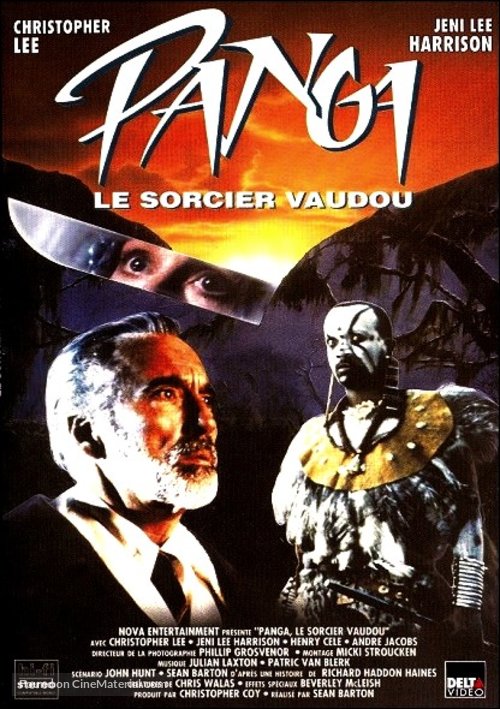
MY CALL: In order of release, the Curse movies go from best to worst it seems. Part III has its merits, but they are limited to Christopher Lee and the African setting—sadly none of the effects, horror or death scenes are worth your time. IF YOU LIKE THIS WATCH: Well, The Curse (1987) and Curse II: The Bite (1989), then maaaaybe even Curse IV: The Ultimate Sacrifice (1988; aka, Catacombs). For more horror with ties to Africa, go for The Kiss (1988), The Exorcist (1973; and prequels) and Headhunter (1988).
Franchise Continuity SIDEBAR: An adaptation of H. P. Lovecraft’s “The Colour out of Space”, the first “curse” (The Curse) involved melty-fleshed zombies created from an other-worldly ooze that infected the water supply from meteorite contamination (in Tennessee). Clearly having nothing to do with the first film, Curse II: The Bite (1989) followed a man infected by a radioactive snake bite and mutates into a snake-handed, snake-regurgitating monster in Arizona. This third film predates the other two stories, taking place across the world in Africa in the 1950s.
In an opening that sluggishly drags us through a typical morning with Elizabeth (Jenilee Harrison; Fists of Iron, Illicit Behavior) and Geoff Armstrong (Andre Jacobs; Black Sails, Demon Keeper), we learn that they are sugarcane farmers in East Africa.

The set up for this movie is ridiculous. After Elizabeth mistakenly interrupts a ceremonial sacrifice, the village witch doctor furiously curses them, and he cackles dramatically. Apparently, he summoned a sea demon to exact his revenge. Serving as our expert on all things African occult, Dr. Pearson (Christopher Lee; Sleepy Hollow, The Wicker Man, Howling II) provides much of our exposition.
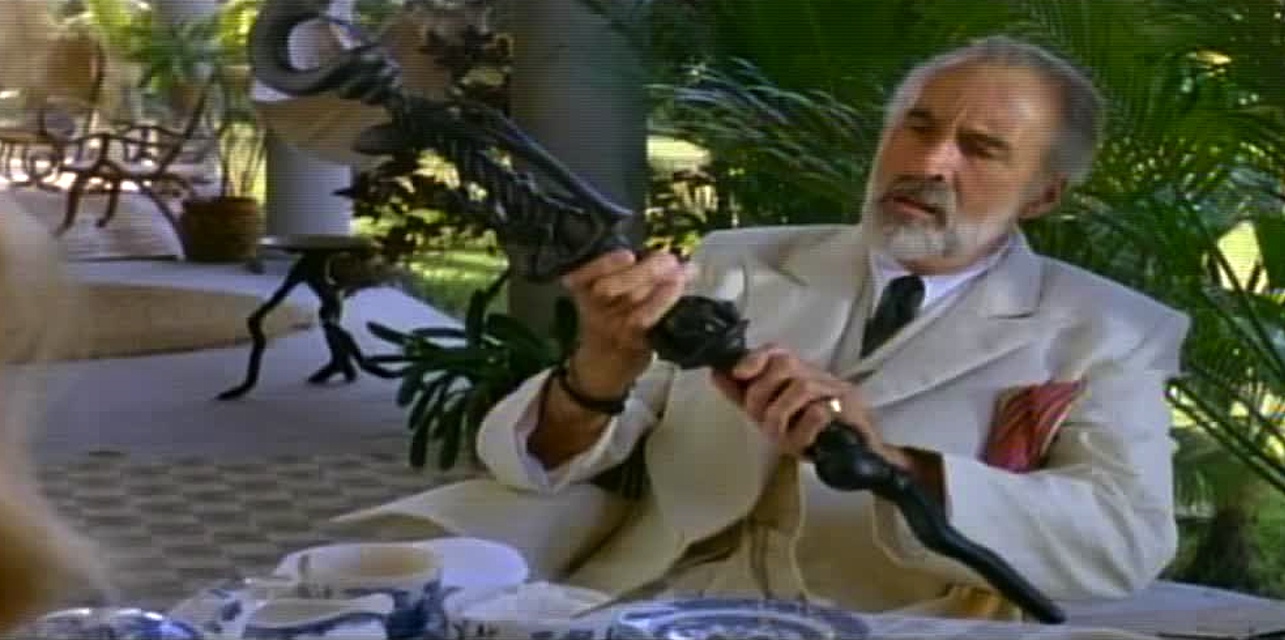
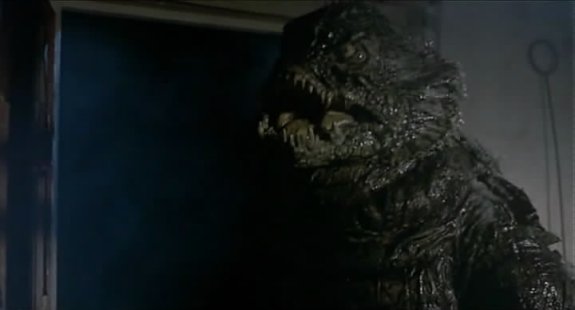
There are some nice shots of landscapes. For an 80s horror film the cinematography is quite impressive. Quite to the contrary, the death scenes were awful, with all kills occurring off-screen—all of them! Isn’t that some kind of horror filmmaking blasphemy? We also don’t see the creature until the last 10 minutes. It looks like a bulky Creature from the Black Lagoon (1954) with more of a tail; basically, a gill man. We see it just long enough for it to roar a half dozen times. It’s basically a rigid rubber monster suit with poor articulation in the mouth/jaw.
The only link I can discern between the first two Curse movies is the inclusion of some God-fearing folks who liken the malady as a test from God (or punishment or something like that). But this third film involves a direct curse from a witch doctor. So, as a franchise anyway, these movies share no synthesis. Were it not for the African setting and Christopher Lee, this would readily be even more boring than Curse II (1989).
This was all sorts of not good and, for both horror and effects. I’d rank it the worst of the Curse series so far. At least Curse II (1989) tried to show off its lousy effects as much as it could (and makes for a fun nonsense B-movie night), and The Curse (1987) was a B-movie delight! I’d go watch them instead.


 Movies, Films & Flix