John’s Horror Corner: Hellraiser: Bloodline (1996), an anthology that is so much more than simply Pinhead in space.
NSFW NSFW NSFW NSFW NSFW
This article is rich with images you do not want your boss to see when he’s looking over your shoulder at work. View at your own risk.
NSFW NSFW NSFW NSFW NSFW

MY CALL: A nice change of pace as the franchise reviews the past and future of the Puzzle Box in this anthology of sorts. This franchise remains worthy through the fourth film, even if pale in comparison to the first two films. MOVIES LIKE Hellraiser: Be sure to see Hellraiser (1987) and Hellbound: Hellraiser II (1988) first, of course. Then maybe Hellraiser 3: Hell on Earth (1992). Also try Lord of Illusions (1995) and Nightbreed (1990) for more creepy practical effects reminiscent of the first two Hellraiser films.
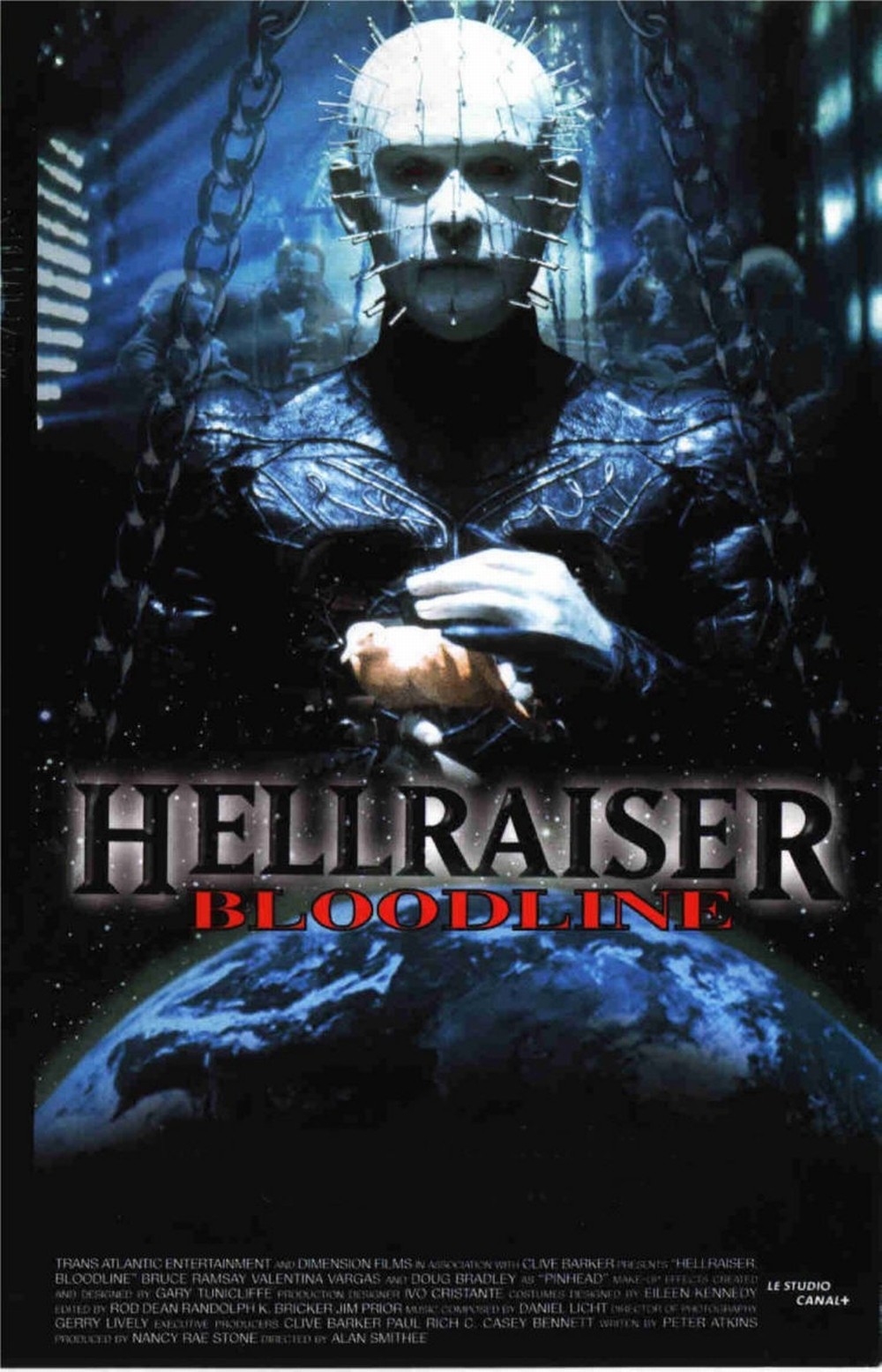
Jason X (2001) took Jason Voorhees to space, as did Leprechaun 4: In Space (1996). I think we can all agree these were bad, but fun and campy ideas. Thankfully Pinhead’s (Doug Bradley) legacy retains some value as this film actually rights its swervingly uncertain path in the wake of Hell on Earth (1992) and returns the franchise to a more worthy storyline than Pinhead on a killing spree or simply giving us “Pinhead in Space.” Yuck. If you want Hell in space, you want Event Horizon (1997). Period.
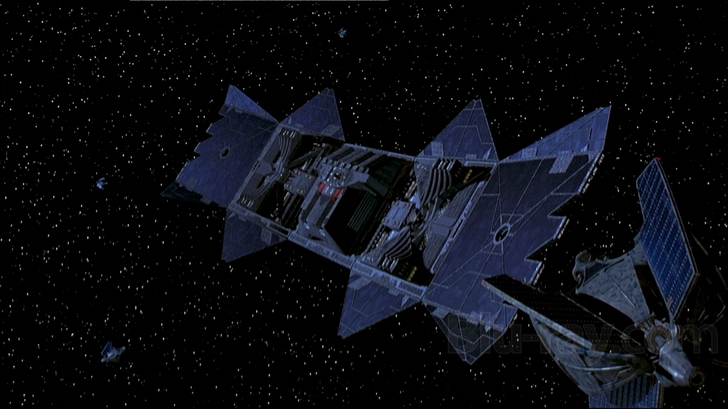
Entering the fourth installment of the franchise, Bloodline opens on a 22nd century space station where Dr. Paul Merchant (Bruce Ramsay; Alive, Continuum) uses what I can only describe as a 1990s Nintendo PowerGlove operating a robot to open the Puzzle Box. A team of “space marines” manages detain him (after he opened the box), and he reveals that the Puzzle Box has been in his family for centuries and he must put an end to its lineage of terror. As he explains, we are told of two past generations in his bloodline that possessed the very same infernal artifact.
I was most pleased with the very different approach in storytelling in this movie. This film is essentially an anthology in which the space station story wraps around two other stories within, all three being of different time periods; past, present and future.

Merchant explains (in the first encapsulated story) that in the 18th century, his toymaker ancestor Phillip L’Merchant (also played by Bruce Ramsay) commissioned the Puzzle Box for a twisted cultist magician who, along with his young assistant (Adam Scott; Piranha 3D), used this device to summon a demon. They skinned a young woman as a sacrifice such that the demon Angelique (Valentina Vargas; Faces in the Crowd) may inhabit her skin and walk the Earth. Contrary to past Hellraiser canon, if you summon a demon you control that demon “as long as you don’t stand between the demon and Hell.”


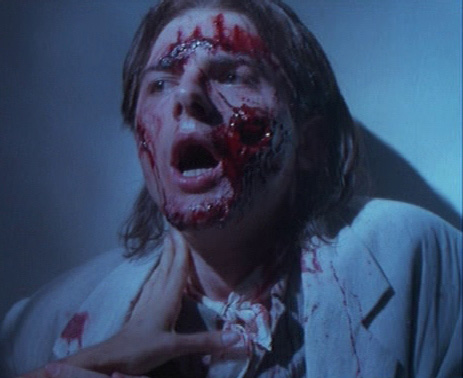
Part 3 (Hell on Earth) ended with the Puzzle Box being dropped in wet cement, which was revealed to be the foundation of a business class skyscraper with the interior decorated with the famous Puzzle Box design all over the walls like modern art. Accordingly our second encapsulated story advances Angelique and her master to present day (1996) as she “senses” the presence of the Puzzle Box and is drawn to America where another of Merchant’s ancestors has been inspired by the designs of the box.
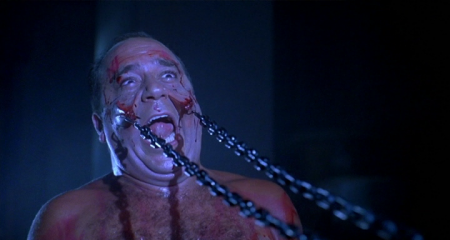

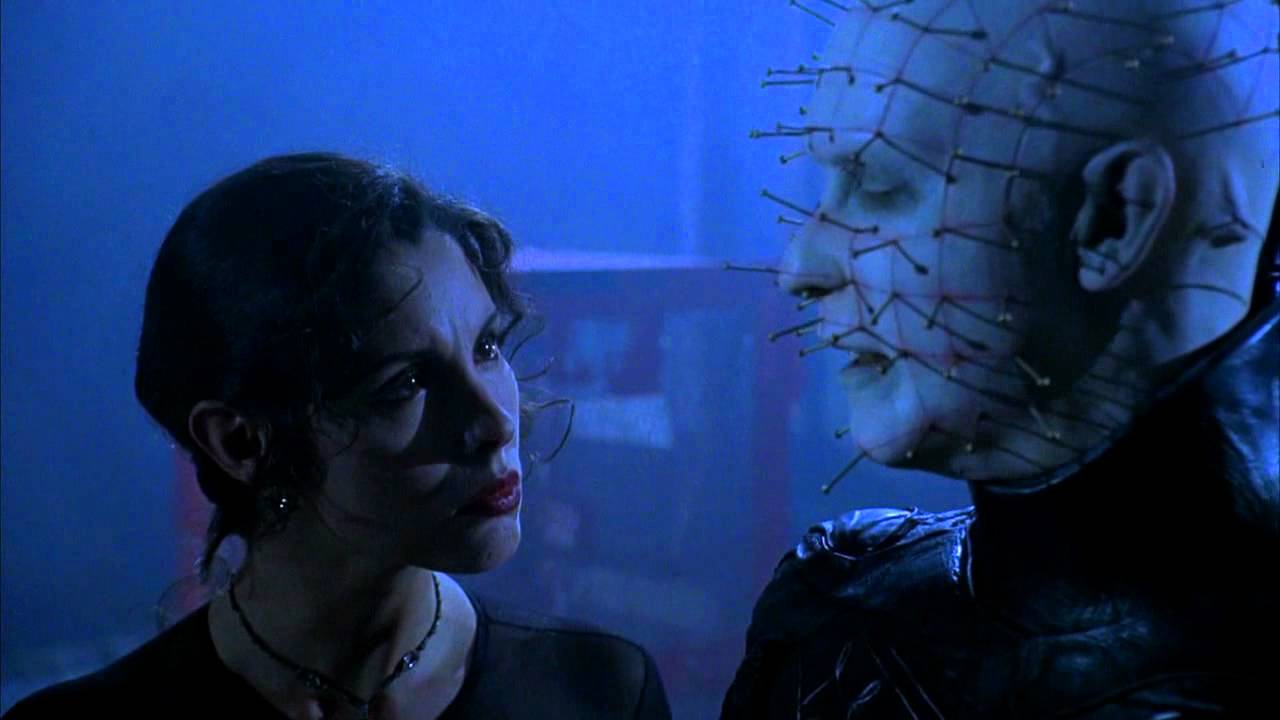

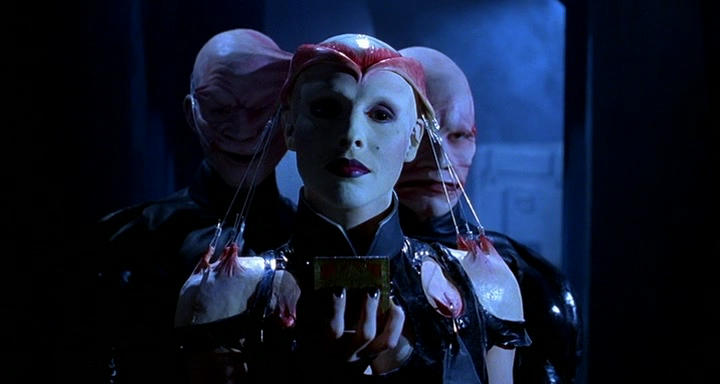

Angelique makes some temptations and summons Pinhead who. as usual, wants the box. Thankfully, Merchant successfully thwarts Pinhead, Angelique (now in Cenobite form) and their newly created “Twin Cenobites” but the box remains in the wake to threaten future generations.
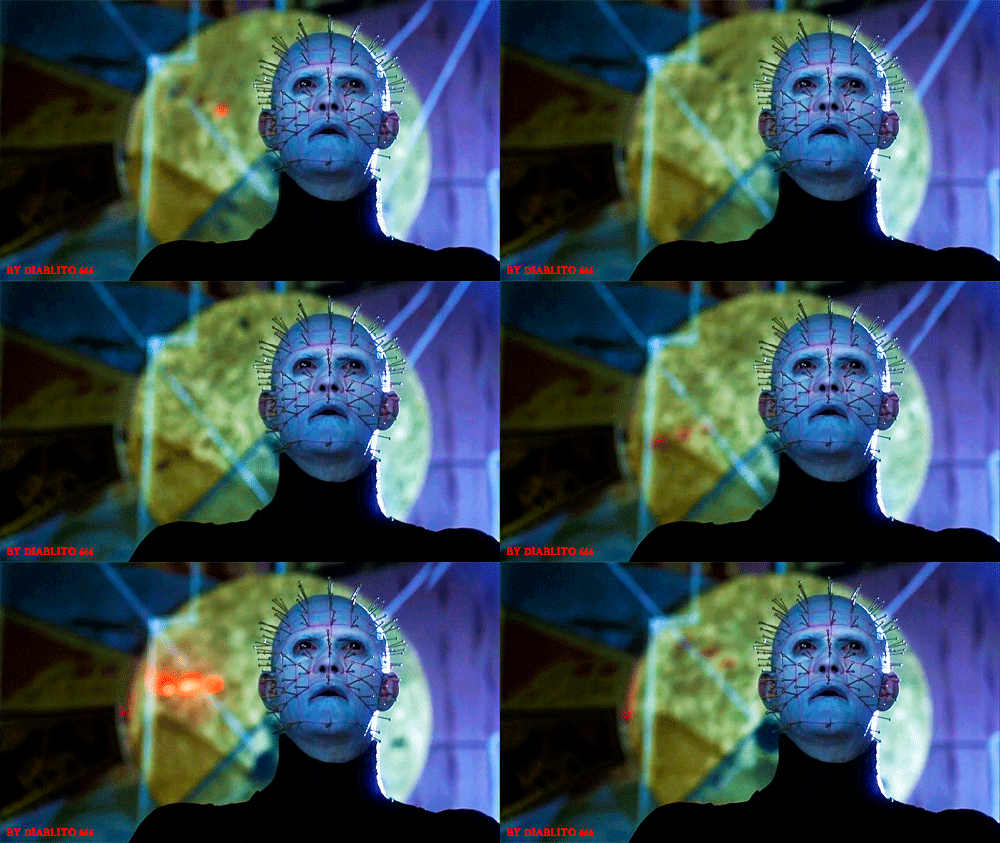

I was pleased with the stories underlying all of the Hellraiser films so far. Even though Hell on Earth felt too much like an action horror with some silly troped-up components, I remain pleased with it as it refrained from the all too often exploited cartoonishness of 90s horror. It remained dire and creepy with a rich story leading up to the “Pinhead action sequence.” A major fault of Hell on Earth was the blatant over-exposition. While this fault did not keep me from enjoying the movie, it is a bit frustrating nonetheless, and we find this fault here in Hellraiser IV. Directly paralleling the degree of over-exposition is the drop in acting quality of these two movies. It’s worst in the opening space station sequence but becomes more tolerable later on.

An interesting notion in this story is that the rules continue to change from film to film. Or, if they haven’t changed, then they’re not being properly explained. In 18th century Paris, he who summoned the demon controlled the demon. I’ll bet Hellraiser‘s Kirsty wished someone had told Pinhead that in 1987! And, like in all the sequels, innocent people grow less safe with each movie. In Hellbound the Channard Cenobite goes on a mental patient killing spree, in Hell on Earth Pinhead tries to kill EVERYONE, and now Pinhead continues to kill without reservation once summoned and converts Cenobites at will. Back in the original Hellraiser, Pinhead couldn’t touch anyone unless he at least believed that their “desire” was behind opening the box. My, how times have changed with now a fourth director and set of writers for as many films.
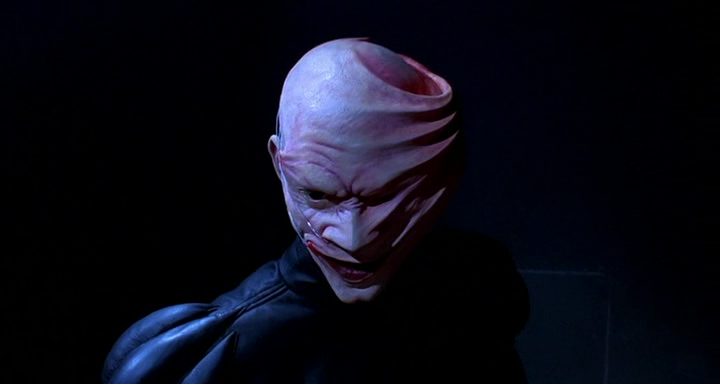


The effects remain entertaining and gory. The Cenobites have a more traditional appearance again, except for the Cenobite dog (where did that thing come from; did Cujo open the Puzzle Box and go to Hell?) and the franchise mythology continues to expand our interest in the Puzzle Box.




Our story finally returns us to the space station where Pinhead now wanders. In the end Pinhead is perhaps permanently deported to Hell in an interesting and clever story development involving the space station itself, which Merchant designed. Lucky for us, this is about 200 years in the future. So we’re good for as many sequels as they want to make until then.

Perhaps nothing in comparison to the first two films, I still consider that this film (and part 3 as well) remains worthy for viewing pleasure.
Share this post:


You can stream all episodes on BlogtalkRadio, stream old episodes at the Sharkdropper website, or download the podcast on Itunes.
If you get a chance please REVIEW, RATE and SHARE the pod!
We hope you enjoyed our previous episode on: Developing the Perfect Horror Film.

SUMMARY: This week the MFF crew discusses the past and upcoming projects of Guillermo del Toro, X-Men: Apocalypse and the X-Men and Marvel Universe franchises, and muse the past, present and future of the Alien franchise with Neil Blomkamp’s upcoming Alien 5 project.

We also answer such important questions as…
“How are Guillermo del Toro’s movies all connected?”
“What makes a bad movie enjoyable?”
“How do Sarlacc’s mate?”
“Has the X-Men franchise added too many characters for us to care?”
“Did Prometheus or AVP actually hurt the Alien franchise?”

This week’s podcast is based on the following articles:
Prometheus
Prometheus (2012) Vivisected: The Unacceptable Discontinuity between Alien and Prometheus
Prometheus (2012) Vivisected: The sea of questions regarding the mysterious black goo
Bad Movie Tuesday: AVP/AVPR/Predators
Pacific Rim (2013), an epic live-action anime experience
Pacific Rim: It’s All About the Monsters Getting Punched in the Face
X-Men First Class
Sit back, relax and learn about everything you missed.
If you haven’t seen some of these movies, be comforted that we will geekily inform you as to why you should watch them.
You can stream the pod at the Sharkdropper website, listen to us on with your mobile app OneCast, or download the podcast on Itunes.
If you get a chance please REVIEW, RATE and SHARE the pod!
Proudly sponsored by the audiobook company Audible, your new MFF podcast episode is here!
Share this post:

Slow West: Slowly Going the Way of the Bounty Hunter
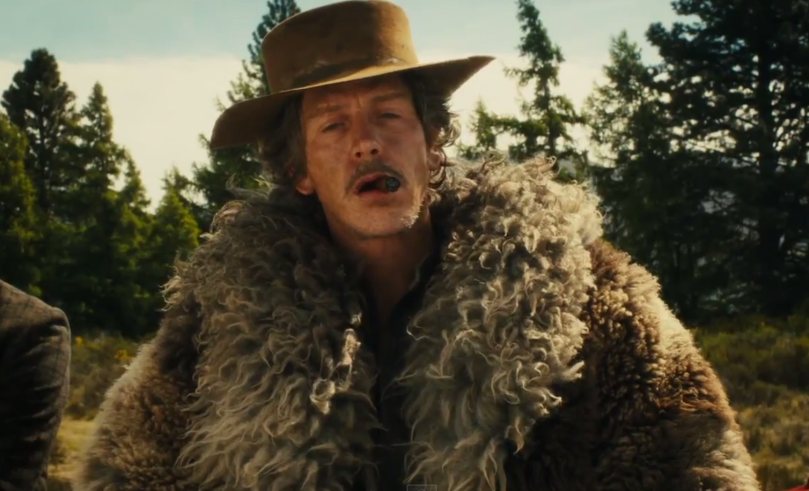
Slow West is the kind of film where salt literally falls into somebodies bullet wound. It has an off-kilter vibe that blends tragedy, beauty, dark humor and gorgeous New Zealand cinematography into one cohesively random movie. It is a comedic tragedy that may be one of the most memorable films of 2015. Whether it be the skeleton of a logger trapped underneath a tree or a massive fur coat worn by Ben Mendelsohn Slow West feels like the Coen brothers teamed up with Jim Jarmusch watched the Norwegian book adaptation Headhunters and were transported into a first time feature directors body. Did I mention the amazing fur coat that Mendelsohn wears?
Slow West revolves a nice kid named Jay (Kodi Smit-McPhee..think a young Jay Baruchel) traversing throughout America’s west in search of his lost love Rose (Caron Pistorius). Somehow he has made it all the way from Scotland and things are looking bleak for him until he runs into a reformed bounty hunter named Silas (Michael Fassbender). Silas takes most of Jay’s money in exchange for protection and together they unwittingly lead a pack of bounty hunters towards Rose and her fathers cabin. There is a $2,000 bounty on Rose’s head and that attracts Ben Mendelsohn’s Indian hunting/absinthe drinking maniac Payne. From there we get a journey where absinthe is consumed, loggers are smooshed and Swedish people run amok. It all leads to a fantastic shoot out that features some of the best visual gags I’ve seen in years.
Director John Macclean made a wise decision to shoot Slow West in New Zealand. The locations are beautiful and all he needs to do is set his camera and let his A-list actors stroll through the shot. I was constantly amazed at Maclean’s patience. He trusted his actors and knew the countryside would speak for itself. It was refreshing to watch action scenes where the shots are longer than 1/8 of a second. You get the feeling that the action came secondary to the characters.

Slow West is never predictable and I applaud it for that. The gags aren’t highly stylized and there is a sick yet sane sense of humor. You’ll laugh when you shouldn’t laugh and sit on the edge of your seat as the action unfolds. Slow West is a love letter and calling card that proves that Westerns can be done right.
If you get a chance check out Slow West and read my post about films you might have missed in the theater. It features What We Do in the Shadows, Ex-Machina, It Follows and ”71.
Share this post:

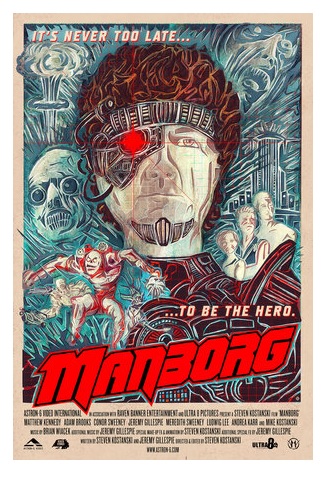
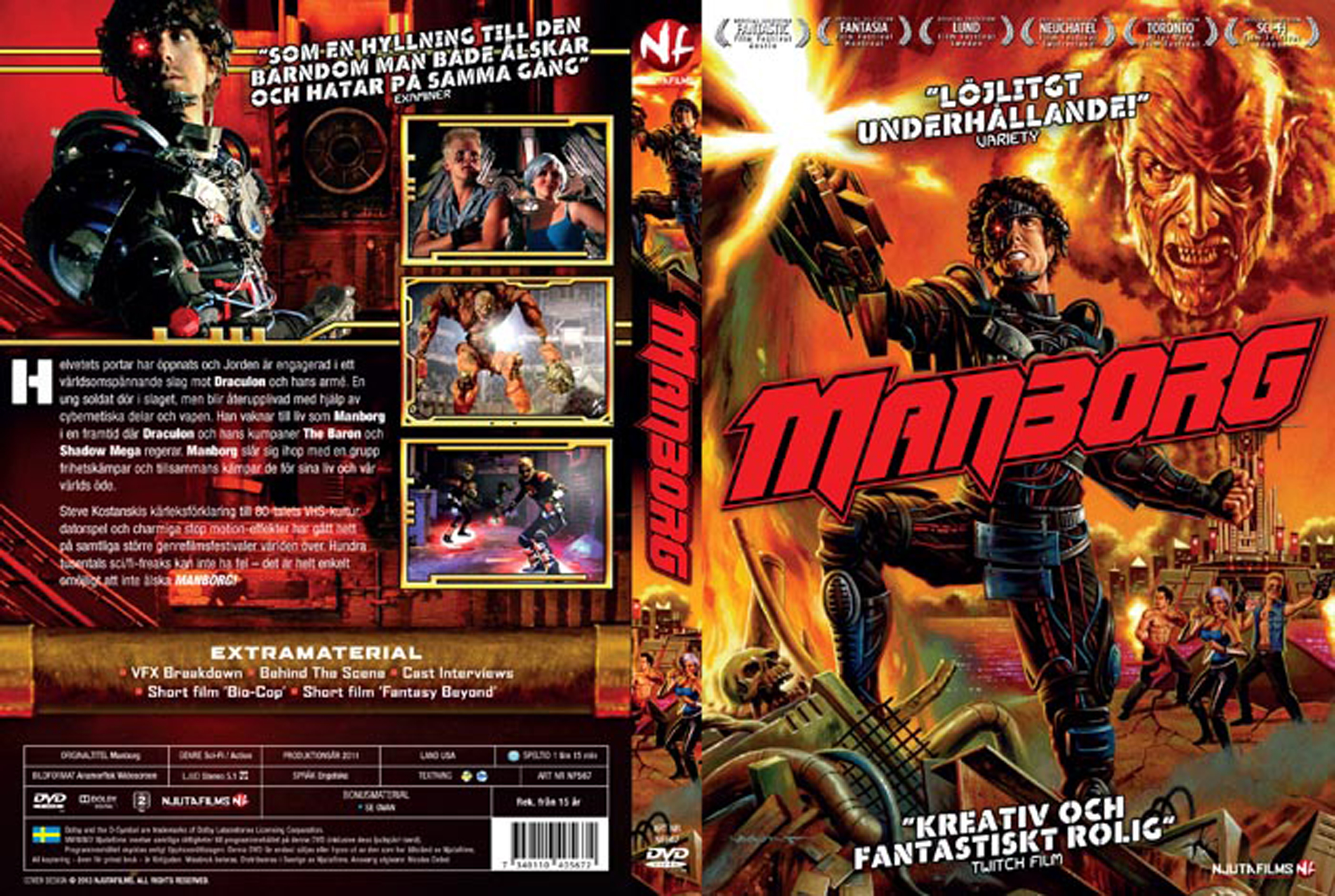
Manborg (2011), the schlocky tale of a cyborg battling Nazi zombie mutants, robots and vampire demons from Hell.

MY CALL: This is an homage to 80s schlock trash cinema. As such, everything about this movie is stupid and cheesy and over-the-top…but for some people that works. You know who you are. 😉 MOVIES LIKE Manborg: Kung Fury (2015), Mutant Hunt (1986), Tokyo Shock films.

Kung Fury (2015) meets Mutant Hunt (1986) with a dash of cracked out Robot Chicken (2005-present) and Flash Gordon (1980) in this trashy collage of schlock, super cheap effects and stop-motion creatures.
So here’s the short synopsis by IMDB: “A soldier, brought back to life as a cyborg, fights alongside a band of adventurers against demon hordes in a dystopian future.” If that doesn’t make you want to see this movie entirely on its own, then you probably shouldn’t watch this.
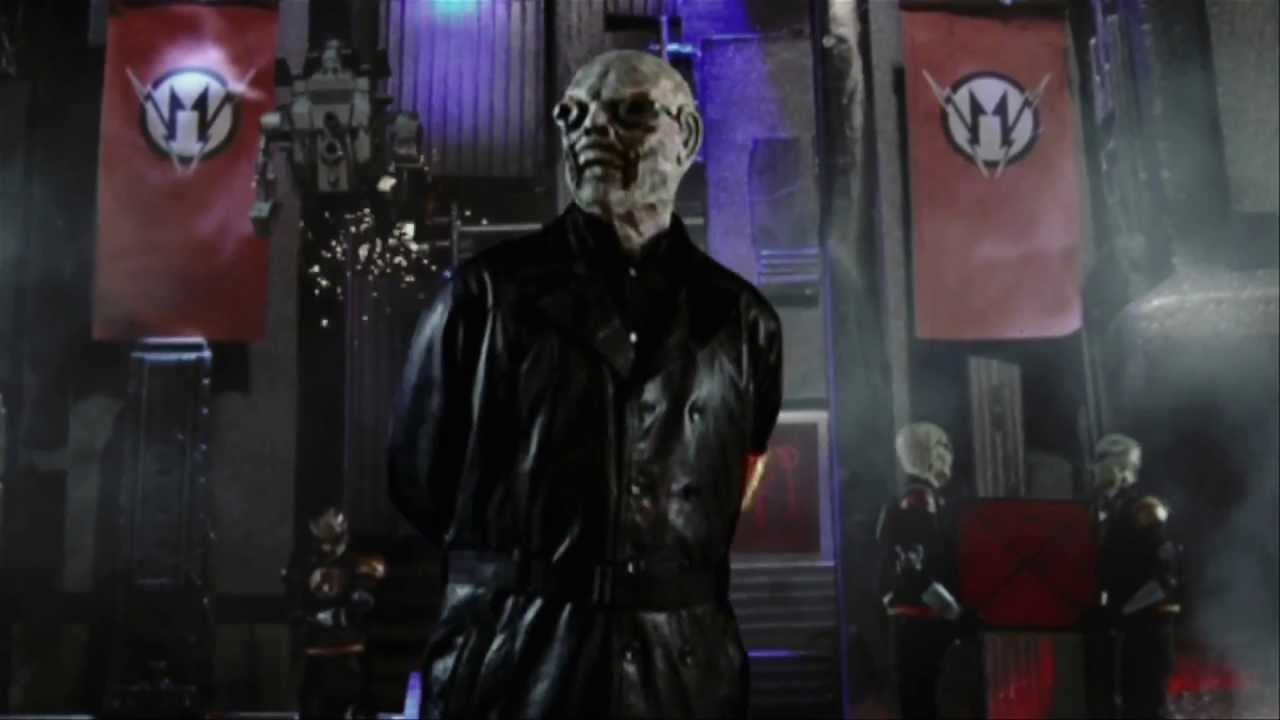
“Earth, the legacy of the Hell Wars when mankind fought the armies of Hell and Hell won… With every passing hour, another nation crumbles to the technological might of this unholy menace, and their monstrous leader Count Draculon.”

The film is choppy and it appears as if actors are being greenscreened over a 1990s videogame backdrop as soldiers battle Doom zombie pseudo-Nazis with laser guns and stop-motion monster zombie shock troopers. In fact, this feels a lot like watching a videogame…while on drugs. One brave man in the battle field goes toe-to-toe with the evil warlord Count Draculon (a Nazi vampire demon from Hell?) and is left for dead.

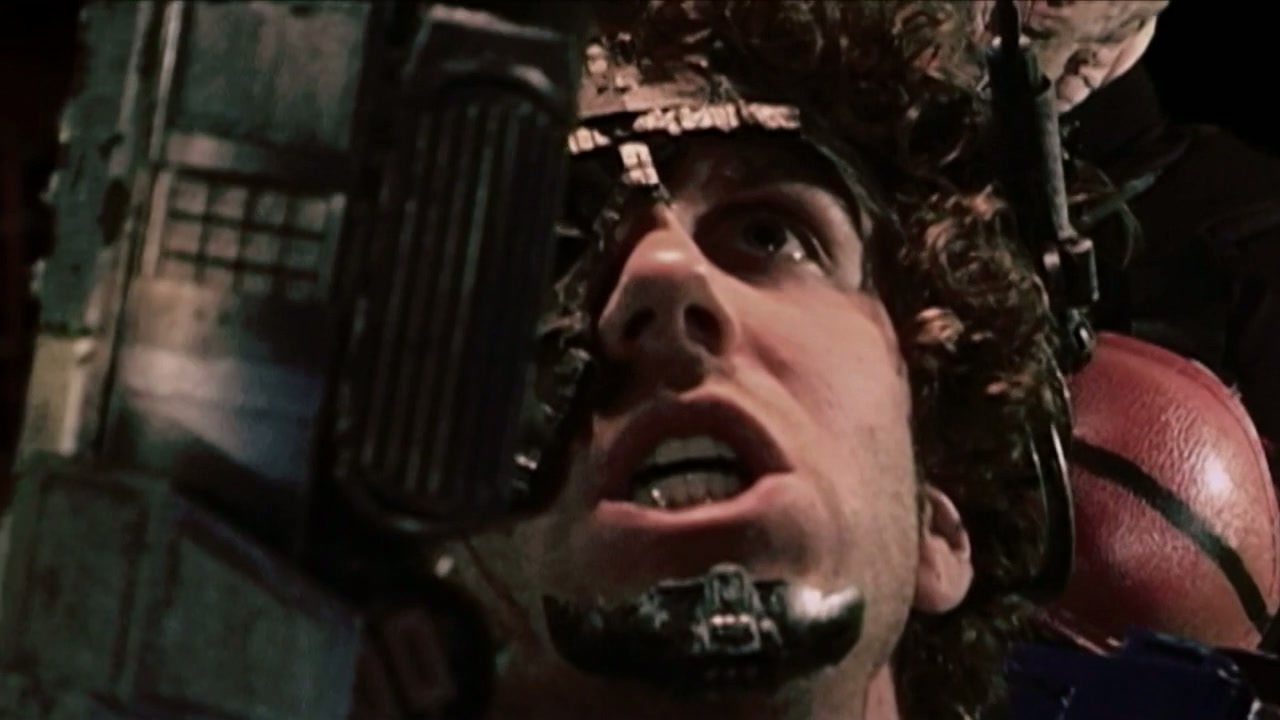
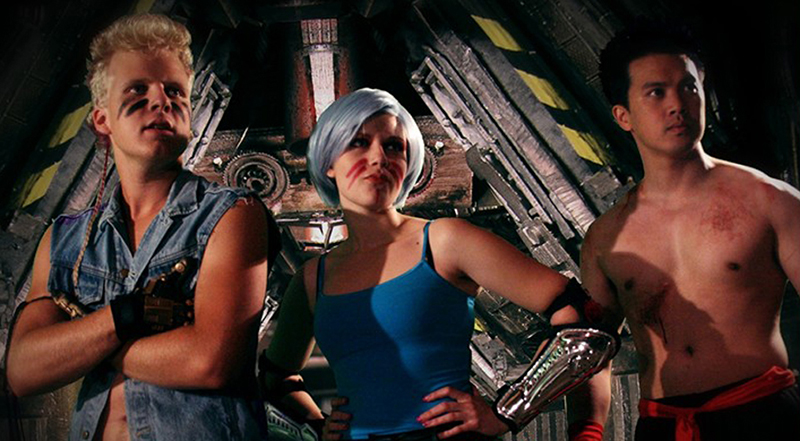
This man becomes Manborg (Matthew Kennedy; Father’s Day) in a cybernetics montage. Laser hoverboards, combat droids, cheap computer graphics, even cheaper costumes, and a Liu Kang-ish martial arts-y sidekick named “#1 Man” mix nicely into this persistent assault on good taste—or a delightful bubble bath of bad taste, depending on your preferences.
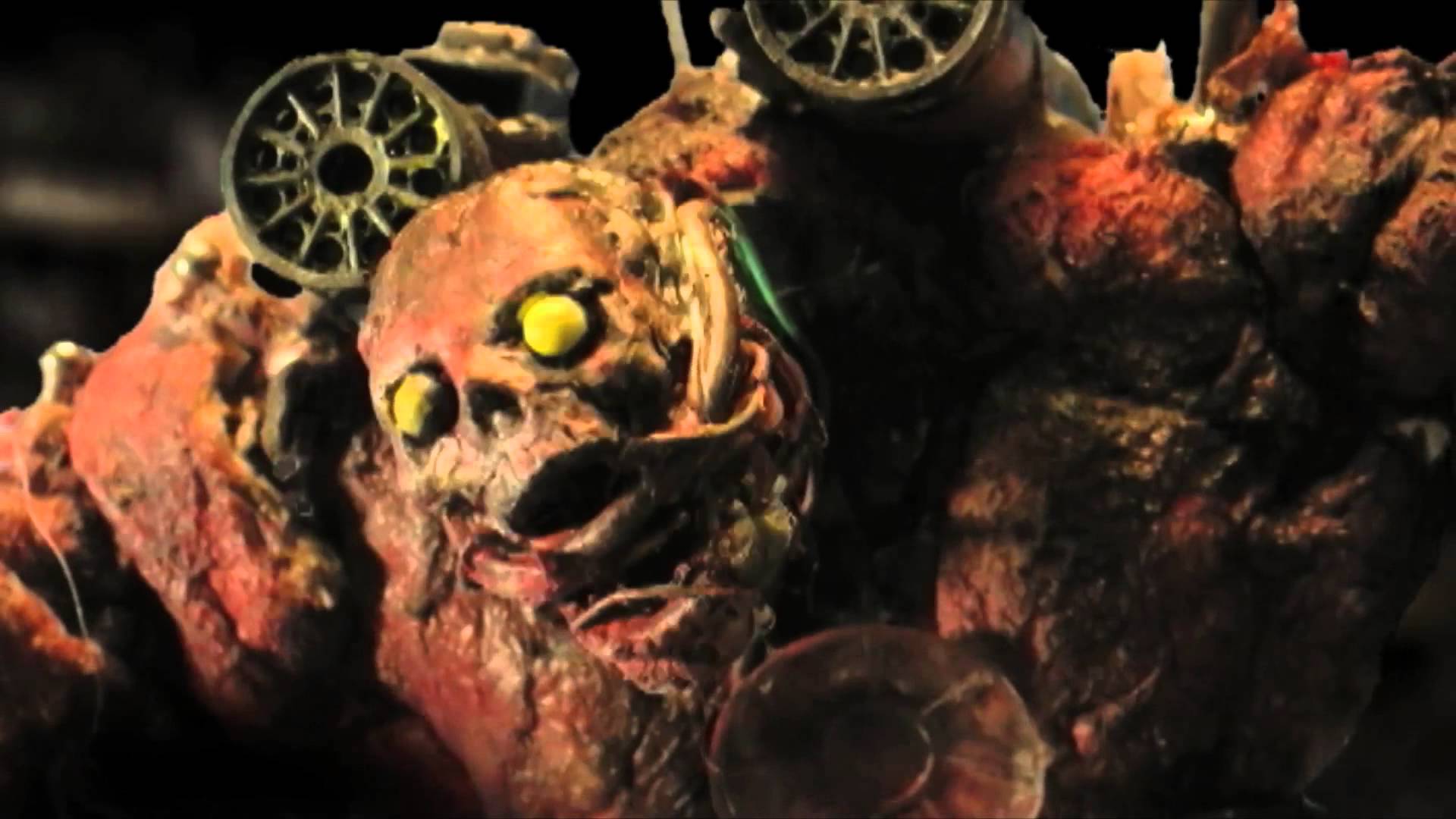
Manborg is captured and forced to battle in the evil Nazi zombie fighting pits. Their champion is a giant claymation monster with laser rocket launchers. I loved the claymation, however bad it was. Speaking of “bad” this film was both bad and delightful (to lovers of bad films). It had a budget of $1000. 1000 DOLLARS!!!!! That in mind, this is actually quite impressive.


Massively cheap and grossly overacted, Manborg is an homage to 80s schlock trash cinema directed by Steven Kostanski (Father’s Day, ABC’s of Death 2 “W is for Wish”). At times the ultra-low budget and ultra-badness of it all was a bit exhausting. Other times it was weirdly refreshing. I especially enjoyed The Baron’s lines, attempts at romantic courtship and awkward demeanor. Attempts at gore, however cheap they may appear, were abundant and suitably messy and gross to match the trashy scale of the rest of the film.

This film even made an attempt at a plot. You see, Manborg was actually created by the same mad scientist who accidently opened the gate to Hell in the first place. So, he made Manborg to combat this infernal evil from Hell. While doing so, Manborg delivers loads of tropes from 80s trashy action badness along with digital future-scapes and weird special effects galore.
This is CLEARLY not for everyone. But for some of you (the schlock lovers), this may be just what you need.
Share this post:

Hello all. Mark here.
With the Wet Hot American Summer mini-series ready to unleash itself on Netflix I wanted to recommend other cult classics that you can stream on Netflix. These films were dismissed upon initial release and have since amassed loyal followings that quote the films ad nauseam and have bought every special edition VHS/Laserdisc/DVD/Blu-ray released (Think Evil Dead and its hundreds of editions).
There is a reason these films are considered cult classics. They have bumps and bruises and are loaded with personality. They get better with repeat viewings and you might not have liked them the first go around. These five films feature talking mixed vegetable cans, iconic improved lines and amps that go to 11. There movies simply won’t quit and you sorta need to watch them.
Wet Hot American Summer

Wet Hot American Summer is a weird little thing that has grown in brilliance throughout the years. Nobody could have guessed that a movie about fondling sweaters and hot dog breath would be resurrected 14 years later. Wet Hot is the kind of film that gets better with each viewing and makes you interested in cheddar fondue. It plays so fast and loose it feels incomprehensible to the normal mind. The stupidity becomes genius and you learn there was a method to the madness. David Wain and Michael Showalter knew what they were doing and it is hilarious.

.
The Warriors

Warriors come out and play!
The Warriors tells the age-old story of a crew called The Warriors battling their way back to Coney Island after they are falsely accused of killing a gang leader. It is weird, stiffly acted, violent and über memorable. Director Walter Will created a violent and cheeky hybrid that features lots of broken bones and a gang that looks like KISS started a baseball team. It takes a cool idea and builds a mythology around NYC’s gang culture. I totally understand why people were turned off by the macho posturing and eccentric nature of The Warriors. However, Hill’s vision of violence struck a chord and spawned video games, fan art and a whole lot of baseball playing cosplayers. What I love the most is the line “Warriors come out and play” was improvised and those clinking bottles were a game time decision. I love when tiny random moments get burnt into the lexicon.

.
Big Trouble in Little China

Kurt Russell is my hero and Jack Burton is my favorite cinematic blowhard of all time. Big Trouble tells the story of a long haul trucker failing upwards while navigating a world full of magic, immortals and sleeveless shirts. It is rare when the hero ends up being the sidekick and more often than not Burton is a semi-hindrance to the rescue party. However, he is a blowhard who willingly puts himself in harm’s way and comes through in the end. Watch this scene and you will immediately want to watch Big Trouble.
.
If’ you’ve been reading MFF for sometime you know that we love Kurt Russell and John Carpenter. I’ve written about his sleeveless shirts and we covered him endlessly on the podcast.
.
Ravenous
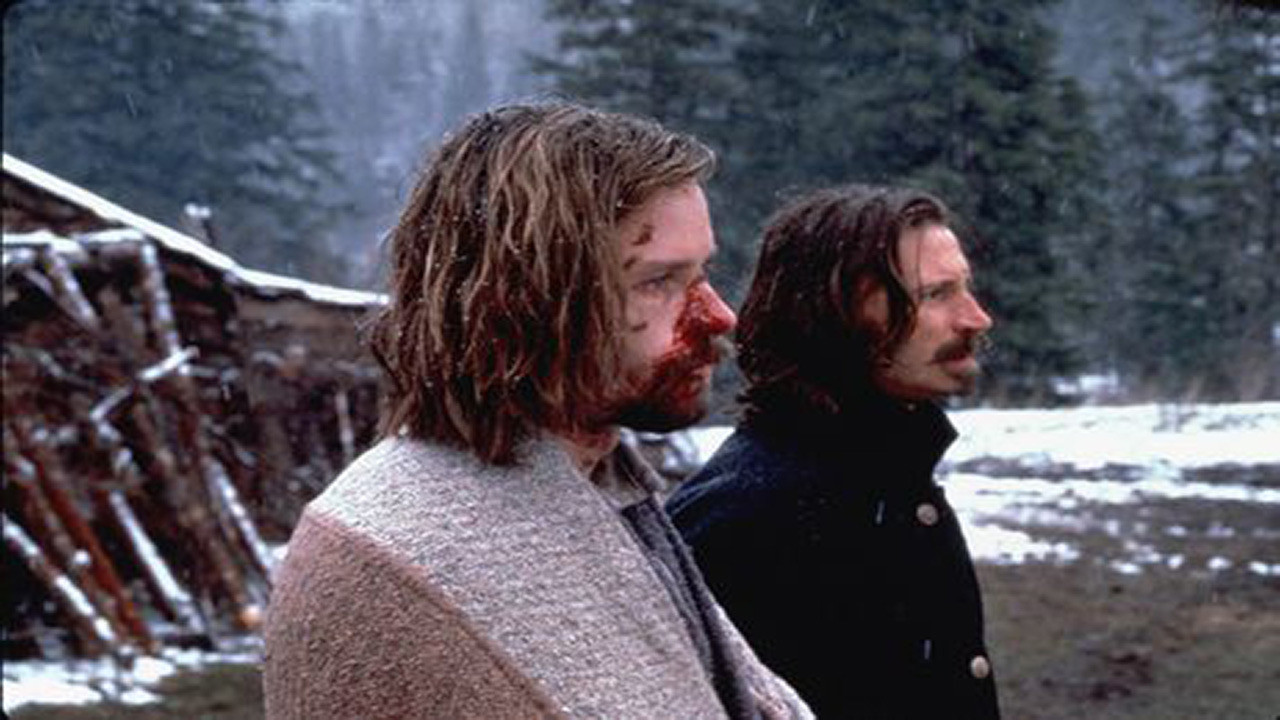
Ravenous is an odd little film. Dismissed upon initial release in 1999 it has picked up a cult following that has made the recent Blu-ray release an event. The film is characterized by a quirky soundtrack, bonkers performances and the famous line “he was licking me!” It is clear to see why this film is so adored. Like most cult classics it has an off-kilter vibe that features performances with personality. I love how it subverts clichés and feels like a hybrid because of the sudden directorial shifts. Ravenous has a personality all its own and can stand alongside films like Evil Dead, The Warriors and Donnie Darko.
.
Spinal Tap
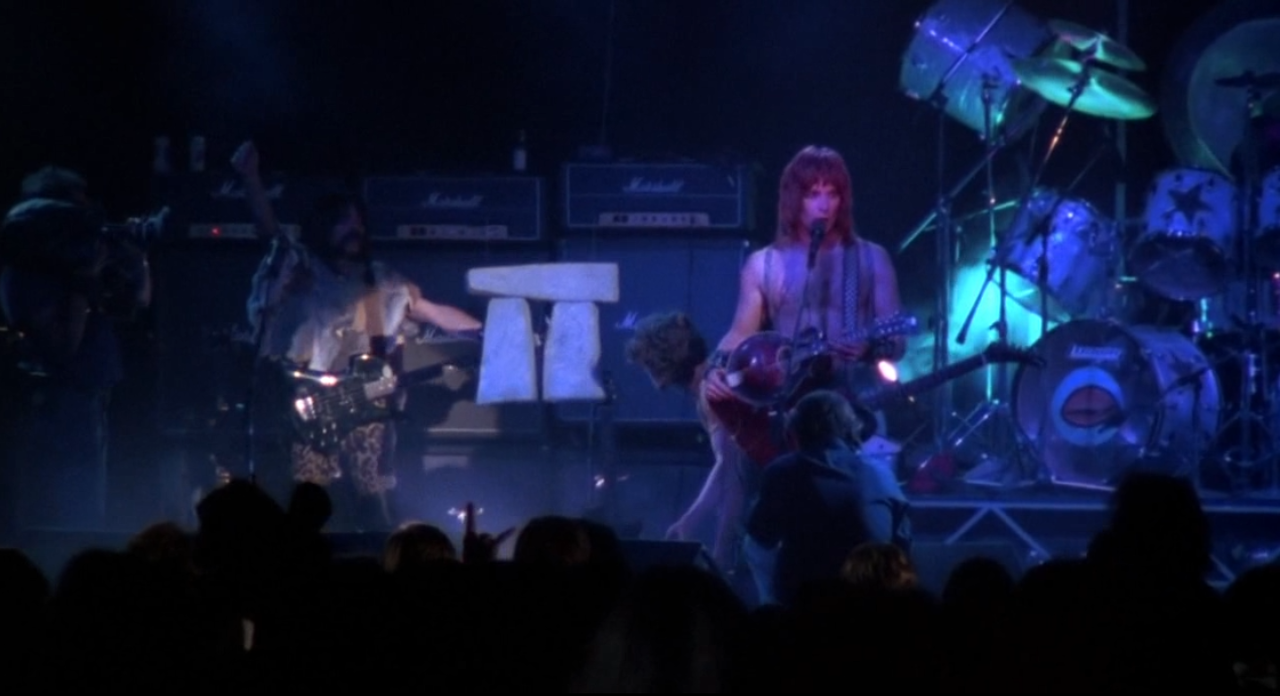
Spinal Tap is the best mockumentary ever made. It focuses on a rock band named Spinal Tap who are on a world tour that should be called Murphy’s Law. They get lost backstage, get stuck in cocoons and draw up Stonehenge in inches not feet. The band is so optimistic and innocent you can’t help but cheer for them as they make amps that go to 11 and are applauded for their “unusual loudness.” I will let Roger Ebert sum up the band.
Yes, their music is pretty bad. But they’re not bad men; they’re holy fools, living in a dream that still somehow, barely, holds together for them. They deserve the last-minute rescue of their Japanese tour–although what have the Japanese done to deserve them? One of the loveliest ironies of “This Is Spinal Tap” is that the band took on a life of its own after the movie came out, and actually toured and released albums. Spinal Tap lives still. And they haven’t gotten any better.
What cult classics would you recommend?
Share this post:


NSFW NSFW NSFW NSFW NSFW
This article is rich with images you do not want your boss to see when he’s looking over your shoulder at work. View at your own risk.
NSFW NSFW NSFW NSFW NSFW
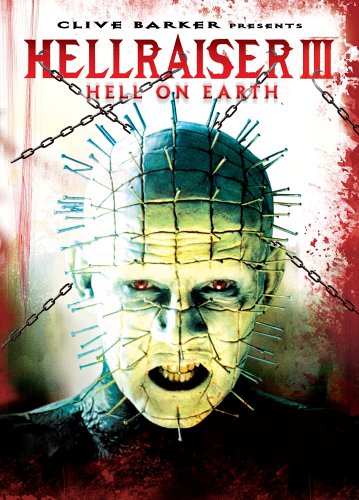
MY CALL: If Hellraiser was the Alien of the franchise and Hellbound the Aliens, then Hell on Earth falls somewhere in the Alien 3/Resurrection zone. But just because Hell on Earth pales to its predecessors, it doesn’t mean we forget that it exists. Not great, but worthy. Whether you’ve been educating yourself with 80s and 90s horror or are simply revisiting your old favorites, don’t give up on this franchise just yet. MOVIES LIKE Hellraiser: Be sure to see Hellraiser (1987) and Hellbound: Hellraiser II (1988) first, of course. Then maybe Lord of Illusions (1995), Nightbreed (1990) and The Thing (1982) for more creepy practical effects.
Franchise background so far: Whereas Hellraiser (1987) delivered credible character reactions to an incredible evil force, Hellbound yielded less plot credibility while delivering a vaster array of effects and revealing more about Hell and the Cenobites. As such, I consider part 2 the point in the franchise when we stop using the word “film” and start calling it a “movie” however much I enjoyed the story. Part 1 was more compact, being entirely based on illustrating one man’s escape from Hell and the temptations required to accomplish the task. Hellbound addressed that component just in the first act and then moved swiftly on to exploring the Labyrinth and various personal Hells while being introduced to how Barker’s Hell works and is ruled. We learned more about the background of the Cenobites and the mythology behind Barker’s Hellish Labyrinth. It felt that perhaps the sequel’s director Tony Randel (Amityville: It’s About Time, Fist of the North Star) was trying a little too hard to fill Horror Master Clive Barker’s shoes. The gore–which was already heavy, sloppily gross and pleasurably unique in part 1–was turned up to an “11” and the plot elements seemed to downshift in credibility.

A friendly warning: This movie gets a bit more sacrilegious than its predecessors.
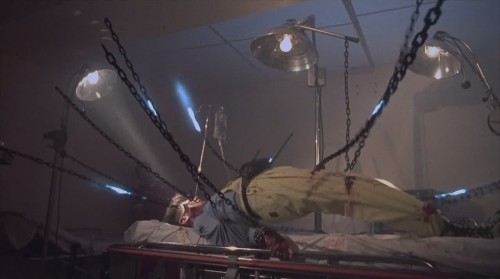
In an obscure art gallery we find J. P. Monroe buying an infernally adorned pillar from a mysterious purveyor. A connoisseur of macabre art, Monroe owns a huge night club that features an attached VIP penthouse, hair metal bands and death metal décor like baby dolls wrapped in barbed wire. After a club-goer steals the Puzzle Box embedded in his “Pillar of Souls,” the thief is rushed to the hospital dragging behind him bloody chains. This is witnessed by news reporter Joey (Terry Farrell; Star Trek: Deep Space Nine) who is in need of a good lead and is now obsessed with discovering the story behind this strange “accident.”
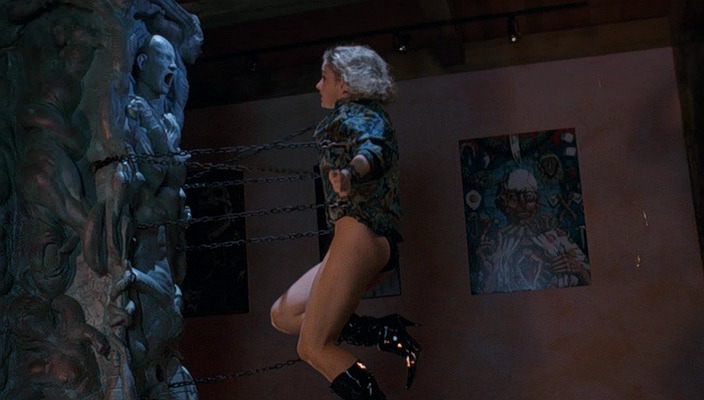
Meanwhile back at the club, after a one-night stand with a bimbo he finds at his bar, Monroe’s date for the evening examines his new art purchase a bit too closely and, well, you know…something bad happens. LOL. Pinhead’s now lively face appears on the pillar, hooked chains harpoon the young girl and flay her skin, and the pillar basically eats her as a blood offering to Pinhead. It’s actually a pretty cool scene.
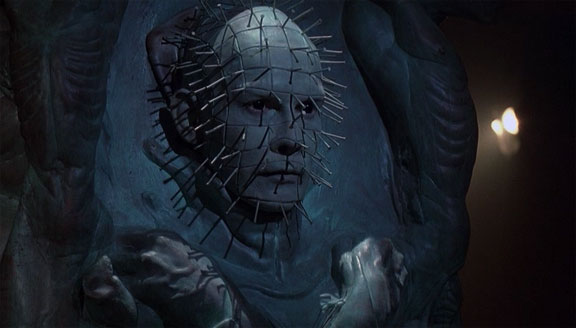

When we last saw Pinhead, he had been killed by the Channard Cenobite in Hellbound. Once something of a torture-master servant of Hell, in this movie Pinhead is introduced more as a desperate diabolical tempter. So he gets Monroe to bring him more blood to make him whole again. Monroe calls his ex-girlfriend Terri (Paula Marshall; Warlock: The Armageddon, Nip/Tuck). The sacrifice doesn’t go very well and Monroe himself is consumed by Pinhead fueling his infernal resurrection. The pillar turns into a collage of the animated flesh of trapped souls and begins to fragment, falling apart and oozing a slimy afterbirth. Yet another gooey, memorably gory scene. [Like its two predecessors, this movie will please gorehounds.]

Upon release, Pinhead goes on a metalhead killing spree, unleashing a storm of summoned hooks and chains from the club’s warehouse ceiling to rend and flay the panicking masses. I’m assuming they’re not all heinous sinners, making this is the first of the Hellraiser movies in which Pinhead kills innocents having nothing to do with the Puzzle Box and, crueler yet, turns innocents into Cenobites! Summoned in the same manner as Frank and Julia (in parts 1 and 2), Pinhead is now apparently free to roam the Earth! It seems that the rules have changed and, now unbound by the laws of the Hell’s Labyrinth, he may wreak havoc as we wishes. There’s one catch, though. Just as the Puzzle Box opened Hell’s door to return Frank and Julia to Hell, it can do the same to him; he must destroy it! It’s up to Joey to stop him.
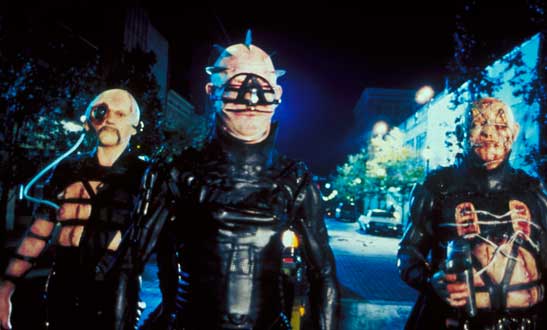
The Cenobites are a bit less inspired. Look at the top right and note the Cenobite holding a drink shaker. He was a bartender in life.
Then CDs in the head of the DJ and a camera through the eye of the cameraman.
In something of a side plot we learn that Captain Spencer (Doug Bradley), the man whose curiosities opened the Puzzle Box and transformed him into Pinhead, was not an evil man. The evils inside him were sundered from the good, leaving his good-intentioned ghost and his evil-immersed Pinhead as two separate entities in Hell. His ghost visits Joey in her dreams to warn her of Pinhead’s powers and intentions.
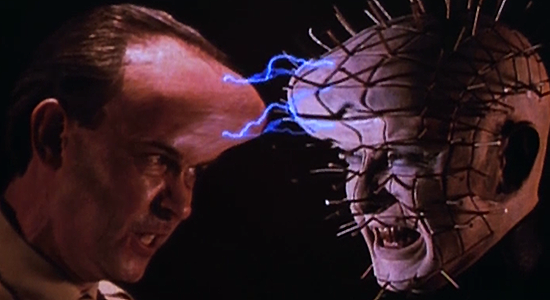
Now in our third installment, Clive Barker’s (Nightbreed, Hellraiser) infernal art and brilliant storytelling are behind us now. This third film finds a third director (Anthony Hickox; Waxwork) and a third set of writers—contrary to Hellraiser which was written and directed by Barker himself and Hellbound which involved Barker in the story development. This film continues a very engaging story (the ongoing franchise story) but is cheapened a bit by falling into some 90s horror trope snags.
I just want to pause here and say that I really enjoyed this movie. So whatever you read below, just now that I’m not hating. I’m simply being critical.
In the first film the Cenobites seemed to be demons from Hell intent on torturing souls for eternity. Their mutilations and appearance were suggestive of their sins. Hellbound then revealed that the Cenobites were once human and we see Dr. Channard transformed into a Cenobite (and an irregularly tough one at that!) in Leviathan’s “Instant Cenobite Chamber.” So we added substance to the Cenobite mythology illustrating that they were the creation of the God of Hell, but cheapened the entity with the creation of a new one in less time than a “7 Minute Abs” workout and more like “The Clapper.” In this third film we find Pinhead himself creating Cenobites left and right. Further cheapening the Cenobites is that our new demons lack mutilations indicative of their sins in life or torture in Hell. Instead their appearance is consistent with how they were killed onscreen…impalement by CDs in the mouth and head, constricting a head with barbed wire, jamming pistons through a head (and WTF was up with those pistons coming out of the Hell pillar sculpture anyway!?!?!). Oh, and while easily killed in Hellbound, these Cenobites are totally bulletproof. You can only kill them with glowing Atari videogame lasers fired from the Puzzle Box. All that said, they were still fun to watch, rather menacing and born of gory means.


Another major flaw would be the writing. The story is fine, but EVERYTHING is over-explained in such fine detail that it feels like listening to SAT test prep instructions or a “Do It Yourself” audiobook. I found myself a bit exhausted as the ghost of Captain Spencer directed, warned, instructed and taught Joey about the Puzzle Box, its history and importance, Pinhead, what he wants, how he’ll get it and how to defeat him.
The acting is fine—nothing spectacular but everything that we need. The effects and gore are satisfactory and abundant, although not as wowing as the first two films. This movie seemed to approach gore with the “more is better” mentality. I certainly enjoyed it, though. What holds this film together is our fear of Pinhead and what happens if he is free to wander the Earth.

Yup. This is clearly the influence of the 90s, a decade known for the dark humorization of horror and over-exposition. The Freddy and Jason of the 80s could be funny, but Pinhead is darker and should stay that way. Thankfully, outside of the annoyingly instructional dialogue, the uninspired Cenobite mutilations (which were entertaining in their own right) and a few grotesquely lame one-liners (“ready for your close-up?”) reminiscent of a mid-franchise Freddy Krueger, this film’s tone remains quite dire. That’s what makes this third film work despite its shortcomings. But it has lost its once truly surreal luster and now simply feels murderous…which is probably why this was the last Hellraiser movie to hit theaters, leaving only direct-to-DVD films in its wake.

Yes, this movie has many faults. But it was also exciting and perhaps the only film in the franchise that felt like it “starred” Pinhead. What we learn about Captain Spencer’s ghost also adds to the developing mythology.
Hellraiser was the Alien of the franchise, Hellbound the Aliens, and Hell on Earth falls somewhere in the Alien 3/Resurrection zone. Just because Hell on Earth pales to its predecessors, it doesn’t mean we forget that it exists. It remains worthy. Whether you’ve been educating yourself with 80s and 90s horror or are simply revisiting your old favorites, don’t give up on this franchise just yet.
Share this post:

Examining the State of Horror Cinema in 2015: A Look at the Current Trends, Auteurs and Squishy Noises
If you’ve read MFF and listened to the podcast you know that we’ve plumbed the depths of horror and keep coming back for more. We’ve written about its wardrobes, fights, gore, tank tops, survivors, football teams, horror corners (check the index) and talked endlessly about the perfect horror film and new classics. If you are interested check out how the 2014-2015 horror films stack up against the rest of the 21st century horror movies.
I am excited about the direction horror is taking in 2015. There is a new crop of horror directors and older maestros who are taking what they love of horror and creating something new. There is a “boutique” vibe to the films as they’ve become fashionable and wear classic horror influences like accessories. They are told by horror lovers who are very much so part of the modern generation.
There will always be remakes, prequels, reboots and sequels littering the horror landscape but the last several years have seen new blood injected into the genre. In 2010 Blumhouse productions unleashed the $1.5 million Insidious that featured Patrick Wilson, Rose Byrne and Lin Shaye battling an incredibly jerky Further demon. It was a runaway hit and since then the horror world has been on an upswing. A good amount of the movies haven’t followed a trend and seem to exist in a world all their own. They’ve ditched the A (Killer) + B (Nubile Co-eds) = C (Blood) formula and explored different trails in the same park. They were not made in response to influences like Night of the Living Dead, Jaws, Nightmare on Elm Street, Scream or Paranormal Activity. They are not cash grabs looking to follow trends (I Know What You Did Last Summer) and there is genuine art taken to create mass carnage.

Director Richard Linklater said Spring was “a beautiful, unique love story. An accomplishment of genre and tone.”
Author and Grantland contributor Mark Harris recently wrote about the indie horror boom and had this to say:
Perhaps it’s unfair for those of us who are, ahem, considerably older to sigh about what is and isn’t scary — if you’ve indiscriminately slept around in the genre for decades, of course you’re going to feel “Is that all there is?” But there are signs that the films themselves feel that ennui. At least It Follows scavenges the detritus of the genre in search of fresh ways to be frightening, not just as a way of creating wry commentary about it
In other words they’ve pulled a Carl Weathers and turned leftovers into delicious broth.
.
Today’s cinematic and televised (Walking Dead, Hannibal) horror landscape is full of thoughtful and literate people who understand horror. Thus, we have gotten The Guest, Backcountry, It Follows, Spring, The Conjuring, Creep, We are Still Here, The Babadook, Honeymoon, Housebound, The Taking of Deborah Logan, Cheap Thrills, Under the Skin, Dead Snow: Red vs. Dead, Oculus, A Girl Walks Home Alone at Night, Only Lovers Left Alive, What We Do in the Shadows and Tusk. These 19 films averaged 87% on Rotten Tomatoes (Tusk’s 39% didn’t help). Horror is becoming hip and critical darlings are everywhere.

If you say you don’t like The Babadook there is a very real chance a hipster horror lover will come out of nowhere and punch you in the face.
What I love about the 19 films is that they feel original (only one sequel in the bunch) and only slightly familiar. They know what they are and in the case of The Guest have the patience to build to a final line (What the f**k?) that sells the entire movie. I don’t think any of them will be considered classics as they lack suitable cult aesthetics (Think Evil Dead and Ash) and villains (Nosferatu) that offer primal scares (The Thing). However, they are fun and feature truly memorable lines, moments and erotic dancing.
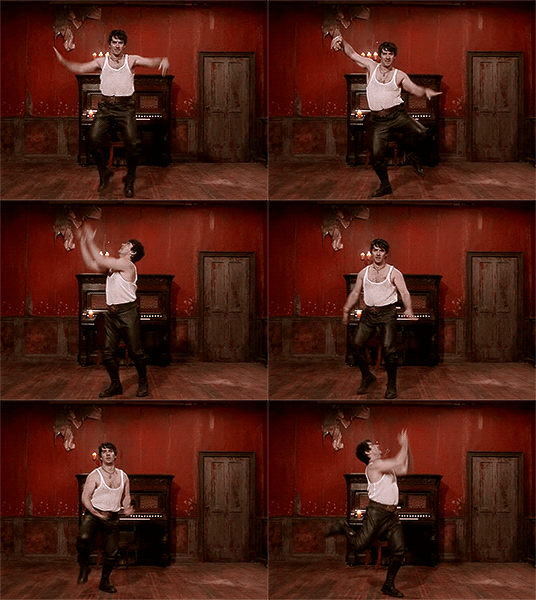
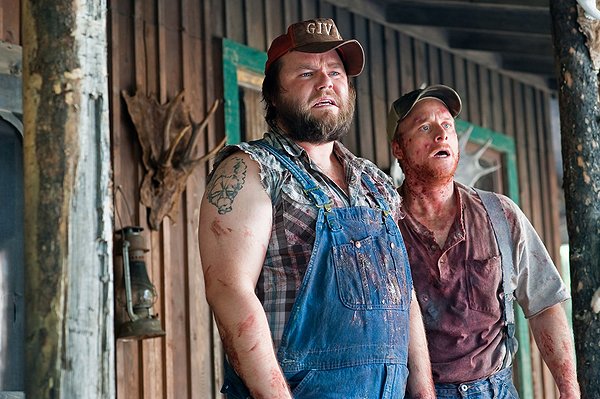
It is no longer a male dominated genre as The Babadook, Honeymoon, Carrie and A Girl Walks Home Alone at Night were directed by female directors. These solid films join female directed Near Dark (Kathryn Bigelow is my hero), Ravenous and American Pyscho as examples of tone and style coming together to form a solid film. It is a breath of fresh air to have a different viewpoint and female characters who aren’t machete fodder. The stock “final girl” aspect has been skewered as You’re Next, Final Girl and The Final Girls all acknowledge the trope. Take them alongside Cabin in the Woods, Tucker and Dale vs. Evil, Grabbers, Cockney’s vs. Zombies and you have self-aware comedy horror films that take the piss out of long-established clichés.
Why are these college kids killing themselves!?!?
Directors and writers are fully aware their films will be compared to the classics so they take care to offer something new. A good example of a director explaining and defending his work is in this Anatomy of a Scene video by the New York Times. It Follows director David Robert Mitchell breaks down the opening scene.
.
It plays like Nightmare on Elm Street met a De Palma woman in peril film and was scored by John Carpenter. In the opening scene we’ve already found three comparisons. However, as the movie continues it becomes its own beast with its own origins, world and scary moments. It takes the familiar and makes it fresh. It was a love letter and a calling card. It Follows is well aware of the horror genre yet breaks new ground.
For a horror fan it shouldn’t be surprising if we recognize trends occurring in horror. Much like any genre, studio productions are a study in trends and they wait to exploit whatever is popular. There is nothing wrong with striking while the iron is hot but it wears down the fresh creation into homogenized fare that exploits rather than creates. It is a waste of time to complain of similarities and tropes. This may sound like a weird example but soccer has been around for a very long time (1,004 B.C.) and it still centers around athletes kicking around a ball. Horror films have been around since the invention of film (1896) so it is no mystery that there are recurring themes (people will always go to cabins in the woods).

If you like the people in the cabin it doesn’t matter. You like the people in Honeymoon.
1922’s Nosferatu was an unauthorized adaptation of Bram Stoker’s Dracula that set the tone for many horror films. I love that in 1922 it was unauthorized and Max Schreck was so iconic the film Shadow of a Vampire suggested he actually was a vampire. So, one of the first and most iconic horror films stole its source material, changed a couple of names and has gone down in the pantheon of great films. The studio had to declare bankruptcy and only a few prints survived. Since then we’ve seen every iteration of vampires and we are in no way done with them. Not much has changed in the last 90 years.

What We Do in the Shadows is the greatest vampire mockumentary ever made.
I read the fantastic book Shock Value: How a Few Eccentric Outsiders Gave Us Nightmares, conquered Hollywood and Invented Modern Horror. It is about the late 1960’s and 1970’s horror boom that influenced decades of horror. It was like the wild west and I love that a few people set the standard for modern horror. It is abundantly clear that we won’t get dirty sweat stained movies like Texas Chainsaw Massacre, Henry: Portrait of a Serial Killer or The Exorcist ever again. The days of soul-destroying yet artfully made horror may be in our rear view mirrors. Occasionally, violent cult classics like I Saw the Devil, Devil’s Rejects, Thirst and Martyrs sneak through the cracks but we are moving on to something more tame and less daring.
It crushes my soul watching new ideas like Tomorrowland, Waterworld, Frailty, Event Horizon and Oblivion falter while sequels upon sequels bring in the money. New isn’t always lucrative but with the expansion of VOD artistic horror films are starting to pop up once again. Now that talented folk can experiment, create and shoot on a budget I fully expect more gems to sneak through the system. For instance, the über low-budget Creep is a neat little found footage film that is about two people and a camera. Director Patrick Brice and actor Mark Duplass started it off an as experiment and it evolved into something worth watching. It proves that two men, a camera and a love of film can create something that reaches the masses. it was very inspiring to watch and Brice intended Creep to be a motivator.

With the new technology comes more freedom and much like in the 60’s and 70’s I expect more artists to create their unhindered and slightly less bonkers visions. For instance, the movie Spring is a horror hybrid that does something new on a budget. I love this quote by Spring co-director Justin Benson.
It felt like there was something sort of rebellious in the act of creating a new monster. Because for some reason it was something that so few people attempt to do now. Usually, when people want to tell a monster story, it’s a vampire, it’s a werewolf, or it’s an alien. It’s always got to be one of those things. That’s pretty much it, conceptually.
Bring on the new monsters! I am optimistic about the state of horror as David Robert Mitchell, Alejandre Aja, Ti West, Adam Wingard and others are maturing and creating fantastic yarns. 2016 will be loaded with remakes but there is a welcome presence that are providing us horror hounds with new horror tales.
If you enjoyed this post make sure to check out our podcast on Itunes or Blog Talk Radio. In our latest pod we came up with quite possibly the most random horror film idea ever. It is kinda glorious.
Share this post:

John’s Horror Corner: Extraterrestrial (2014), a playful approach to gory sci-fi horror that samples a little of everything.

MY CALL: In this spirit of entertainment (and good fun), this flick seems to have sampled a little of everything. It’s pure dumb fun for the uncritical horror fan. I recommend it. MOVIES LIKE Extraterrestrial: There have been several recent horror approaches to traditional aliens… Alien Abduction (2014), Skinwalker Ranch (2013), Dark Skies (2013), Signs (2002), The Fourth Kind (2009), The Thing (2011).
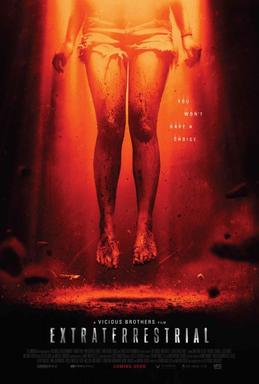

The opening scene is worth mentioning. After being refused refuge by some ponytailed jerk at a woodsy remote gas station on a stormy night, a frightened young woman makes a call from a phone booth in the middle of nowhere and it–the entire phone booth and woman–disappears…then crashes down from the sky without her in it. This sets the tone for a fun flick. Next, the credits seem serious and well composed, with glimpses of what appear to be red-filtered UFO clips. So apparently some aspects of the production were tended to more lovingly than most direct-to-DVD horror flicks.
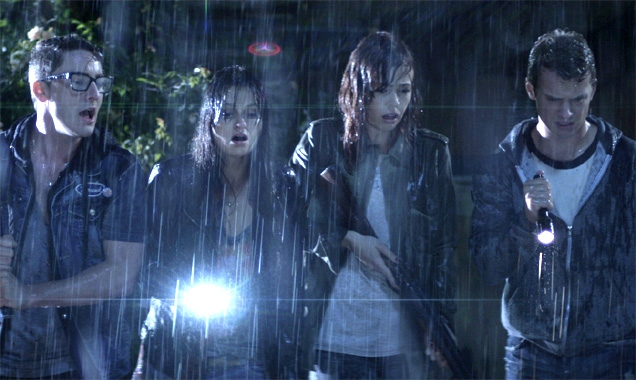
April (Brittany Allen; Dead Before Dawn) is going to the family vacation home, a cabin in the woods, with her boyfriend Kyle (Freddie Stroma; the last three Harry Potter movies). Unbeknownst to April, who was only going to take photos of the cabin to put it on the market, Kyle invited a bunch of their friends. Melanie (Melanie Papalia; The Den, Smiley), Seth (Jesse Moss; Tucker and Dale vs Evil, Wolfcop, Ginger Snaps) and Lex (Anja Savcic; iZombie) join.
The sheriff (Gil Bellows; The House at the End of the Street) warns these 20-somethings of recent criminal activity in the area. After agreeing to behave, our youth in revolt drink and smoke, grill and dance. In the middle of a drinking and pot-smoking session, the group observes something fiery falling from the sky. Upon investigation, they find a prototypical flying saucer has crash landed leaving inhuman footprints departing the scene.
When we see the alien it has the classic look to it, however much taller and quite gangly. They shoot it, leave it for dead and end up trapped in the woods by a suspicious treefall blocking the road.
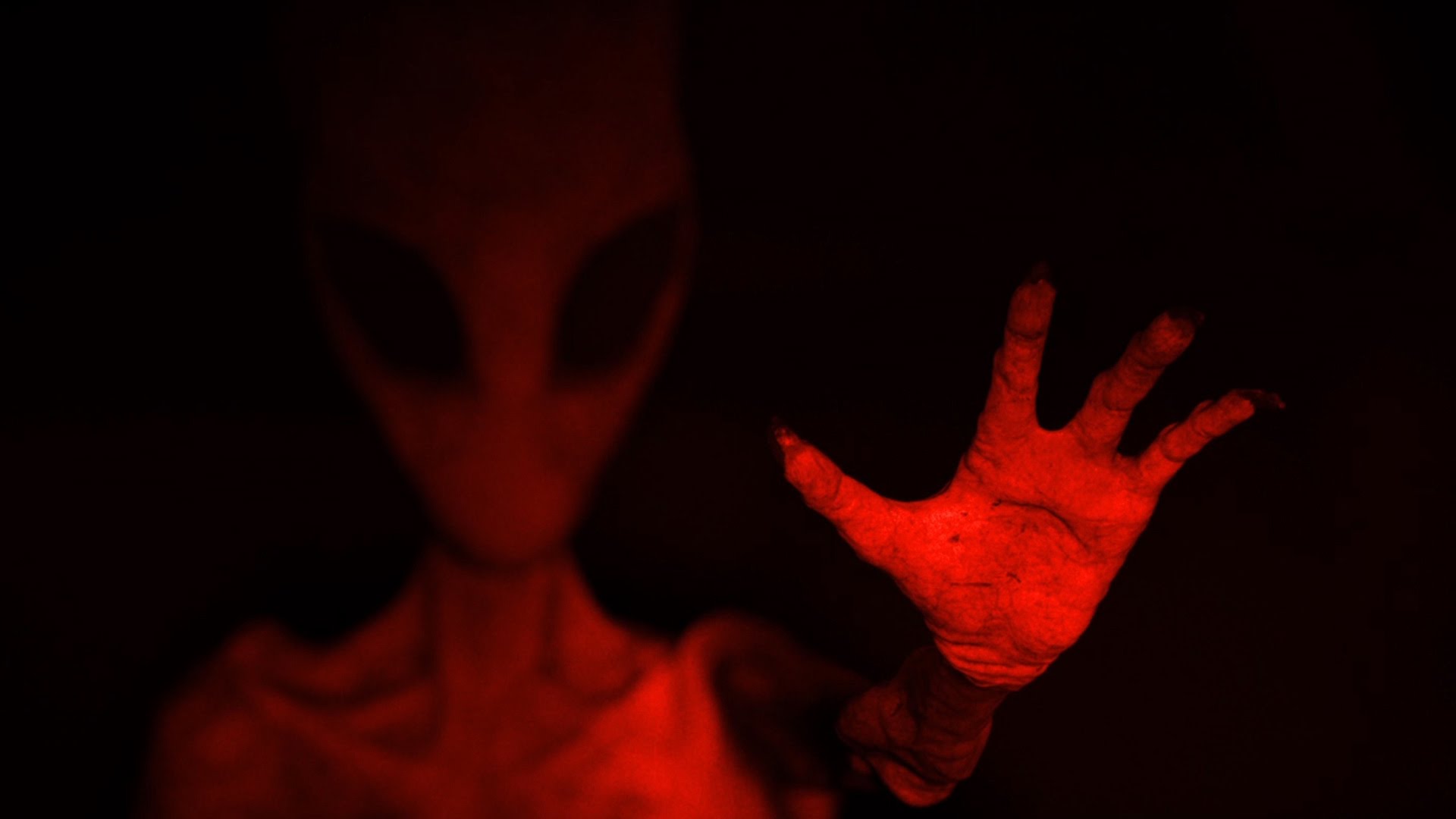
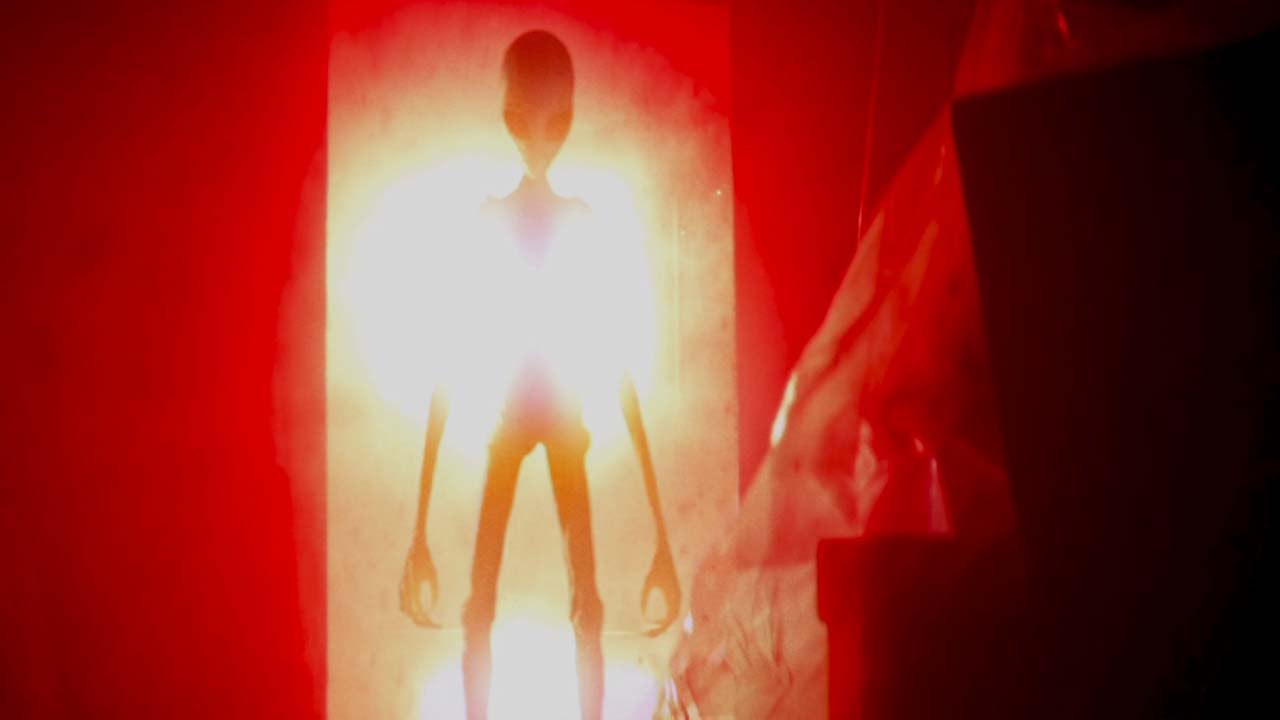
Filmed in both traditional and found footage techniques, this trope-by-numbers movie over-explains things to us with the victims saying things like “that’s a fucking alien” and “is it still in the house.” We see things like a skinny naked alien with big eyes a la Communion (1989), someone getting beamed up in a tractor beam, and every other alien movie staple you can think of…so it should come as no surprise that the aliens use mind control as well.
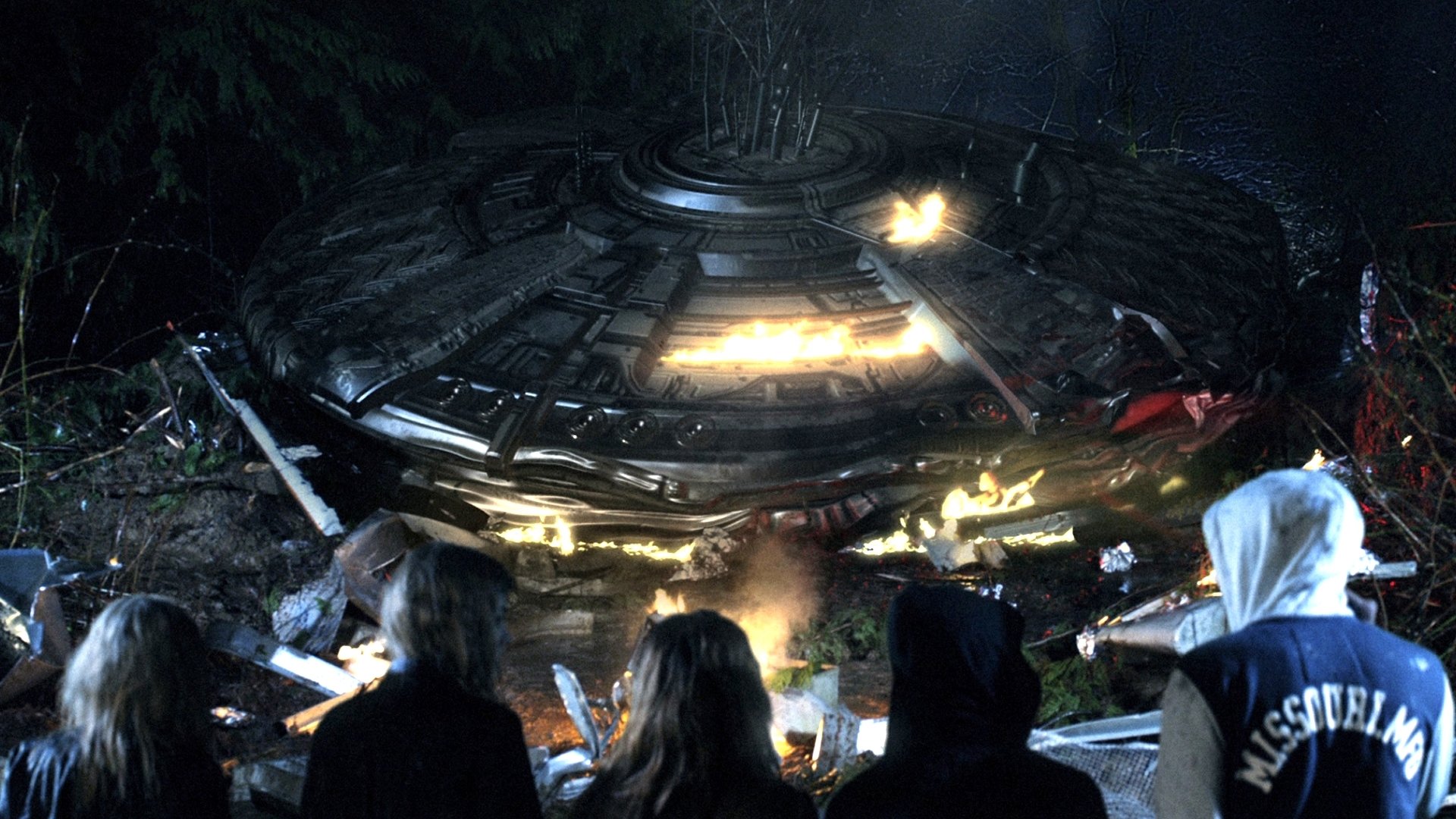
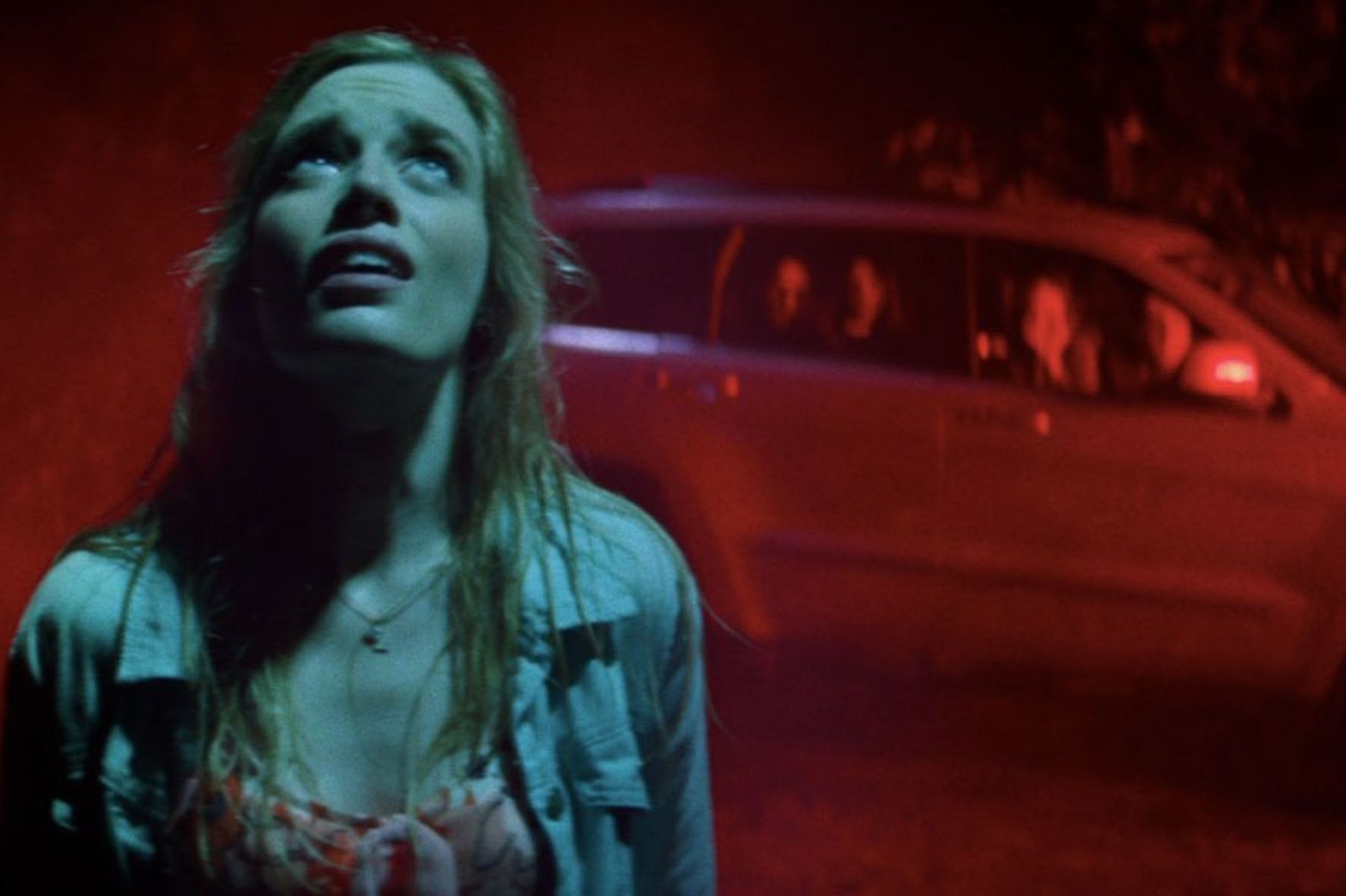

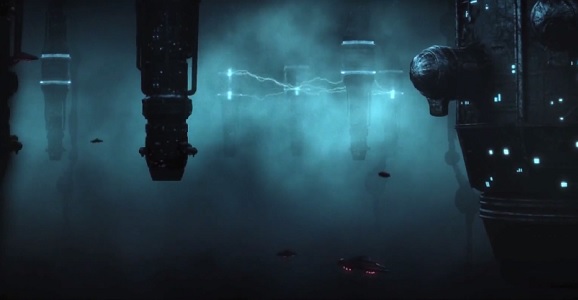
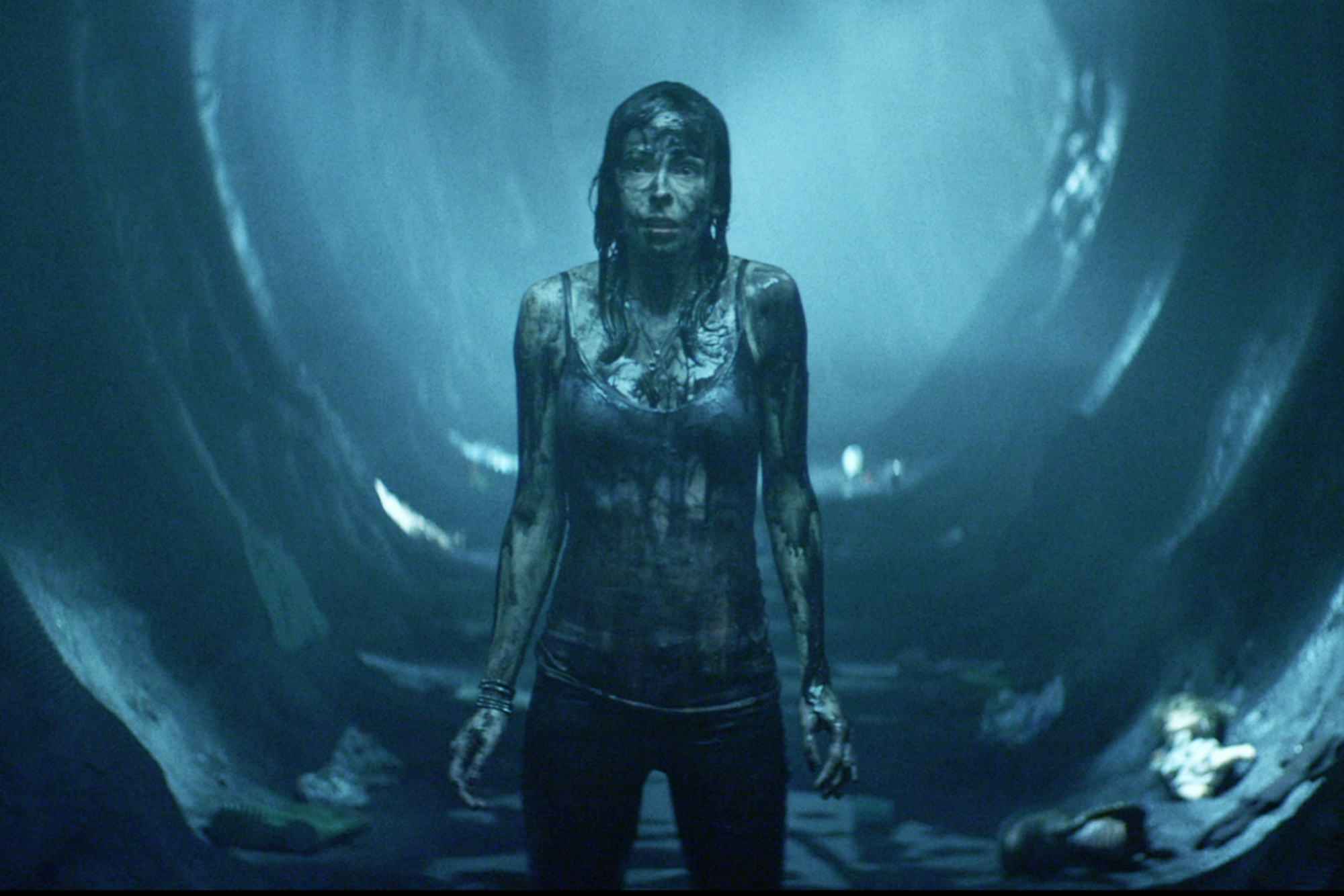
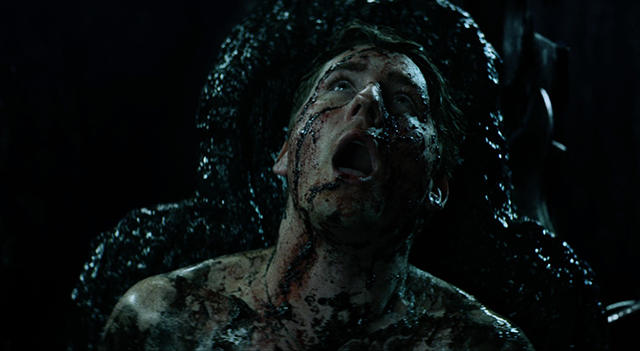
The effects were as good as they needed to be, including a very cool yet simple effect involving rain. I was also quite pleased with some gunshot wounds, loving the gore from the headshot. There were slimy imprisoning cocoons and slimy hallways a la Aliens (1986), a cabin siege a la Signs (2002), an Alien mothership megaplex a la Independence Day (1996) and Oblivion (2013), a weird grub impregnation a la Wrath of Khan (1982) and a bladed drill bit anal probe. Yuuuuck. We also encounter experiments hybridizing humans and aliens a la Alien Resurrection (1987) and District 9 (2009). In this spirit of entertainment (and good fun), this film seems to have sampled a little of everything.
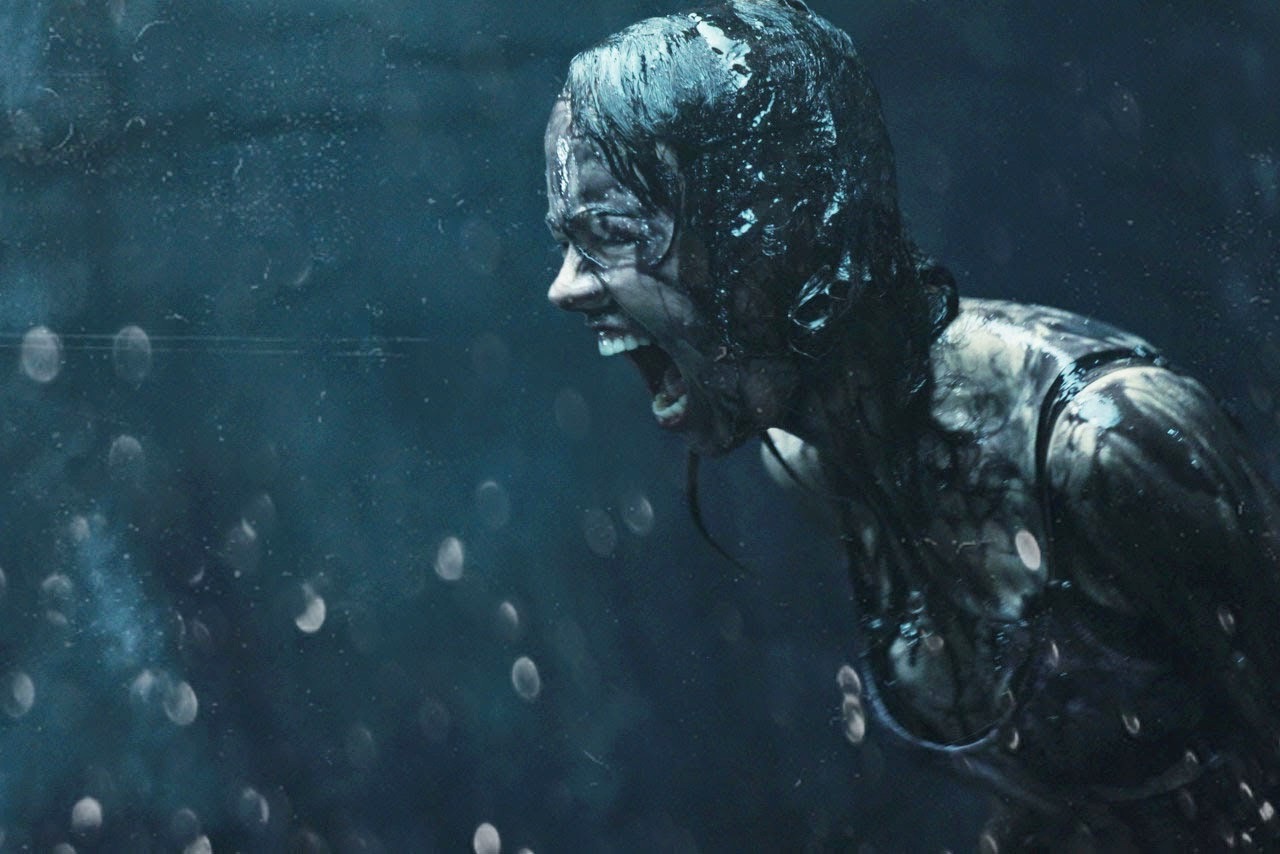
I was happy to see Sean Rogerson (Grave Encounters, Underworld: Evolution) as a deputy. Also, look for Michael Ironside (Starship Troopers) in a cameo as a weed-farming nutcase. He’s a conspiracy-theorist Vietnam veteran with claims of nearby experimental aircrafts. His character is annoying at times, poorly written most of the time (perhaps deliberately), and entertaining all the time. He explains that the aliens are attacking because a peace treaty with these gangly aliens was broken when our victims shot the first alien.
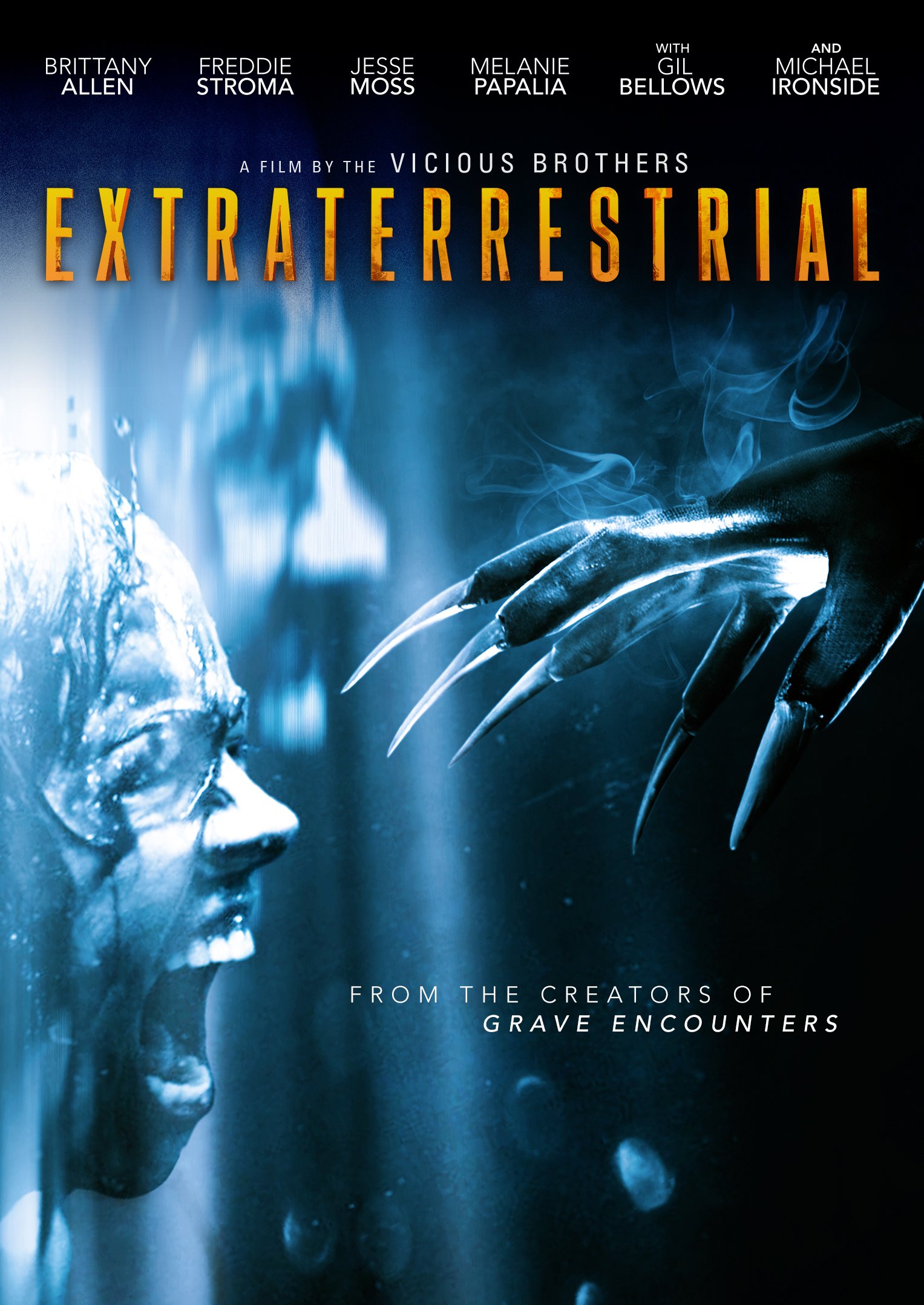
From the makers of Grave Encounters (the Vicious Brothers), this is pure dumb fun for the uncritical horror fan. I recommend it.
Share this post:

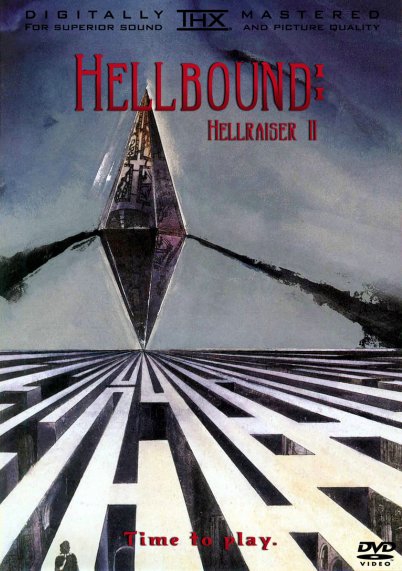
John’s Horror Corner: Hellbound: Hellraiser II (1988), exploring Clive Barker’s Labyrinth and Cenobite upgrades.

NSFW NSFW NSFW NSFW NSFW
This article is rich with images you do not want your boss to see when he’s looking over your shoulder at work. View at your own risk.
NSFW NSFW NSFW NSFW NSFW
MY CALL: This is one of the more interesting horror movies of its decade—second only to its franchise predecessor. Gory, dark, exploratory and with an engaging story, this is not a movie to miss. MOVIES LIKE Hellraiser: Hellraiser (1987), Re-Animator (1985), Lord of Illusions (1995), Nightbreed (1990) and The Thing (1982).

The movie opens with a something of a highlights reel of the best and grossest scenes from part 1. Continuing immediately from where Hellraiser (1987) ended, we find Kirsty (Ashley Laurence; Hellraiser, Warlock III) in a mental hospital where her account of what happened to her father, uncle Frank and stepmother Julia (Clare Higgins; Being Human) is received as more than a little hard to swallow.
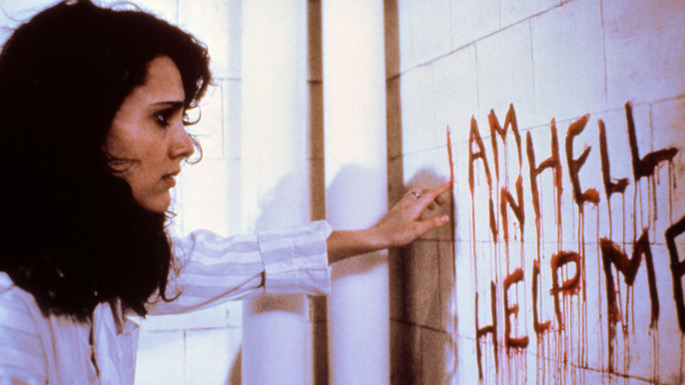
Whereas Hellraiser (1987) delivered credible character reactions to an incredible evil force, Hellbound takes a nosedive into bonkersville in terms of plot believability. I, in no way, mean this as a complaint…I LOVE this movie. But this “movie” is the point in the franchise when we stop using the word “film.” Clive Barker’s infernal art and brilliant storytelling are behind us now. It seems that perhaps our new director Tony Randel (Amityville: It’s About Time, Fist of the North Star) was trying a little too hard to fill Horror Master Clive Barker’s (Nightbreed, Hellraiser) shoes. The gore–which was already heavy, sloppily gross and pleasurably unique in part one–is now turned up to an “11” and the plot elements seem to have shifted from credible to nonsense. Almost every event in the story evidences this mania—not that the horror genre is known for its storytelling. In fact, as bonkers as it is, this story is told more eloquently than most horror (especially in the late 80s).
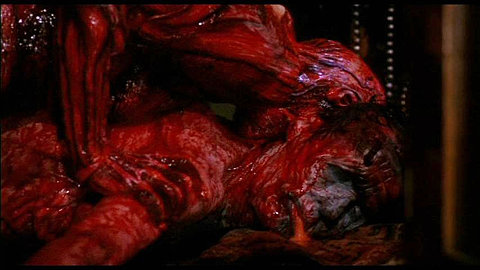
Now in a mental hospital, the doctor in charge of Kirsty’s case just happens to be an amateur expert and collector obsessed with all things occult, especially the Puzzle Box and its history. In other words, coincidence has been pushed to the extreme as Kirsty’s caregiver has been waiting for this! After Kirsty warns police to destroy the mattress on which Julia died in part 1 (because Kirsty somehow understands exactly how coming back from Hell works all the sudden), Dr. Channard (Kenneth Cranham; Hot Fuzz) somehow gets the police to deliver this murder case evidence to his private residence with the intentions of summoning Julia. For a blood offering he checks out a deeply disturbed patient from the screaming basement ward of his mental hospital–it’s what you’d expect from an 1800’s mental hospital…in a horror movie…on steroids…and then more extreme!!! Dr. Channard seems to frequently bring disturbed patients to his home without restriction.

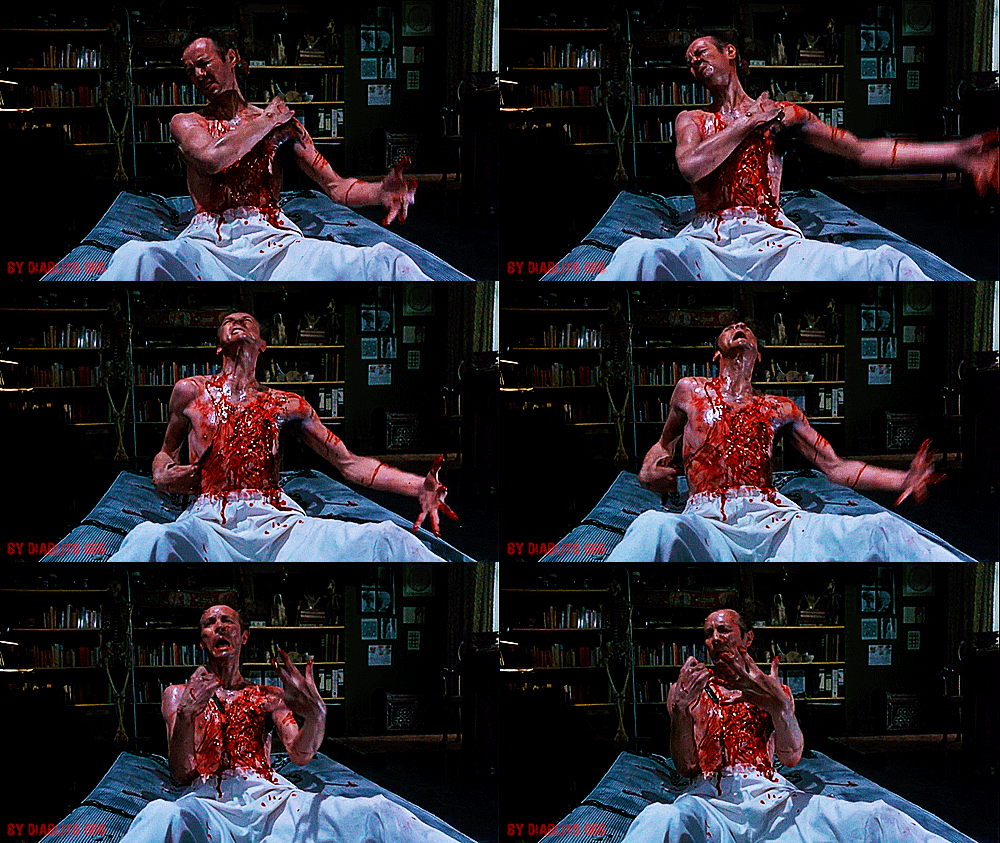
So clearly, this movie has gone to comicbook lengths to bring something crazy to the screen. But you know what? It remains crazy awesome!!! I haven’t read Clive Barker’s books (on which this is very loosely based), but I think we can safely assume that these actions would all much more carefully explained and tactfully justified in his detailed pages. As it turns out, the book on which Hellraiser was based (The Hellbound Heart) was quite short and only minorly addressed Pinhead and his Cenobites–so already the films have taken their own path. Meanwhile, in Hellraiser movieland, no one seems concerned with the disappearance of several patients.
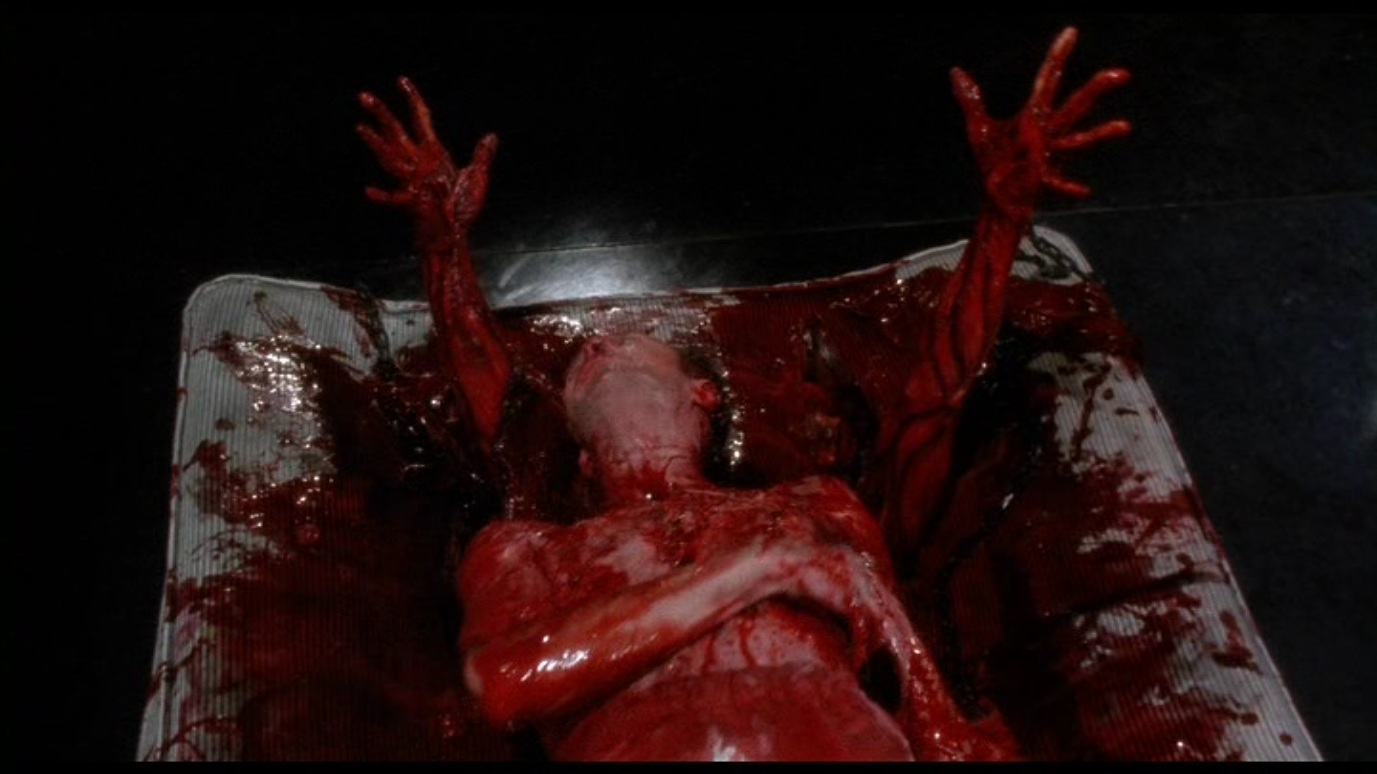
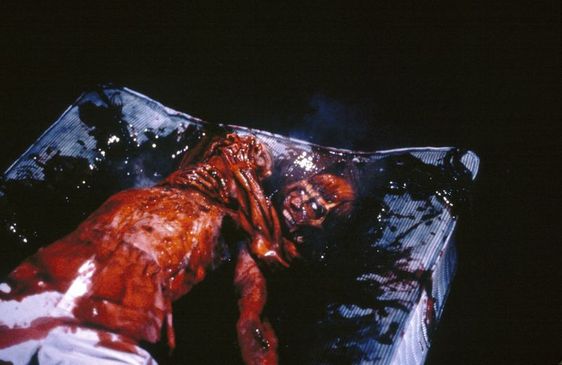
It may sound like I’m slamming the plot. I’m not. In fact, overall the story itself remains elegantly unique. After all, whatever liberties this director took in making this film, it is still based on Barker’s refined writing.

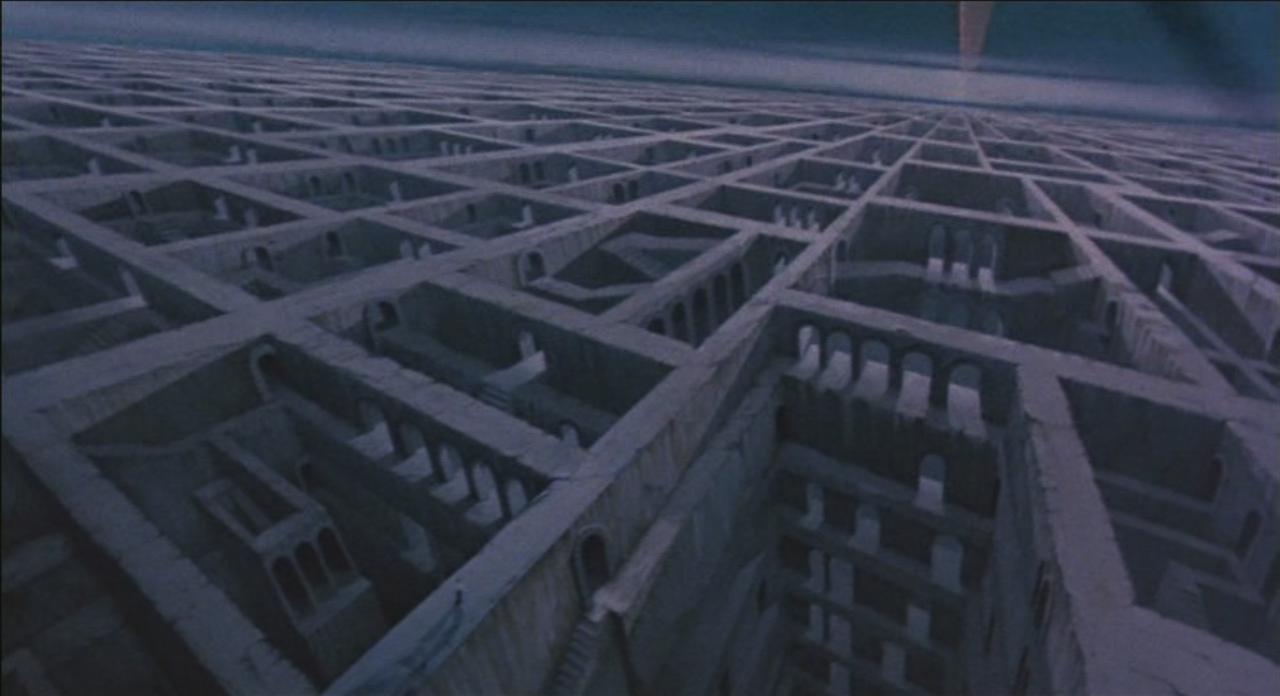
After Julia’s “resurrection,” she sexually beguiles Channard–even though she hasn’t any skin–to help fully restore her with more victims. He obliges and we get to enjoy a room full of life-drained corpses. But this isn’t enough for Channard. He wants to know and see the secrets of the Hell that is The Labyrinth. So he brings a mute patient with a knack for puzzle-solving to open the gate to Hell with the Puzzle Box.




Things get yet crazier as Channard and Julia wander the corridors of Hell. He gets transformed into a Cenobite himself (simply referred to as “the Channard Cenobite”) by the God of Hell Leviathan and is for some reason way tougher than Pinhead and his Cenobite gang. He kills loads of people with his stop-motion bladed hand tentacles, so Kirsty gets Pinhead to see his inner child and wears Julia’s skin as a suit. A lot of cool stuff is happening, FOR SURE!

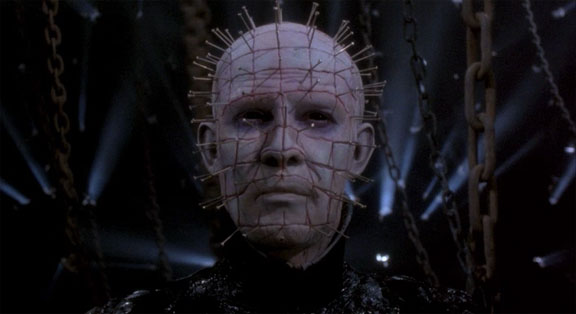
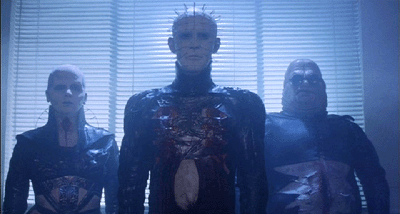
Whereas part 1 was entirely based on illustrating one man’s escape from Hell and the temptations required to accomplish the task, this sequel addresses that component just in the first act and then moves on to exploring the Labyrinth and witnessing various personal Hells while being swiftly introduced to how Barker’s Hell works and is ruled. Despite the busy plot of this movie (it does cover a lot), it remains very dark and creepy and, more importantly, the plot makes sense. We can’t say that about a lot of horror. Its gore-pleasing effects are abundant, the story pushes the Hellraiser franchise into a new dimension, and we learn more about the background of the Cenobites and the mythology behind Barker’s Hellish Labyrinth.

This movie is buckets of cool (and blood) and one of the more interesting horror installments (along with part 1) of its decade.
Watch it! Love it! Buy it! Watch it again!

Share this post:


.
The found footage world is a mixed bag of the good, the bad and the ugly. For every Blair Witch and Troll Hunter we get hundreds of The Gallows and Devil’s Pass movies. Occasionally, a weird little film climbs its way out the found footage wasteland and distinguishes itself via an original story, all-in performances and creepy masks that look great in movie trailers.
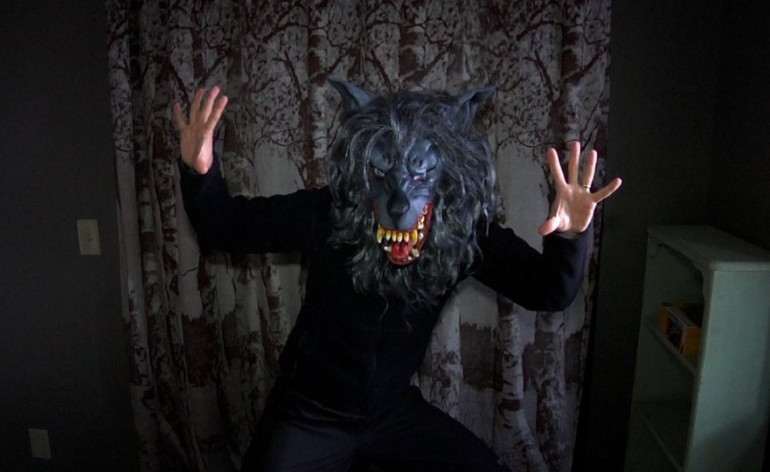
Creep is a semi-improvisational horror hybrid about a camera man answering a Craigslist ad. He will be paid $1,000 to film a man’s final moments before cancer and a brain tumor kill him in a few months. The final product will go to his unborn child and will provide a glimpse into his daily life. Things go wrong (of course) but the direction of Creep is never predictable. The dark humor, paranoia and performance by Mark Duplass create an immensely watchable 80 minute horror hybrid.
What makes this film work is that it doesn’t seem to be a cash grab or more of the same. It fits perfectly alongside the original and proactive horror hybrids that have been hitting the theaters in the last couple years. Mark Duplass (The League, Safety Not Guaranteed) and director Patrick Brice started filming with a five-page outline and over the course of a year it evolved into a tight little thriller. Here is what Duplass had to say about it.
In the case of Creep, there was no stress at all. We never were attached to this movie being released. This was an arts and crafts experiment from the beginning. This was the most unprepared we’ve ever been going into a movie — or I’ve ever been — and we just put it together as we went. Then we promised ourselves, if it sucks we just won’t put it out there. So that was very freeing and stress-free. Where the stress does start to come in is when your movie starts testing well and you realize you do have something but it’s not quite there yet. Then you feel the responsibility to make it good, and that’s the point where we brought in Blumhouse as a partner and really employed our smart director friends to help us figure it out. That was a little stressful, but totally worth it.
Creep has a grounded realism that focuses on two very lonely people. One person resorts to answering craiglist ads for money while the other has obvious mental problems. Together they form a weird duo brought together by loneliness. Their day filming spirals into a controlled chaos in which clues are unraveled and the term “Chekhov’s axe” takes new meaning.
Creep doesn’t reinvent the found footage wheel but it doesn’t go flat either. The footage isn’t nausea inducing and the video diary brings an organic vibe to a man holding a camera for way too long. If you are a horror hound looking for blood and guts you will be disappointed but you might be inspired by the nature of the movie. It is a tiny little thing that is getting national press. It doesn’t feature CGI and the locations are scarce but it features a good idea and enough vision to get it in front of audiences.
If you are looking for inspiration and want to create something in the film world I totally recommend you watch this film. It is simple, smart and builds to a brutal conclusion. Let me know what you think when you watch it!


 Movies, Films & Flix