Bad Movie Tuesday: What happens when the horror ends?
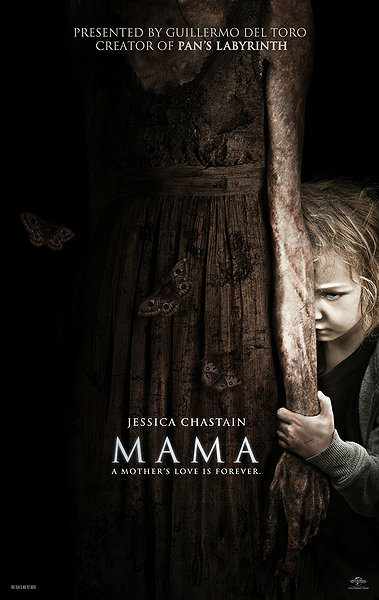
SPOILER ALERT!!! READ NO FURTHER IF YOU WANT THE PLOT OF MAMA REVEALED. Read John’s non-spoiler wonderful review of Mama here.
Throughout the course of my cinema watching career there have been certain moments, villains and spin kicks that are so bad they’ve become intriguing. They’ve left me thinking about the movie long after it has finished. This particular post will be about the ending of the film Mama. Mama is not a bad film. It is confidently made, well acted and original. There are several fantastic shots and it seems well thought out. I say “it seems” because the ending leaves the heroes in a terrible spot that will likely result in a long court battle and years of jail time. It is the ghost equivalent of “a dingo ate my baby!” The people are innocent but it will be hard to explain to the courts.
The ending of Mama goes like this. Mama gets jealous and kidnaps the kids. So, yada yada yada Mama takes one kid and leaves the other. Mama and the child fall off a cliff where they turn into leaves and blend back in with nature. This is where the real problem starts.
Have you ever wondered how the people involved in horror films are able to explain all the death and destruction once the bad demon has been destroyed? I pondered this conundrum when Mama ended. How will they explain a missing child, mummified aunt and crunched psychiatrist? All the evidence has disappeared and the evil demon has become one with nature again. I do not envy their predicament.
This post destruction phase could make for ripe narrative territory. They have to explain a missing child who was with them the entire time. I don’t think Matthew McConaughey’s Lincoln Lawyer could prove “innocence via angry ghost.” The jury could not literally handle the truth of the situation. There are no dead zombies, rednecks or masked maniacs lying around so there is no one to put the blame on. Also, the surviving man’s twin brother became murderous and that is why the kids ended up in the care of an angry ghost mama. So, no alibi, unbelievable excuse and history of mental illness in the family will spell doom for the survivors. Will Jessica Chastain ever play in her band again? Will Nikolaj Coster-Waldau hear that he looks like Jaime Lannister in prison?
These are not the thoughts one should be having after watching a film. I should have been basking in the wonder of all things Mama but instead was scratching my head at the vague ending. I’d compare this to running a disciplined marathon and running off course ten feet before the finish line.
What do you think will happen?
Share this post:

Pacific Rim (2013), an epic live-action anime experience

MY CALL. Effects. Effects. Effects. That’s why you wanted to see this movie. NOT for a good story! This is live-action anime. If I hear one more fool (who thinks he’s a deep thinker) criticize the story while overlooking the action I’m going to lose it. You can’t sound smart if your critique of the story suggests this movie is “bad.” IF YOU LIKE THIS WATCH: Real Steel (2011) and Transformers (2007) successfully captured similar action and CGI-robot combat choreography.

This is one of those movies that gets your over-critical friends saying “it just looks like a big blob of CGI.” Sure, the scale of this summer blockbuster-style film is TREMENDOUS. But, unlike the Transformers sequels, it doesn’t get away from itself. No. We still find some Guillermo del Toroisms, especially in creature-creation and preternatural market senes. The story, on the other hand, is quite simple. It strikes me as something out of a videogame or a futuristic Dungeons & Dragons adventure. It’s no Troy (2004). Troy was an epic-scale war story that–among some AMAZING action sequences–still allowed its viewers to intimately understand the characters. Rim is less (successfully) character-driven. A few things are revealed about the characters, but they don’t seem to “develop.” But why was this movie made, how was it marketed and who was it made to please? Probably not a bunch of stuck up plot critics. No, this was made for sci-fi effects and action junkies. So, if you’re not willing to check your critic’s hat at the door, then I suggest you just shut up and wait for the next giant monster fight when you go see this.
Through some manner of portal between tectonic plates deep below the Pacific Ocean emerge giant behemoths called Kaiju. These creatures come all shapes and plus-sizes.

There’s your movie. If you need great writing to accompany this, then shame on you.
To save humanity all of the world powers set aside their differences to pool their finances and engineer Jaegers, giant robots jockeyed by paired, mind-melded (aka, drifting) pilots. All seems to be fine–given that we are under attack by 600 foot tall abominations–until the Kaiju start winning! Though simple behemoths at first, subsequently emerging Kaiju are bigger, smarter fighters with more bells and whistles. The world powers begin to doubt the Jaeger program, whose director Stacker Pentecost (Idris Elba; The Losers, Prometheus) is running out of options.
Despite the simple story, there is a steady flow of information to keep us informed and updated about the Jaeger program and what we know about the Kaijus. It provides a nice balance between the action, which was delivered with a sense of uncertain urgency as to just how bad things were going to become for the Jaeger pilots in many situations. To put it briefly, the dire consequences of piloting a Jaeger are realistically depicted even as we enjoy a world-threat story in which humanity actually unites instead of letting our differences impede our success.
Pentecost turns to ex-pilot Raleigh (Charlie Hunnam; Sons of Anarchy, Deadfall) and Mako Mori (Rinko Kikuchi; Assault Girls), who get the most attention among several pairs of Jaeger pilots we meet. Mori is meant to strong and complex, but to me her character seems ill-imagined and entirely out of place. Raleigh isn’t perfect either, but at least he’s not another one of those “reluctant heroes.” There’s a little romantic interest there and I think it fails both in execution and contribution to the movie.

Raleigh and Mako suited up
Interspersed between pilot-Jaeger highlights we have a pair of bantering scientists who provide some silly, charming comic relief. Dr. Gottlieb (Burn Gorman; The Dark Knight Rises, Red Lights) is some sort of physicist and Dr. Newt Geiszler (Charlie Day; who brings a welcomed quirky performance) is some combination xenobiologist-neurobiologist-biomedical engineer.

Lastly, Ron Perlman’s Hannibal Chau is a Kaiju parts broker. Why is he in this? I’d just say because del Toro can’t seem to make a movie without him…Hellboy 2, Blade 2, Cronos.
Returning to the effects, the effects make this movie. They don’t “save” it. They make it a satisfying experience all on their own. The Kaiju each come with their own distinct appearance and fighting style, and the same goes for each Jaeger and its pilots. In fact, the Jaegers and Kaiju are presented as their own named characters. Amazing attention to detail was placed on the movements of these over-sized combatants, their surroundings and how they destructively plow into and through them. I already can’t wait to watch it again because so much was going on in each of these fights that I feel I must have missed a lot of clever nuance.

See this movie. Then see it again!

Share this post:

Movienomics: Explosions and Movie Posters
Hello all. Mark here.
It all started with “the overcoat discovery.” Movie posters featuring Jason Statham in an overcoat averaged a 70% critical rating on Rotten Tomatoes whereas posters featuring him in suits/cardigans only received a 40% average. Of course, correlation and causation are impossible to predict but I found the results of the analysis to be intriguing, cheeky and fun. This got me thinking about movie posters that feature explosions. Do explosions matter? Does placement matter? Is it a marketing trick? Why are people standing motionless whilst engulfed in flames?

Our crew at MFF compiled a list of 266 action film posters (one poster per film. We used the theatrical trailer) from 2000-2013. We set up a spreadsheet and sent the data to my Swedish number crunching cousin to analyze. What follows is an exploration of whether movie posters can make a difference on box office and critical reception.
Without further ado here it is! Do explosions matter?

Most mainstream movie critics will tell you that, of the many different factors that can effect a given movie’s success, the placement of explosions in a move poster doesn’t rank in the top 5. Or 10. Or 1000. We say, “Whateves, it does.” Their response to that would probably be something like, “Any relationship you found between placement of explosions in a movie poster and success would be spurious.” To which we would reply, “Whateves. No one would use the term ‘spurious’ in any movie with an explosion on the poster. I think Vin Diesel would get an aneurysm just trying to pronounce it.” That imaginary debate (and unnecessary slap at the greatest actor to ever drive fast and furiously) is all we needed to crack the whip and get our interns to work digging up some (surprisingly reliable) data.
Objectives and Methodology
We started with a basic question: is there a relationship between the placement of explosions on action movie’s poster and of the movie success. We defined success in two ways: critical and financial. Our outcome measures for critical success are the movies scores on the Rotten Tomatoes and Cinema Score websites. Our outcome measure for financial success was a given movie’s total domestic box office gross.
Our sample was all (or at least most) big-budget action movies released in the US between 2000 and the mid-point of 2013. Here is how all of those 266 movies did on our two measures of success:
| Table 1 | |||
|
Critical Success |
Financial Success |
||
|
Rotten Tomatoes |
Cinema Score |
Domestic Box Office (from Box Office Mojo) |
|
| Top quartile |
68.3% |
74.0% |
$132.4 million |
| Median |
46.7% |
62.1% |
$98.8 million |
| Bottom quartile |
26.0% |
50.0% |
$28.0 million |
As you can see in Table 1, action movies scored better on Cinema Score’s (CS) rating methodology than they did on Rotten Tomatoes’ (RT). Biggest benefactors of the CS-bump were Underworld 2 (17% on RT and 77% on CS), Bad Boys 2 (23% on RT and 80% on CS), and Transformers 2 (20% on RT and 76% on CS). We would also point out that the average action movie released between 2000 and 2013 made close to $100 million dollars. Top three grossing flixs were Avatar ($760.5 million), The Avengers ($623.3 million), and The Dark Knight ($533.3 million)

Explosions and Success
If you accept our premise that the inclusion of explosions anywhere on an action movie’s theatrical poster can influence its critical and financial success, behold Table 2:
| Table 2 | |||
|
Average Critical Score and Box Office (Domestic) Gross |
Percent Change |
||
|
No Explosion in Poster |
Any Explosion in Poster |
||
| RT |
48.0% |
44.8% |
-6.7% |
| Cinema Score |
63.0% |
60.8% |
-3.5% |
| Box office/Domestic |
$95,574,193.55 |
$103,339,639.64 |
7.5% |
Apparently, action movies with an explosion on their theatrical poster did about 4.5 percent worse on both measures of critical success (e.g., RT and CS scores) but did about 7.5 percent better at the box office.

Conclusion
If you are producer and want to make a few extra bucks at the expense of a few Oscar votes, slap some explosions on your movie poster. If you’re an art-house director who needs those Oscar votes to (ironically) shore up your indie cred, leave them off. Or not. Whateves.
Next in our Series on Explosions on Posters…
We break down success by location of the explosion in movie posters. Does it matter whether or not the explosion is on the left or right!

Share this post:

The Conjuring: Good Looking Ghostbusters + A Credible Villain + James Wan = The Scariest Movie of the Year
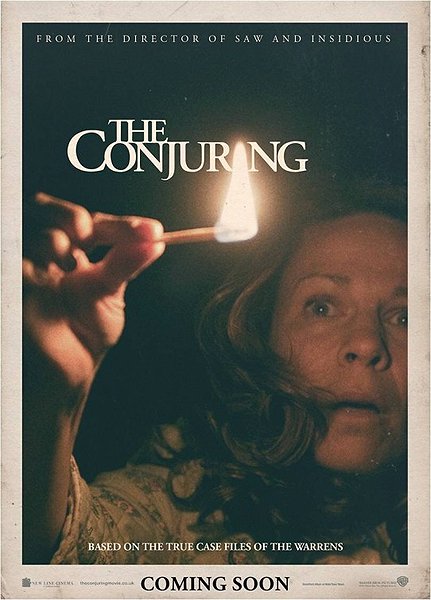
The Conjuring is a wonderful beast. The acting, storytelling and massive amounts of dread are proof of a director on the top of his game. James Wan directed the wonderful Insidious and proved horror can be told on a budget and not be a remake, sequel or prequel. Certain critics complained of Wan’s usage of Poltergeist themes but as Alonso Durade of The Wrap so elegantly put it:
The Conjuring doesn’t try to reinvent the tropes of horror movies, whether it’s ghosts or demons or exorcisms, but Fred Astaire didn’t invent tap-dancing, either.
James Wan has become a maestro of mini-budget mayhem. He directed Insidious on a one million dollar budget (that equals one minute of Transformer’s 3). He tells tightly knit stories in which family is important, demons are totally evil and the acting is always wonderful. Wan made the incredibly smart decision to bring back Patrick Wilson from Insidious and add the wonderful Vera Farmiga. Together they play the real life couple Ed and Lorraine Warren who believe they were put together to do the world good. Aside from being the world’s best looking paranormal duo they have grace, charm and the authority to go head to head with persistent spirits. The real life Warren couple has a huge following (lovers and haters) and they inspired The Amityville Horror which was one of their cases. What I like most about this couple is they have a locked room inside their house where they keep all the evil (?) artifacts. They don’t want them destroyed because the spirits will be released and they don’t want them in the populace because they will continue to terrorize. You have to appreciate people who risk their safety to protect the world.
I’d compare Wan’s two latest films to the Fast & Furious franchise (He will be directing the seventh installment). Fast may have ripped off Point Break and feature 35 mile runways but they are told with confidence, intelligence and insane action set pieces. None of the films are Shakespeare but they are effective money makers that have huge followings. They’ve found ways to created likable characters who battle something bigger then themselves (With the exception of The Rock).
What I loved most about Insidious and The Conjuring is the people involved are all very nice and the haunting are WAY above their heads. They get entangled with evil and will do anything to protect their families and friends. Unlike other films like Sinister where terror is caused by selfishness these films focus on family. You understand why they stay in the house and why they can’t leave. Sure, there are moments when they look in mysteriously opened doors but these moments lead to creative set pieces inside the foreboding house. Another thing Wan excels at is creating scary images that stay burnt in your memory. I still can’t get the Jigsaw puppet from Saw out of my memory and his red demon still haunts me. In a day and age of annoying horror films that feature nothing memorable it is nice to be scared by shadowy demons who don’t photo bomb or wear skin masks.
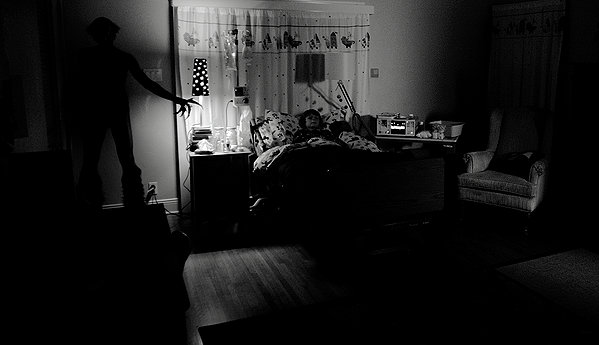
I don’t want to give away anything about this film. From the trailers you know clapping, matches, good music and retro outfits will be involved. However, the movie covers several genres and gives us a big bad who relishes causing harm. Stay away from the trailers, don’t read too much about it and allow it to scare the crap out of you. If you are a horror buff don’t go into the film looking to complain. Empty your mind and allow Wan’s film to fill your senses with constructive shots, fantastic set design and creepy moments.
Watch The Conjuring. Appreciate James Wan. Hope he knocks Fast Seven out of the park. Check off the days till Insidious 2.
Share this post:


One of the best horror movies of the year? What, did this come out on New Year’s Day or something?
MY CALL: I had fun with it. Just try to ignore that this is a remake of a classic trendsetter and take this for what it is: an 80s-style slasher movie in which gore is celebrated and a shower scene is simply there to deliver bare breasts rather than to convey a sense of vulnerability and “will she die” tension. IF YOU LIKE THIS WATCH: Black Christmas (1974), Halloween (1978) and When a Stranger Calls (1979) were also born in the 70s and do a much better job at building tension and testing our nerves.

In this is a remake of the 1974 classic Black Christmas, the girls of Alpha Kappa are again slaughtered
during Christmas break. Our Alpha Kappas include Kelly (Katie Cassidy; A Nightmare on Elm Street, Harper’s Island), Melissa (Michelle Trachtenberg; Buffy the Vampire Slayer), Heather (Scream Queen Mary Elizabeth Winstead; Abraham Lincoln Vampire Slayer, The Thing) and Dana (Lacey Chabert; Thirst). To prime the story the girls and their house mother Ms. Mac (Andrea Martin; Phyl of the original Black Christmas) retell the story of Billy the Black Christmas killer, his twisted childhood and his daughter…
This background story spends far too much time explaining why Billy is the way he is much as the Halloween (2007) remake did for Michael Myers. In fact, any explanation is too much explanation. Both Billy and Michael Myers were originally scary for the same reason: no one knew why they killed or what motivated them. They just killed without reason and it was terrifying. This attempt to justify the killer’s psyche is an excellent example of how exposition truly is the death of good horror.

MERRY CHRISTMAS!

Another unfortunate fault is that the sorority girls all have very similar personalities. Sure, one of them gets drunk (probably attempting to mimic Margot Kidder’s lushy debutante role from the original) and another is homesick, but under the surface these characters may as well be spun from the same mold. Stacking on the faults, this movie even failed to capture the creepiness of the call coming from “inside the house.” Not because it’s now been done so many times, but because it was too hammed up to be creepy. CALL “COMING FROM INSIDE THE HOUSE” FAIL!!!

This has a classically perfect set up. A bunch of attractive college girls are blizzard-bound in their sorority house over Christmas break and an escaped, murderous mental patient who used to live in their house is on the loose. Through homogenous characters and exposition the story is ruined. But through brutal, gory deaths an entertaining movie experience was salvaged-for those of us who are in to that anyway.


Billy? Is that you under that wig? Noooooooo…
The gore is brutal and abrupt. Our killer doesn’t toy with his victims once they’re within reach. He’s really quite the dynamic slayer. Early on he sets the pace when he gauges then tears out an eyeball with no warning from his still-living coed victim. In fact, eyeball-gore seems to be a pleasant theme, often accompanied by tongue-in-cheek cannibalism. We also get some brutally prolonged beatings-to-death, lots of stabbing, loads of gore, and some gore-slathered sound-editing to really bring it together. Some may say the sloppy-squishy sound effects were overdone. Perhaps…but overdone damned well! Gorehounds will be pleased for sure. I should add that the “falling icicle” death scene was hilariously perfect! The ice skate kill was also pretty damned special. All in all, only the sound editors and special effects folks demonstrated thoughtful approaches to their craft.

Try to ignore that this is a remake of a classic trendsetter and take this for what it is: an 80s-style slasher movie in which gore is celebrated and a shower scene is simply there to deliver bare breasts rather than to convey a sense of vulnerability and “will she die” tension. I had fun with it.
Share this post:


People love Melissa McCarthy. Her groundbreaking work in Bridesmaids made her a bona fide box office star and was a revelation for several reasons. It gave us a larger than life woman who was in charge of her surroundings, embraced her sexuality and loved puppies. She laid the groundwork for Rebel Wilson’s Fat Amy in the sleeper hit Pitch Perfect and she is the only reason Identity Thief made money.
Identity Thief is bad. The critics didn’t like it (20% Rt) and audiences thought it was rotten (58%). However, it collected $135 million at the box office. Nobody seemed to like it yet it swindled the audiences cash over a period of several weeks. Here is how it fared from February 8th-March 10th (35, 27, 14, 10, 6 million). The first week drop off was unprecedented. I recently wrote a piece about correctly predicting word of mouth hits. Identity Thief does not fall into the criteria of any of the films I mentioned. It is mean, scattershot and features Jason Bateman unnecessarily hitting Melissa McCarthy in the face with a guitar. Instead of being nice the characters are archetypes ranging from emasculated, insane, brutish and depressingly sad.
McCarthy works her butt off in the film. She falls, dives, swears, throat punches, runs slowly, cries, has an amazing perm and ends up redeeming herself. However, she is one of the most depressing film characters in recent memory. She is cartoonish to the point where her bones must be filled titanium yet has a fragile psyche due to some childhood trauma and abandonment. She wrecks lives, is desperate for attention and is ultimately redeemed in a cringe worthy manner.
To top off the cartoony realism the plot is absolutely incoherent. You will say What? Huh? When? Who? What? Really? No? Yuck. I will let Roger Ebert explain it.
Thanks to an idiotic premise involving Jon Favreau as the world’s worst boss, Morris Chestnut as Denver’s dumbest cop and John Cho as the world’s worst friend, it’s up to Sandy to make his way to Florida, capture Diana and bring her to Colorado. Then it’s up to the screenwriter to find ways to keep Sandy and Diana on the road together for a series of wacky escapades, when all Sandy has to do is pick up a phone, dial the authorities and say, “Hey, you know that woman who stole my identity and has committed hundreds of felonies? Got her!”
Ebert normally gave movies the benefit of the doubt. In my sleeper hit post Ebert gave Paul Blart: Mall Cop a positive review because he liked the nice characters. Ebert wasn’t an angry reviewer yet he saw through the zaniness of Identity Thief. Intelligence and practicality are sacrificed for throat punches, car chases and “Sandy” jokes.
Why did audiences flock to this film? Why did it hold up so well the second weekend? Box Office mojo explained it’s success like this:
From its clearly articulated, relatable premise to its broadly-appealing leads, the movie feels like it came off some kind of “comedy hit” assembly line, and Universal is reaping major rewards so far.
Essentially, the movie boiled down to people thinking it would be fun. On paper the teaming of Bateman and McCarthy is inspired and worthy of further exploration. Thief reminded me of the soul crushing Due Date. The film had a hot cast (Downey Jr. Galifianakis), was bashed by critics (39%) yet still cleared the 100 million dollar mark. Both of these films instilled faith in the cinema going public that they couldn’t be all that bad.
Alonso Duralde of The Wrap agreed by saying:
“Identity Thief the kind of cast that makes audiences ask, “How bad could it be?” before proceeding to answer that very question.”
Thief’s director Seth Gordon (who best film is still King of Kong) had a similar critically and audience reviled hit with Four Christmases in 2008. The cast was hot at the time (Vince Vaughn, Reese Witherspoon) and those famous people carried the film to $120 million. Four was absolutely soul crushing yet had such an amazing cast people went to watch it. A year later Couples’s Retreat with Bateman, Favreau and Vaughn went on to make $109 million with a abysmal 11% RT score. These movies made money because of the great casts but imagine how much money they would have made if they were good. Also, they hurt the long term marketability of the stars. Nowadays, Vaughn’s comedies are not doing so well with Dilemma, The Watch and The Internship all under performing.
People went to watch Melissa McCarthy do her thing in Identity Thief and instead had their time and money stolen. McCarthy’s latest film The Heat is doing well so all is forgiven. However, in order for McCarthy to retain her box office clout she needs to pay close attention to what made her famous in the first place. Bridesmaids will not be duplicated anytime soon but it did lay out a nice blueprint for success. It put characters first and built the gags from there. A silly character is not funny because they are silly. Characters are funny because you like them.
Don’t watch Identity Thief. Search out The King of Kong: Fistful of Quarters. Cherish Bridesmaids.
Share this post:

The Lone Ranger: A $250 Million Runaway Train
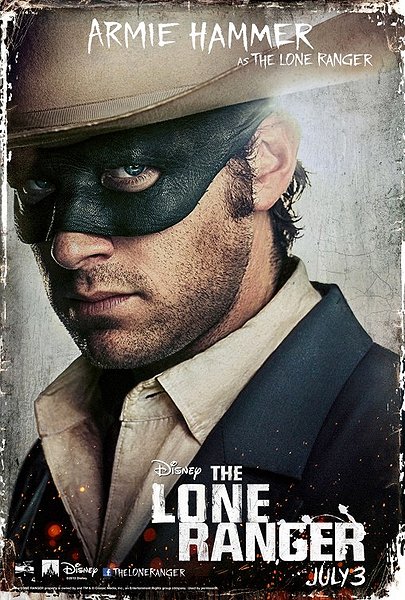
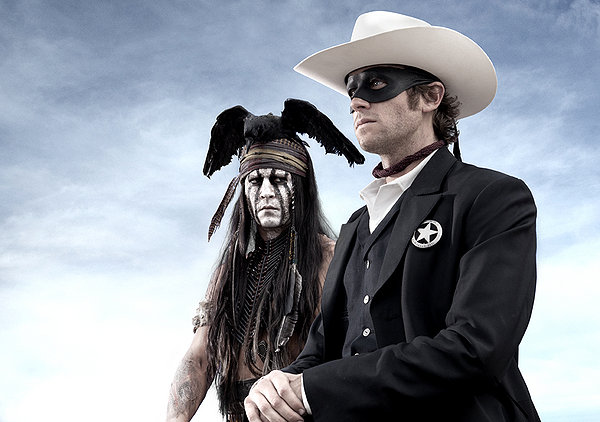
The Lone Ranger was slightly better than expected. I was thinking I was in for another Pirates 4/Dark Shadows/Tourist debacle in which copious amounts of money was spent and little is good. However, it is such an odd film full of violence, smart horses and surreal moments that it stands out amongst the traditional summer fare. The movie seemed destined to be a disaster with egos running high and bank accounts being emptied. The production suffered with inclement weather, chicken pox, wildfires and Verbinski, Depp and Hammer deferring 20% of their salary to keep the film on budget. It became a massively expensive machine headed to John Carter land. After the first weekend it isn’t looking good for the iconic outlaw. With a $50 million domestic haul it will be a miracle if it crosses $100 million.
The $250 million dollar price tag disturbed me from the beginning. Do you need that much money to tell the story of a lone ranger? The production budget of Verbinski/Depp’s Pirate of the Caribbean: The Curse of the Black Pearl was $140 million and it was loaded with sea battles, CGI and wonderful characters. Audiences loved it and it featured one of the best character introductions in recent memory. Watching Captain Jack Sparrow correctly gauge his sinking ships arrival at port demonstrated intelligence, insanity and luck which were defining traits for Sparrow. I’d argue that as the next three Pirates films budgets grew (225, 300, 250 million) the worse they became. There was too much money, too many egos and character creativity was lost amongst krakens, battles, bonnets and rum. The Lone Ranger is a product of excess and it faltered because of that.
The Long Ranger is massive, violent and odd. The director Gore Verbinski infused the film with heart eating, severed fingers and moments ripped off from the Pirates series. Gore and Depp originally wanted $260 million for the film but had to cut it down to $215 but THEN it went past $250 because Gore wanted his own trains built and sand storms straight out of The Mummy ravaged sets.
The finished product is a 150 minute mixture of cannibalism, cross dressing and Barry Pepper’s mustache. The movie wants to be Rango and Pirates but in the end it feels too bloated and convoluted to be a hit. There are moments of surreal brilliance but those moments are dwarfed by the sheer size of the film. The little moments and neat shots make this film worth the eventual rental or TNT viewing. There are fantastic shots involving Depp on a ladder, doing shadow puppets and staring quizzically at lawmen who leave him underneath a moving train.
The plot revolves around Depp and Hammer battling evil rich guys who want to collect silver and own all the continental railways. Of course, the bad guys kidnap the love interest (Ruth Wilson who is much better in Luther), wipe out many Native Americans and thankfully do not have mechanical spider legs (Wild Wild West) or turn out to be aliens (Cowboys & Aliens). It all leads to a final duel aboard two moving trains that is a fun blast of violence, creative usage of ladders and the William Tell Overture.
The Lone Ranger is a product of excess. I wish it would have spent more time with Hammer and Depp and less on making things look expensive. If a sequel is somehow made I hope they scale the action down and make more room for character. I’d like to see these two again.
Share this post:

John’s Horror Corner: Curse of the Puppet Master (1998), and what should have been the death of a franchise

http://shenanitims.wordpress.com/2012/10/10/curse-of-the-puppet-master-1998/
MY CALL: Hands down, the worst of the franchise. Even serious fans will likely find nothing but disappointment here. IF YOU LIKE THIS WATCH: Puppet Master (1989), Puppet Master II (1991; the most slapstick crazy of the first three), Puppet Master III (1991) and Puppet Master 4 (1993). Also try Ghoulies (1985) and Ghoulies II (1988). SEQUEL SIDEBAR: Puppet Master III (1991; set in 1941 and having the highest production value of the first three franchise installments) is actually a prequel to Puppet Master (1989), which occurs decades later in present day and is seamlessly followed story-wise by Puppet Master II (1991; which was the least serious, most zany installment). Puppet Master 4 (1993) returns us to present day after Puppet Master II. Puppet Master 5 (1994) picks up right where part 4 ended and marks the most noticeable drop in quality of any other franchise installments. But Curse just gets worse.
David DeCoteau (Puppet Master III, Dreamaniac) has returned to the franchise and is steering it catastrophically off a cliff. What’s wrong with it? SO MUCH! For example, the lead character may not be Toulon, but he behaves exactly like Toulon. Why? No apparent reason. Just bad writing. It doesn’t “mean” anything. MAIN CHARACTER FAIL!
Dr. Magrew (George Peck; Dawn of the Mummy) runs the “House of Marvels.” His star attractions are Toulon’s animated creations Blade (Parts 1, 2, 4 and 5), Pinhead (six movie veteran), Jester (six movie veteran), Six-Shooter (from parts 1, 4 and 5), Tunneler (six movie veteran) and Leech Woman (parts 1, 2 and 3), all of whom he purchased at an auction–we receive no further explanation of this shady backstory nor does the House of Marvels come into play later. So why bother telling us these things at all? Writing 101, people! You don’t put a gun on the wall in Act 1 unless it’s going to be fired in Act 3. PLOT FAIL!

http://shenanitims.wordpress.com/2012/10/10/curse-of-the-puppet-master-1998/
Ever since, he’s been trying and failing to create his own living puppets. This is another plot element that gets no proper development other than a ‘nod’ later in the movie. This could have saved the story. Instead, it just worsens it like a cancer because you really want to know more about these failed efforts–are they little monsters? DOUBLE PLOT FAIL!

http://shenanitims.wordpress.com/2012/10/10/curse-of-the-puppet-master-1998/
I would love to see how this little guy was made, and at what cost. Are there others? Do they all look like that. Folks, THIS idea is cooler than this whole movie!
To redouble his efforts Magrew hires a talented wood carver (Tank) to help him in his endeavors. Because clearly it’s good wood work, and not next-gen science or Toulon’s sorcery, that is holding him back from playing God! TECHNOLOGY FAIL! So Tank moves in with Magrew and his cute teenage daughter (Jane). For whatever reason, Magrew has no issue with moving a strange quiet man he just met like YESTERDAY into his house under the same roof as his cute teenage daughter. That’s a TRIPLE PLOT FAIL and a FERTILE VIRGIN DAUGHTER FAIL at the same time!

http://www.silveremulsion.com/2011/03/01/curse-of-the-puppet-master-1998/
Yeah, as if any hot-blooded man would move some strange dude who’s “good with his hands” in him and his daughter.
For whatever reason–hey, wait a minute. I’m saying “for whatever reason” a lot in this review. I think it’s because the writing and direction were so idiotically haphazard that I truly don’t know “the reason” that things are happening in this movie! Any, for whatever reason, Tank has nightmares that he is part puppet–like, for real, half-man, half-puppet. No clue as to why. In the first 45 minutes of the movie, these nightmares are all of the “action” we get, making this is, by far, the slowest and most boring of the Puppet Master franchise. DREAM SEQUENCE FAIL!

http://shenanitims.wordpress.com/2012/10/10/curse-of-the-puppet-master-1998/
Ahhhhhhhhhhhhh! Puppet parts!
Magrew transitions from a nice old guy with some puppets into a something of a sociopath. But with this change we find little satisfaction. The death scenes are few and only Tunneler, who drills a guy in the crotch while he’s bro-ing out blasting his pecs, seems to get any worthy screen time. To properly appreciate how underutilized the characters were I’d like to point out that a character named Leech Woman never shows us why she’s named Leech Woman. LEECH WOMAN FAIL!

http://witneyman.wordpress.com/2010/01/20/the-series-project-puppet-master/
Like this really couldn’t fit in their budget? Come on! This scene probably cost 10 bucks!
There were some lame blood splatter attempts, but the effects were clearly the worst of the franchise. The puppets were often poorly puppeteered rather than the classic stop-motion that Puppet Master fans craved, the body count was too low, the kill creativity was non-existent and, making matters worse, the movie basically just ended in the middle of a scene that certainly did not feel like an ending. What–did they run out of money at that exact moment? OUCH! ENDING FAIL!

http://shenanitims.wordpress.com/2012/10/10/curse-of-the-puppet-master-1998/
You know what? I just don’t care any more! SPOILER ALERT! The ending looks like this.

http://shenanitims.wordpress.com/2012/10/10/curse-of-the-puppet-master-1998/
Then this happens…then they roll the credits.
WTF? That’s it? For realzies? That screen shot is the last second of the movie?
Yes.
Hands down, the worst of the franchise. This FAILS us in every way imaginable.
Share this post:

John’s Horror Corner: V/H/S 2 (2013), another mixed bag horror anthology that’s worth a look for the adventurous

FYI: This should be treated as NOT SAFE FOR WORK.
So don’t come complaining to us when your boss peaks over your shoulder to your monitor and sees a dude in his underwear covered in blood (see image below). That’s on you! This is a horror post. I can’t make everything PG. LOL
MY CALL: Looking for a film that features mass suicide, demons, evil omen fetuses, zombies, cults, poltergeists, possession, aliens and disfigured murderers? Well, depending my interpretation of what I saw in the melee of clips from this film you may be in for all that and more…all be it in small doses. We get to taste a lot of stories and ideas and, if we don’t like one of the shorts after ten minutes, just wait ten more minutes for the next one to start. If you like anthologies then don’t miss this. IF YOU LIKE THIS WATCH: Some other fun, decent and/or clever anthologies include (in order of release date): Black Sabbath (1963), Tales from the Crypt (1972), The Vault of Horror (1973), Creepshow (1982), Twilight Zone: The Movie (1983), Stephen King’s Cat’s Eye (1985), Creepshow 2 (1987), Tales from the Dark Side: The Movie (1990), Necronomicon: Book of the Dead (1993), Campfire Tales (1997), 3 Extremes (2004), Trick ‘r Treat (2007), Chillerama (2011), Little Deaths (2011), V/H/S (2012), The Theater Bizarre (2012), The ABCs of Death (2013) and The Profane Exhibit (2013).
Episodic horror anthology meets found footage as the movie opens with a private investigator’s footage (taken by his assistant). They make their way into a home loaded with VHS tapes. What’s weirder than the lack of DVD upgrades are the other things they find in the house and its general semi-abandoned state.
Anyway, clearly the assistant never saw The Ring because she happily starts watching the tapes one after the other, alone! As she watches the videos, we watch the short films that comprise this episodic anthology. Like many such episodic horror films, the introductory story (called Tape 49) additionally moves on briefly in between the shorts with interesting developments.

These short films vary substantially in filming style, acting, gore, direction and writing quality. The second and third films were much better than the other two “tape” films, both of which were so mundane I’d be happier if they were altogether omitted at the expense of the film’s running time. Below is a summary of each short film and, sometimes, a cheeky quote…
Phase I Clinical Trials. After an accident a man (Adam Wingard; not the best actor) receives a prototype prosthetic eye. A part of the compromise of this “free” clinical trial is that it has a built-in recording device that remains on at all times. After getting home it appears that his recorder his short-circuiting on him because he starts to see blips of static, ghostly figures of dead people and general hallucinations. It serves semi-moderately well as a jump-scare flick which is brief tactlessly smutty. Overall I was unimpressed with this play on The Eye (2002 Asia, 2008 USA remake) which failed more often than it succeeded in shocking viewers despite serial attempts. Entertaining, I guess–but nothing special. Filmmakers: Directed by Adam Wingard (The ABCs of Death – Q is for Quack; V/H/S – Tape 56) and written by Simon Barrett (The ABCs of Death; V/H/S – The Sick Thing That Happened to Emily When She Was Younger).

A Ride in the Park. A cyclist wearing a head-cam goes for a jaunt in the park, during which he encounters an injured woman in the process of succumbing to zombiism. This is a straight-forward, blatantly predictable zombie short from the start, but it does a nice job illustrating the simplest domino-like cascading beginnings of a z-pocalypse with a pretty good sense of humor. The special effects are generally weak but I appreciate a good gross-out attempt when I see one–and a few playful attempts are made complete with visceral sound editing. Clever camerawork and good storytelling make this short film a strong success. Filmmakers: Directed by Gregg Hale (producer: Lovely Molly; Seventh Moon) and Eduardo Sánchez (director: Lovely Molly; Seventh Moon). Seventh Moon was quite lame, but this short film has earned Hale and Sánchez another shot in my eyes. Give’em a zombie script.


Safe Haven. This foreign horror short follows a film crew making a documentary of an Indonesian cult, led by “Father” who will lead them to immortality. The crew gets Father’s permission to film on his compound where we learn of some strange sexual conduct involving children. But our attention is quickly derailed as worst-case cultish scenarios play out before our eyes very quickly. The gore is VERY, VERY, VERY abundant, VERY well-executed and VERY in our face! This short becomes totally bonkers for all the right reasons and includes evil omen birth, animated evil corpses, demons, possessed behavior, mass suicide and exploding bodies. Did I mention the fantabulous gore? This is one of the best effects-driven shorts I’ve seen! Although the effects of the major demon were admittedly pretty weak, all else was nothing short of stellar given their humble budget. Filmmakers: Directed by Timo Tjahjanto (The ABCs of Death – L is for Libido) and Gareth Evans (Merantau, The Raid: Redemption) did a pretty rockin’ job with this. I’d like to see a feature length version of this with more amped up creature effects/design and, obviously, more story development.

“Wait. On 3? Or, like, 1-2-3…theeeeeen shoot?”

http://eddieraysmoviereviews.wordpress.com/2013/06/24/vhs2-or-these-tapes-are-not-that-fun-my-fuckin-review/
“Fear not, Father will save you.”

“Just breathe.”
Slumber Party Alien Abduction. Shot in part via “doggy-cam,” this short film is about three siblings, their friends and their dog, and a sleepover. After meeting the foul-mouthed, fun-loving kids their sleepover is invaded by annoyingly classic-looking aliens. The creature concepts, invasion, chase scenes and scares were of the lowest level of cinema and offered us NOTHING. I’m sure the filmmakers were trying to show us some clever style, but I found nothing of the sort; it just looks like a couple of simpletons made a dumb film that serves no other purpose than to warn would-be financiers away from supporting the director’s future endeavors. EXTREMELY BAD! And I’m normally good at finding the kinder angles for recommending most any horror film. Filmmakers: Directed by Jason Eisener (The ABCs of Death – Y is for Youngbuck, Hobo with a Shotgun).

Ahhhhhh! Not-scary aliens!

Ahhhhh! There they are again not being scary!
Tape 49. This is the story of the investigator and his assistant, who is watching the tapes as we, the audience, watch. This was done well and closes with an amazing, gory, intense, creeptastic finish. I was happy with this anthology canvas. Filmmakers: Simon Barrett (The ABCs of Death; V/H/S – The Sick Thing That Happened to Emily When She Was Younger).
Just because I disliked a couple of these shorts in no way means this wasn’t a fun experience. We get to taste a lot of stories and ideas and, if we don’t like one of the shorts after ten minutes, we just wait ten more minutes for the next one to start. If you like anthologies then don’t miss this.
Share this post:

It’s hard to put it any better than to simply say “the best horror movies came from the 80s.” The 80s spawned so many beautiful franchises and, down the road, remakes and reboots–for better or for worse. But even when sequels begin to go sour and remakes fail to do justice to the originals, we must acknowledge that it was a legacy of greatness that compelled horror filmmakers to simply not give up and keep trying.
Here are some of the greats, in no particular order, continued from PART 1.
(CLICK HERE TO GO TO PART 1)
6. Evil Dead 2 (1987) and, for that matter, Evil Dead (1981). These movies really changed the face of twisted and slapstick horror with a homicidal smile. While I also loved Army of Darkness (1992), I couldn’t help but to feel that the comedy to horror ratio was way too biased towards the comedy. That said, I still laugh through almost every minute. Practical effects, intensity and creatively re-architected scenes made the recent remake Evil Dead (2013) one of the best and cleverly made remakes of the last 10 years. Another of Sam Raimi’s Evil Dead-spawn was another of my favorite’s of the last decade: the gastrointestinal gross-out feature Drag Me to Hell (2009). Movies like these–when Raimi puts his lead protagonist through the ringer as if the UFC was crossed with Nickelodeon’s Double Dare–are just the best.
Classic! Homicidal severed hands and dancing, flying, soul-sucking demon-zombies.

The Cabin in the Woods (2012), Final Destination 5 (2011; and the rest of the series) and Tucker and Dale vs Evil (2010) all seem to be following the gore-slathered path to cult-classic-dom-ness secreted by Raimi’s vision. While each of these movies takes a completely unique angle, they all converge on that which simply works for the gorehounds in us.

Yummy.
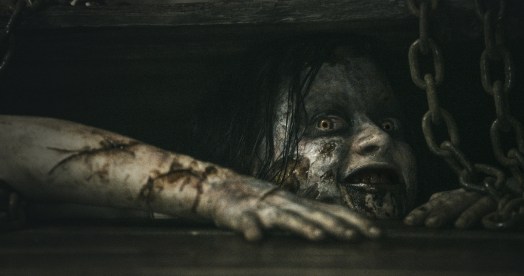
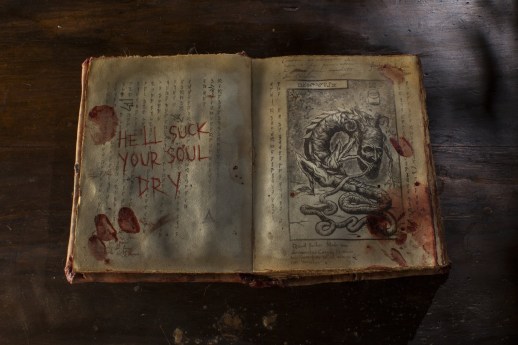
Thank you Sam Raimi. You’ve influenced so many other filmmakers with your work. Thank you so very much for breaking the mold and just doing what you felt like doing!

7. The Howling (1981). Werewolves taken seriously and done well! Perhaps the second best werewolf movie on the market and it takes itself quite seriously. I can still watch and enjoy this movie alongside new releases–and not because it’s so bad it’s good, but because it’s just plain good! This is the second only to An American Werewolf in London (also 1981).

There are a lot of major familiar faces in this movie. The director also took every possible chance to throw wolf cartoons, movies and books in the background, werewolf movie directors’ names for characters, etcetera throughout. This could make for a great horror geek drinking game!

8. An American Werewolf in London (1981). If you’re in the market for a great werewolf movie that has a sense of humor, then see this classic–hands down the best werewolf movie ever made! Steering clear of formulaic horror movie plot clichés, An American Werewolf in London avoids immature promiscuous summer campers and delinquent drug-using twenty-somethings with loose morals as we are introduced to more mature protagonists. Yes, they’re twenty-somethings. And yes, they have their quippy repartees. But their immaturity is no more than an otherwise responsible pair of men enjoying a night of manhood away from the wife and kids. They’re actually somewhat mature when things aren’t crazy.

They also fit in some well-placed dark humor in the form of an undead avatar sent to educate his killer and the movie audience just how the curse of lycanthropy works.
Both The Howling (1981) and An American Werewolf in London (1981) revitalized the lycanthropic subgenre, spawning a sea of new approaches to the mythos and unique moods. These movies also really ignited the celebration of the now-requisite “transformation scene.” A most dramatic example a la The Howling can be found in In the Company of Wolves (1984) and the recent Netflix series Hemlock Grove (2013).

This may have been the first depiction of a painful transformation scene.

In the Company of Wolves took a very provocative, shocking approach to the transformation–as if the wolf was tearing itself free from its prison of human flesh.

Whereas Ginger Snaps took a more contemporary approach to the transformation scene, making the “scene” the entire movie as Ginger slowly took on more lupine characteristics and personality traits.
Another fun-spirited were-film is Cursed (2005), which is loaded with clichés and honors many past horror flicks. Ginger Snaps (2000) brings us a metaphor for puberty, Ginger Snaps 2: Unleashed (2004) is a worthy sequel that takes a strange turn, and An American Werewolf in Paris (1997) serves as a coming of manhood from college man-childhood–but it’s more of a positive journey. If you want another utterly ridiculous werewolf movie, then move on to Howling II: Your Sister is a Werewolf (1985) and Howling 3: The Marsupials (1987). But skip Howling IV: The Original Nightmare (1988), Howling V: The Rebirth (1989), Howling VI: The Freaks (1991) and The Howling: Reborn (2011). The Howling series seemed to drop the ball swiftly after the original.
9. Aliens (1986). This is sort of a stretch, I know. While the original Alien (1979) served as a sci-fi with VERY strong horror elements (or, perhaps, a horror delivered in a sci-fi setting), this sequel was more of an action movie appeal accompanied by some scares. But I’m including it anyway because it was epic!

After all, if you’re going to do a make-up and prosthetics job like this on Lance Henriksen, then I get to call this horror.
After all, as H. R. Giger’s terrifyingly crafted xenomorphs converged on Ripley, Newt and the colonial marines it was nothing short of scary–the words “game over” come to mind. As we watched, we’d grip the theater seat arm rests, slouch down and press the back of our heads into the cushion as if it would get us farther from the screen. That was a little more than simple anticipation. It was a lot like watching The Thing (1982).

Everything about this epic film seemed to be done flawlessly. Such a precedent was set between this and its prequel (Alien) that you’d think no one would dare try to follow it up. But no….they did. Alien 3 (1992) came along. That was bust! Alien Resurrection (1997) was certainly fun. But it had more of an over-the-top Resident Evil appeal with each “stage” bringing its own unique background, a group of very different looking heroes and a variety of battle scenarios. It was a lot like Resident Evil: Retribution (2012). Oh, and Ripley’s clone baby albino alien thing from the “live birth?” Yeah, it got a little weird there, didn’t it? Then there was AVP: Aliens vs Predator (2004) and AVPR (2007), dozens of video games and comic book series, and even plush toys.

Most recently, Prometheus (2012) has come to change the face of the franchise while starting its own franchise (as there is a sequel lined up). In a series called Prometheus Vivisected I look in great detail at the continuity between Prometheus and Alien including the monsters.

10. Hellraiser (1987) and Hellbound: Hellraiser II (1988). Hellraiser was something truly original and creepy. Naturally, following in the footsteps of so many other franchised horror movie series, the story was continued with a sequel. The best quality of this sequel was that Hellbound managed to capture everything that fans loved about the original, added more character and story development with well-formed characters and thoughtful writing, and the sequeled story was told in such a different way that it both functioned as a solid stand alone film as well as a great next storytelling step for the franchise with its own entirely different style.

Hellbound brought us the Cenobites, and they were about as varied as any crew of horror antagonists. It wasn’t really until the Puppet Master (1989) franchise that we met another “team” of recurring horror villains, each of which with their own power, personality and appearance. I mean, The Texas Chainsaw Massacre (1974) sort of did this, but the Sawyer family was usually divided into two groups: Leatherface, and then all the other crazy disorganized Sawyer family members.

Meet the Cenobites: Butterball, Pinhead, Female and Chatterbox. They kind of look like they belong in an 80s death metal band, don’t they?
It’s a shame that the franchise lost its way as it was continued in the 90s. Hellraiser III: Hell on Earth (1992) was admittedly funny–the first of the series to embrace B-horror humor. But the first two movies were completely series, brutal in fact, and suspenseful. They weren’t B-horror movies. They were seriously well done horror films! So, however entertaining this third installment was, this B-style humor harbingered the major quality drops to come in yet future installments…Hellraiser: Bloodline (1996), Hellraiser: Inferno (2000), Hellraiser: Hellseeker (2002), Hellraiser: Deader (2005), Hellraiser: Hellworld (2005), Hellraiser: Revelations (2011). That’s nine movies! Well…I guess even though I don’t think they do the franchise justice, clearly producers have been comfortable with the prophet margins.

A message from the filmmakers of more recent Hellraiser installments.
I doubt we’ve seen the end of this franchise. In fact, given recent Hollywood trends, perhaps Hellraiser is do for one of those remake/reboot/re-imaginings. It hardly needs it, but that tends not to stop Hollywood from making a buck.
CLICK HERE TO GO TO PART 3


 Movies, Films & Flix