–
This video is totally false proof that Michael Myers knows how to drive.
The only thing that can stop an unstoppable force is a red traffic light. For over 40 years, Michael Myers and his driving skills have been scrutinized and mocked. How did a “shape” who lived in a mental institution learn how to operate a vehicle? Michael’s driving in Halloween, Halloween 4: The Return of Michael Myers and Halloween 5: The Revenge of Michael Myers has never bothered me because the driving was erratic and jerky. The driving that bothers me is in Halloween H20: 20 Year Later because he made a 1,994 mile trip successfully — with zero citations or tickets. In the film Michael drives from Langdon, Illinois to Hillcrest Academy in Northern California in a daring feat that raises a lot of questions.
- Does he wear the mask when driving or siphoning gas?
- Did he listen to the radio?
- How does he deal with merging onto highways? Is he cool about it?
- Does he dislike people who drive slow in the fast lane?
- Does he not know how to fix a flat fire?
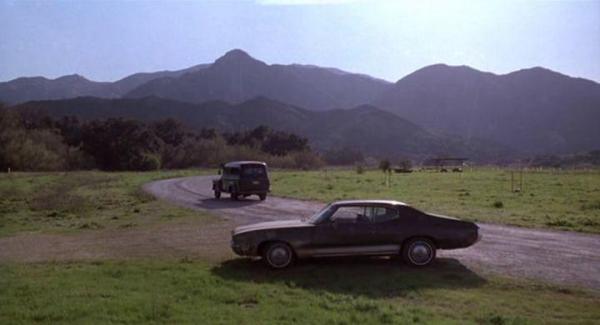
.
I remember loving the film as an impressionable 15-year old punk. The movie had thrills, Dawson’s Creek-esque dialogue and Jamie Lee Curtis going on the offensive. However, I’ve never liked that a mysterious shape could drive cross-country. Michael Myers works best as a mysterious murderer who doesn’t have parent issues and could care less about following traffic rules (or laundry). He had to navigate a lot of terrain on his journey which means he had to follow the rules and not murder people who cut him off. The trip took him an estimated 43.5 hours. Here is the timeline (with some guesswork and actual times from the movie):
October 29 – 5:30PM – Leaves Langdon in a stolen 1971 Buick Skylark. A handy grandfather clock states that it is 5:30PM.
October 31 – 9:00AM – Michael steals a 1956 International Harvester Travelall at a rest stop off Highway 139 in Northern California.
October 31 – 10:00AM – Arrives in the fictional town and cruises around a bit before he settles on main street at 11:00AM
October 31 – 1:00PM – Follows Laurie from the downtown area and finds out where the school is.
Total time: 43.5 hours
Breakdown of hours
32 (driving Highway/Susanville) + 5.5 (refueling) + 2 (waiting on main street) + 1.5 (waiting at rest stop) + 1 (eating? He eats rats in Resurrection…dude needs snacks) + 1.5 (nap?) = 43.5
Michael left Langdon on October 29th at 5:30PM in a 1971 Buick Skylark and drove all the way to California. He was forced to stop close to his destination when an unfortunate flat tire forced him to stop at a rest stop along Highway 139. During the trip he had to make at least nine pit stops to refuel because the 1971 Skylark only averaged 15 miles per gallon and the 15.2 gallon gas tank only got him a maximum of 228 miles. I think it might be easier for him to refuel at night but according to the math he had to make five daytime gas stops. That had to get kinda complicated because he had no money, doesn’t talk and didn’t steal any cars.
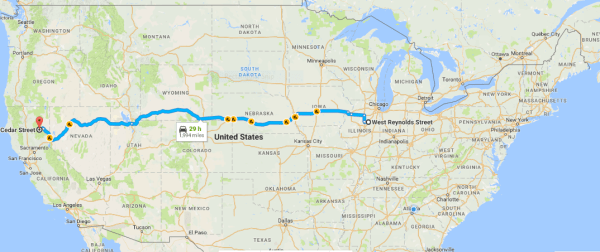
To make it in 29 hours like the map states he would have to drive 68 MPH. I don’t buy it so I slowed him down to 63.2 MPH. 63.2 X 32 hours on the road = 2.022.4. He covered 1,994 miles on the various highways and 28.4 on Highway 139 and various other roads after he found the school.
Since Langdon and Hillcrest are fictional, I found cities that are relatively close to the locations. Landon was in Livingston County, Illinois so I found a town that had a similar population. Then, I looked along Highway 139 in Northern California and picked Susanville due to its proximity to the highway and Yosemite State Park (because there is a convenient school trip there). The locations aren’t exact, but, I was working with fictional towns so I had to make an educated guess.
After coming up with the distance and car information, I started thinking about Myers using his blinker while making turns or switching lanes. There is nothing less frightening than thinking about him casually flipping on the blinker to make a left turn. After looking at the directions Michael had to use his blinker AT LEAST 17 times (per google maps) if he always stayed in the slow lane. If you add the nine pit stops to exit the highway and his cruising around the small town, that is somewhere around 40. Thus, Michael Myers the unstoppable killing force had to use his blinker 57 times. Immortal demons with pitch black eyes should never be bothered with speed limits, rear view mirrors and potential zipper merges.
There you have it! Michael Myers successfully completed a long drive and never got pulled over.
Make sure to listen to our Halloween podcast where we break down the jerky antics of Michael Myers.
If you liked this post make sure to check out my series featuring random data and useless numbers. Start with my groundbreaking post about Deep Blue Sea and Stellan Skarsgard and work your way down the list!
- Jet Ski Action Scenes Are the Worst
- A Closer Look at Movies That Feature the Words Great, Good, Best, Perfect and Fantastic
- An In-Depth Look At Movies That Feature Pencils Used as Weapons
- Cinematic Foghat Data
- Explosions and Movie Posters
- The Fast & Furious & Corona
- Nicolas Sparks Movie Posters Are Weird
- Predicting the RT score of Baywatch
- The Cinematic Dumb Data Podcast
- What is the best horror movie franchise?
Share this post:


I was a fan of the Evil Dead (2013; podcast discussion) remake since day one. Our crew recently discussed the film during our Fede Alvarez Podcast Episode (summary HERE; stream it HERE) and there wasn’t much agreement as to its merits or flaws. And while I realize the highly divisive horror patronage is littered with those who would disagree with me, I wanted to share 10 things I really appreciated about the film in greater specificity than I had previously addressed in my rave review of the remake.


1. A dedicated cast and star. The hardest thing to reproduce is what isn’t in the script: dedication. Jane Levy was put through the ringer for this movie. Consider the sum of her scenes imparting uncomfortable physicality. All the vomiting, crawling through mud, tree assault, being covered in muck…she went through a lot and took it in amazing stride much like Alison Lohman in Drag Me to Hell (2009) or Jo Beth Williams in Poltergeist (1982)—other . She even endured being raped and impregnated by an evil spirit’s regurgitated vomit vine! Between this performance and her subsequent team-up with Fede Alvarez in Don’t Breathe (2016; podcast discussion), I think it’s fair to not only suggest that they make a great team, but that Levy is the on-screen soul of these films.


In the past I’ve praised some actresses for what they physically endure on film: Jo Beth Williams (Poltergeist), Jenny Spain (Deadgirl), Isabelle Adjani (Possession), Elma Begovic (Bite), Linda Blair (The Exorcist), the entire cast of The Descent, Monica Belluci (Irreversible), the women of Martyrs, Charlotte Gainsbourg (Antichrist, Nymphomaniac), Alison Lohman (Drag Me to Hell), Danielle Harris (Halloween), Caroline Williams (The Texas Chainsaw Massacre 2), Jane Levy and Elizabeth Blackmore (Evil Dead), the cast of The Human Centipede films, and all actresses from the I Spit on Your Grave films, that poor victim in Cannibal Holocaust, the women of all other TCM old and new, and Last House on the Left films/remakes/sequels.



By the way, I know those Evil Dead tree rape scenes are tough to watch. If this is unnerving you about future afternoon strolls in the park or planting a shade tree on your lawn, maybe look into 11 Trees I wouldn’t want in my front yard (or our Podcast Discussion on those Nasty Trees).


2. A dog by any other name… I was particularly impressed by the use of the dog in Evil Dead (2013)—subtle yet powerful. Rather than simply barking in the presence of evil and being a canary in a mine shaft, this dog was introduced as a point of comfort while revealing a psychologically traumatic experience to come: the cold turkey cleanse. That poor dog (named Grandpa; likely implying a tough family loss) becomes a victim—we don’t see it transpire much, although it’s powerfully and brutally insinuated. Quite contrary to the standard employment of dogs in horror it never goes after anything, never barks to warn anyone, and never stays close as if watching over anyone. No…this dog is symbol of Mia’s humanity…and how much of her soul remains intact over the course of the film. When Grandpa is found moments shy of death in the shed, Mia’s possession-compelled actions boil and blister the last of her humanity. And when Grandpa dies, so lost is what we once knew of Mia. Grandpa’s journey parallels Mia’s, and serves as the inverse measure of the demon’s hold on her.

You’re all free to accuse me of reading too much into this or manifesting meaning where there’s none. But the moment we were introduced to that dog on screen and Mia uttered his name I quivered when she called him Grandpa.
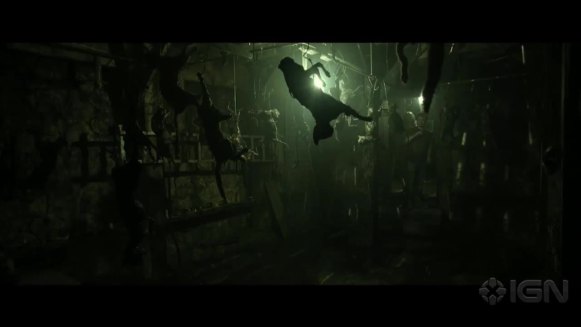
3. Why stay in the house? This intervention crew (i.e., Mia’s friends) is dedicated to task. Because really…shouldn’t they have relocated? Yeah, I said it. I know for horror movies to work we often rely on the stupid decisions of our protagonist victims. But come on. There was a weird smell and they discovered 89 brutally gutted animals hanging from the ceiling in a putrid state of decay in the basement. It may not have been the smartest decision to stay, but we all aren’t the smartest, are we? But perhaps they should have stayed.

They stayed out of dedication and love, however misled. We are informed that Mia had endured (and failed) detox interventions and her brother warned that she’d probably not “survive” another. They had to do this now—dead cats and creepy barbed wire books in the basement or not. It may not be the best justification for staying in that “murder cabin” which was broken into for some clearly satanic ritual and basement pyre using the most frighteningly gift-wrapped book ever…but it’s still a justification. Think about it. At least they gave us one—and it’s one that some of us may have even endured ourselves.
4. Not everything need be explained. And what about those cats hanging in the cellar? The film doesn’t take the time to explain why they’re hanging there. They’re just there. If you understand their connection to witchcraft and cleansing, then you do. If you don’t, you can either inquisitively look it up or remain baffled as if it was just there for the sake of being effectively gross set design. As someone who understood its significance, I appreciated it. If you want to know more about the stimulating topic of historical felicide and its links to witchcraft, start digging into the internet. A similar such reference surfaced completely unexplained in Warlock (1989): “You are to be hanged, and then burned over a basket of living cats.” You can bet your ass I spent a few hours online reading historical accounts linking druidic practices to Medieval Spring Festivals with animal sacrifices and, ultimately, the burning of cats (an animal with purported connections to the Devil) beneath a hanged witch to cleanse all links of evil.
5. Less is more. Especially when talking about Evil Dead cabins, less is more—in that a tiny cabin can somehow house an epic chase scene (after Ash) featuring an unseen force tearing through the framework traversing an unreasonable distance. This was a replayed concept in this remake, but it wasn’t replayed at nearly the same volume. In Alvarez’ hands, it was more tactfully and realistically handled.
I love the floorplan. I think the Zillow listing should read “a quiet, secluded getaway—your cabin in the woods can be both cozy yet surprisingly spacious.” And by spacious I mean that basement was huuuuuuuge (kind of like Ryan Reynolds’ basement in The Amityville Horror remake). It was like a room with a hallway that then led to the murder room—and apparently longer than the entire cabin’s floorplan. And, oh nature. Since 2013, only The Hollow (2015) could match the forestscapes that graced the genre. I know what you’re thinking: “John, what about The Forest (2016)?” And to that I’d warn that however nice those woods looked (or however good Natalie Dormer looked), don’t watch that garbage movie (“Forest Horror” podcast discussion here).
6. Clichés do not equal flaws. A cabin in the woods done right is still a trope, but landing a well-executed trope is an art. Our victims find themselves stranded when recent rainfall causes flooding, marooning them on their secluded elevation with their ill-fated cabin. Some viewers apparently thought this was ridiculous. To that I must contest—is it sillier than what happened to the bridge in Evil Dead 2 (1987)? And secondly, have you naysayers ever been camping in the mountainous woods?
As a biologist, I’ve done quite a bit. And in 2011 a colleague and I couldn’t even reach certain campsites due to flooded roads and wet erosion-uprooted trees in the mountains (the Ozarks). You see, in the mountains 2” of heavy rain means waaaaaay more than 2” of water, as all that rolls downhill. The same thing happened to me in northern Queensland, Australia when I was “trapped” for a week after a tropical depression and after all the rain stopped. The point I’m making for the skeptical flat-land-dwelling city slickers out there, is that heavy rain in or near the mountains results in flashflooding (all the time), much as you may have seen here in Evil Dead (2013) and in The Damned (2013; the highest grossing film of the year in Colombia, and bearing much Evil Dead influence). It doesn’t always take the forces of evil and warped bridges to strand someone.
7. The Locomotion of Evil. The original Evil Dead (1981) presented demon-possessed victims lop-sidedly dancing above the ground. Their bobbing levitation was erratic, disconcerting; clearly inhuman. Rather than duplicate this, the present remake instead alters body control in lieu of demon-possessed minds. As limbs swing to attack victims they do so with a lack of proper coordination…almost as if the arm was being swung by an external force. This is especially evident when the one-armed Natalie (Elizabeth Blackmore) swings a crowbar at her boyfriend. It feels darkly purposeful, as if the macabre puppeteering of the limb leaves no hope for remorse by the attacker. That, and the twitching. I liked the twitching. Reminds me of trying to start a car with a weak or dead battery, or trying to pull on a glove that’s too small.

The loss of control is terrifying in horror movies as well as reality. You don’t need to have seen A Nightmare on Elm Street 3: Dream Warriors (1987) to have a fear of awakening paralyzed during surgery. Even waking up after sleeping on your arm can be more than a bit unnerving. Now imagine the apparent loss of control is in the body of a loved one, staggering towards you thrashing a sharp object with wildly erratic semi-limp arm. Yeah, it’s weird!

8. Iconography need not equal repetition. Some criticize these new characters because none of them had the singular impact of Ash. But no character ever will hold a candle to Ash—too much of our horror history and education compares to him and he is a horror icon. So why try? Instead Ash’s quotables are rephrased and divided among the characters. The same is done with the most famous scenes (e.g., the evil hand severing, who gets bitten, who takes charge for what reason and when, chainsaws and electric turkey carvers, locked in the basement), leaving no one completely helpless nor any one character the most probable or obvious hero (which I admit has some inherent fault to it, not having a clearly identified hero).
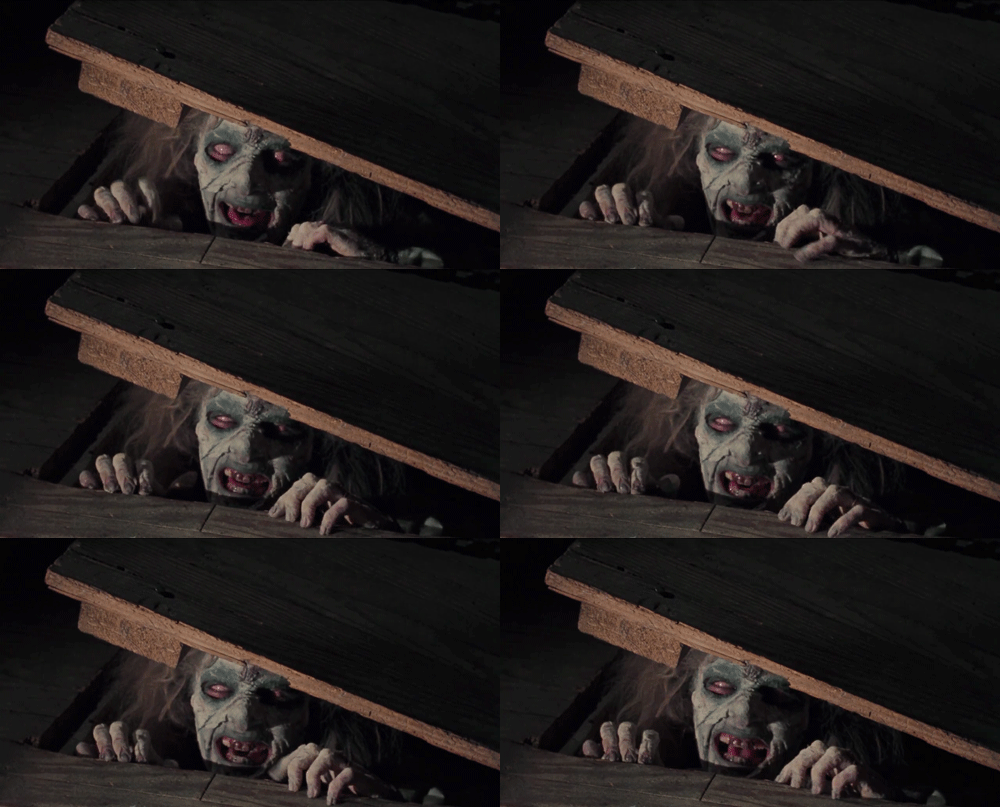

If you go to a remake because you love the original, you shouldn’t be disappointed when you witness something different. Did you really want a carbon-copy of the same script simply executed with different actors and filmmakers? Probably not. Those of you who actually want modern play-by-play remakes should recall Cabin Fever (2016) or The Thing (2011; a prequel/remake). If your love for the original was so easily befouled, you shouldn’t have gone to see this remake in the first place. There, I said it. Me? I go see them either way. God forbid someone try to give a product their own ideas or spin. It may suck, sure. It might. But what percentage of horror movie releases are awesome to begin with?
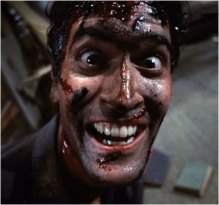

9. It’s actually scary. Having now seen this movie three times (I know, not a lot, but enough), I can comfortably say this movie is a bit jarring. Basically nothing makes me jump anymore. It’s all internalized and, even if scared/jumped/shocked, you would never know it even if you were watching me closely. I won’t even flinch typically. That said, in this remake there were moments I knew were coming yet still their execution and imagery managed made me jump (a bit). Any such surprising scenes in the original would be accompanied laughter (by me, anyway—I’m pretty sick). But some of the remake’s scenes still get me and put me on edge. Not an easy task. Bravo, Fede!

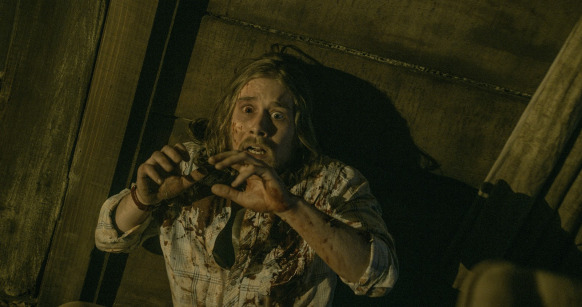

10. The filmmakers knew they’d get flack. Fede Alvarez (Don’t Breathe) knew exactly what he was getting into when he signed on for this. The moment new remakes are announced, the world population of horror fans divide into groups: those who are excited for anything honoring their past loves, those offended that anyone would consider remaking something that “doesn’t need to be remade,” and those in the indifferent crowd who will eventually see it either way when it hits Netflix or Redbox. Just look at the internet reactions to the remake of Stephen King’s It (2017). Many are excited, but the overall consensus isn’t exactly a confettied welcome party like the final scenes of The Phantom Menace or The Force Awakens. Fede took a risk and I think it paid off well. Not just in terms of money, but respect. Sure, you might not have loved this—you might have even hated it. But I loved it. And no one film is designed for everyone.
If you enjoyed my cinematographical deconstructive analysis, please check out my comparison of 2011 and 1982’s The Thing and John’s Horror Corner presents: Critically comparing the Poltergeist (2015) remake to the original Poltergeist (1982).

Share this post:

The Mermaid (2016), a mermaid assassin’s bonkerstastic Chinese action-fantasy love story.

MY CALL: Highly recommended to fans of bonkers Asian fantasy-adventure films. And no, I don’t mean high octane action or crazy stunts, I mean conceptually bonkers. MORE MOVIES LIKE The Mermaid: For more mermaid movies try The Lure (2015) or Killer Mermaid (2014). Want more Asian fantasy action or bonkers Asian-influenced adventure? Try The Devil’s Sword (1984), Crouching Tiger Hidden Dragon (2000), Shinobi (2005), Legend of the Tsunami Warrior (2008), The Good, the Bad and the Weird (2008), The Warrior’s Way (2010), The Painted Skin (2012) and Tai Chi Zero (2012).

Kung Fu Hustle (2004) was pretty silly at times, but knew when to reign in the silly for dire urgency. This film is more deliberately stupid, even slapstick, and feels suitable for children…at first, anyway. We even get a nonsensical lesson in the fairy tale evolution of the mer people—grounded in some Waterworld theory that diverged the “descendants of apes” into man on land and merman by sea. Seems legit.

This was rated R and, for most of the film’s duration, I fail to see why. In the beginning, it’s really more childishly cutesy than anything—with a more PG murderous slant to it. Shan (Yun Lin; Journey to the West: The Demons Strike Back) is a mermaid sent to assassinate Liu Xuan (Chao Deng; Detective Dee), a developer who threatens the ecosystem of her dying mer-race. Somewhere during her humorously botched attempts to kill him using sea urchins and poison, she instead shows him that money isn’t everything and they end up falling for each other.
The film makes a strong pro-environmental statement. Our greedy mogul Liu buys an environmentally protected island, procures a reclamation permit to develop the land, and commissions some sort of super-charged sonar devices to repel (errr…explode) marine life. It turns out the island he bought was home to Shan’s mermaid clan (including Chi Ling Chiu and Mei’e Zhang), who live in a shipwrecked tanker where they take refuge from Liu’s sonar death rays.
The CGI is poor and the wirework is weak and executed too slowly, making long jumps appear more like floating in Willy Wonka’s bubble room. The only effects I appreciated were the Octopus man’s (Show Lo; Journey to the West) cephalopod legs. We get a lot of that and he really steals the show!
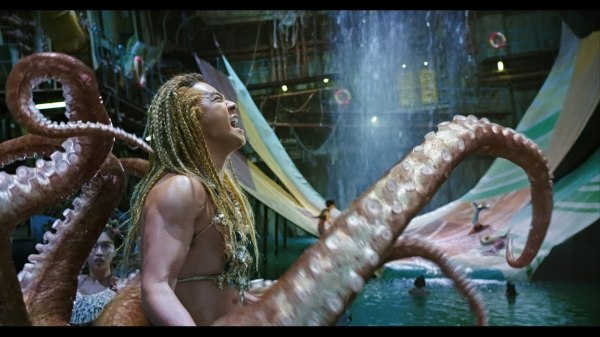

Overall I wasn’t very impressed with the cute aspects of the film—although, admittedly, many would favor that sort of warm fuzzy Anime-romance propelling us from first date “I love yous” to a second date proposal. However, there was one scene that had me howling-laughing out loud for its entire duration. The “octopus teppanyaki scene” is absolutely worth the price of admission and perhaps the first scene worthy of a PG-13 rating since…well…we basically see Octopus get unassumingly tortured, with his tentacles chopped up and “cooked” in a sort of classic comedy scenario right in front of him. His face is priceless! Another hilarious part was the “police station scene” complete with silly sketch art. And don’t even get me into the pants-crapping sonar test bit.
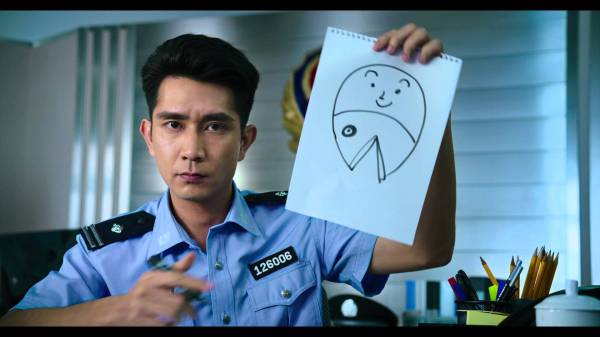

“Was this her?”
As we move into our final and most violent third act, things shift more into the “hard PG-13” stage that apparently earned this an R rating. There’s no nudity, sex or profanity and there is no direct on-screen death (although much is implied and we witness several harpoonings and gunshot injuries).
Director Stephen Chow (Kung Fu Hustle, Shaolin Soccer, Journey to the West) mixes seafaring folklore with Asian action cinema. If you think you’re about to watch The Little Mermaid (1989) meets Kung Fu Hustle (2004), just know it’s going to be much closer to the giggly former than the latter despite a lot of third act mermaid slaughter. And the action is not top notch—just passable. But Chow does deliver all the zaniness you’d expect with his Kung Fu Hustle roots. In addition to the scenes mentioned above, we have fishtail water sorcery smacking of an aquatic Dumbledore and the complete mermaid lair raid insanity including a mad marine biologist shooting machine guns and a leather-clad wealthy realty executrix (Yuqi Zhang; CJ7) giving kill orders and harpooning her business partner as if the two were employed by Doctor Evil!
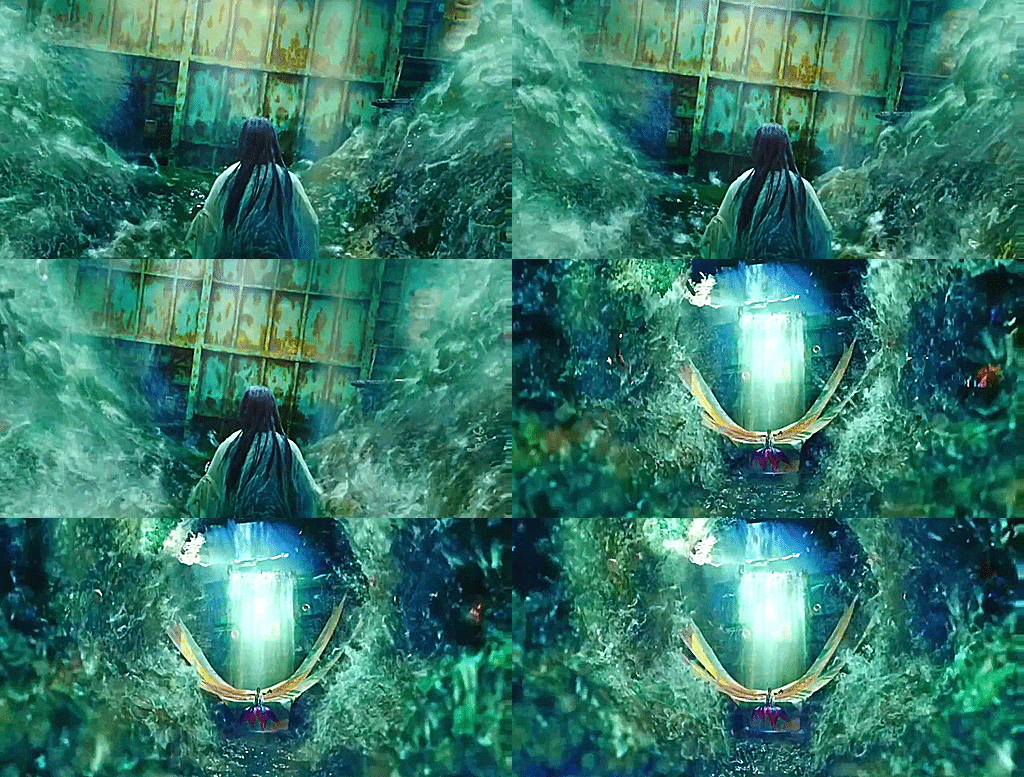
Bonkers. This was bonkers. I’m reminded of The Good, the Bad and the Weird (2008) and The Warrior’s Way (2010). This film is one part cutesy Anime romance, one part mythic-meets-modern Little Mermaid fantasy, and one part mermaid genocide lunacy. No matter what you expected coming into this, I expect you’ll be entertained!
Share this post:

John’s Horror Corner: Fire in the Sky (1993), mastering the fascinating terror of alien abduction.
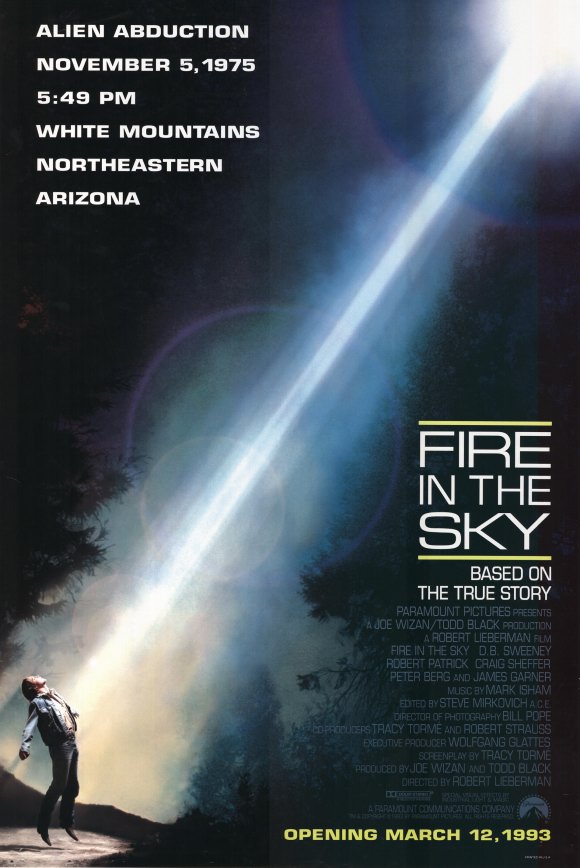
MY CALL: This is an excellent alien abduction movie and its effects and story remain strong despite the film’s age. Highly recommended to fans of the genre. MOVIES LIKE Fire in the Sky: Alien Abduction (2014), Extraterrestrial (2014; which seems to be modeled after Fire in the Sky), Dark Skies (2013), Skinwalker Ranch (2013), The Fourth Kind (2009) and Communion (1989).
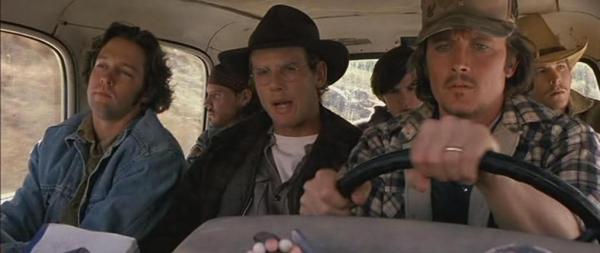
Our story begins as Investigator Waters (James Garner; The Notebook, Maverick, Space Cowboys) is gathered to hear and record a rather unusual missing person report from a group of loggers. We flash back and forth between the actual events of the night before as Mike (Robert Patrick; Terminator 2: Judgment Day, The Faculty, True Blood), David (Peter Berg; Shocker) and Greg (Henry Thomas; E.T., Ouija: Origin of Evil) give their account to the suspicious Sheriff. The crew of woodsmen seem to get along, except for the now missing Travis (D.B. Sweeney; Taken 2, Spawn) and Allan (Craig Sheffer; Hellraiser: Inferno, Nightbreed). Diminishing any credibility in their story, Waters detects the obvious adversity in Allan’s peevish apathy of Travis’ disappearance, quickly making this more of an interrogation.
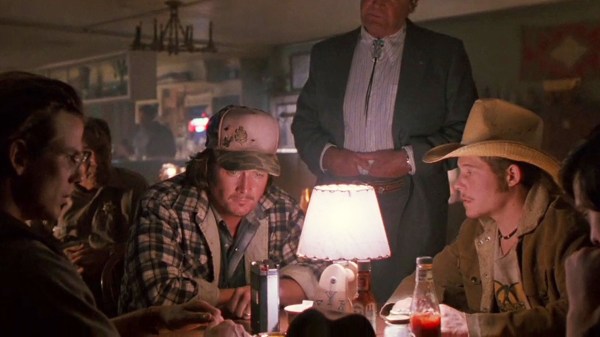
They recall driving home from work in the woods to see a bright “fire” in the sky. Assuming it to be a forest fire, they continued, curious to discover the source. As if dazed or intoxicated with fascination, Travis stumbles out of the truck toward the light.
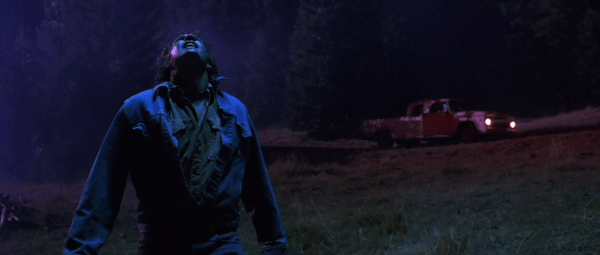
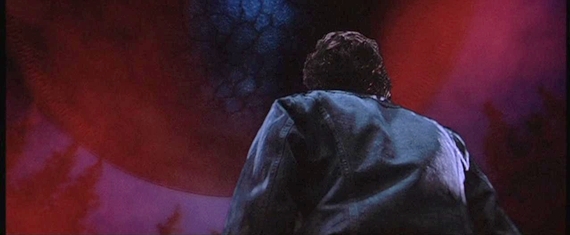
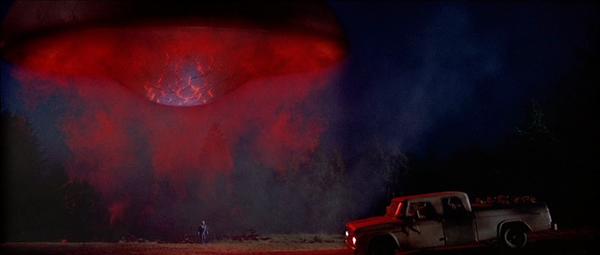
The effects are, well, “very 90s” but competitive for its time (this wasn’t exactly a big budget summer blockbuster or anything). But I appreciate the red smoky mist radiating from the space ship’s undercarriage like an overheated vessel. Its surface shifts like magma before emitting the tractor beam upon Travis as his crew yell frightfully from the truck and flee before seeing what fate befalls Travis—adding yet more damning skepticism to their story. Too scared to think, they just yelled “he’s dead” and tore off into the darkness.
“They took him,” they explain to Waters. But, not surprisingly, Waters expresses doubt in their flying saucer story as if he was actively “trying” not to believe this tall tale. And who could blame him? During the search party the next day their story continues to simply not add up. Days pass with no sign of Travis and the whole town comes to think they’re all liars or, worse, murderers! News crews and believers in extraterrestrials surface as the story goes national, but no evidence can be found to confirm their guilt or innocence. The entire second act hurls us into a crime mystery after Act 1 set the sci-fi stage.
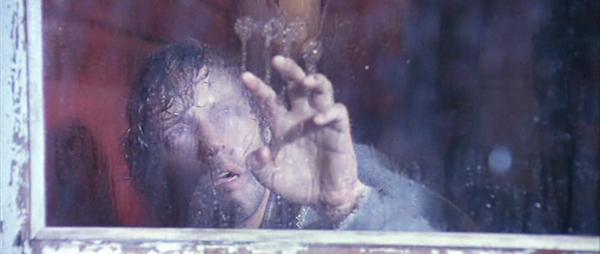
After 5 days Travis is found naked, with his humanity stripped away by the horror he surely endured. What happened to him? What did they do to him?
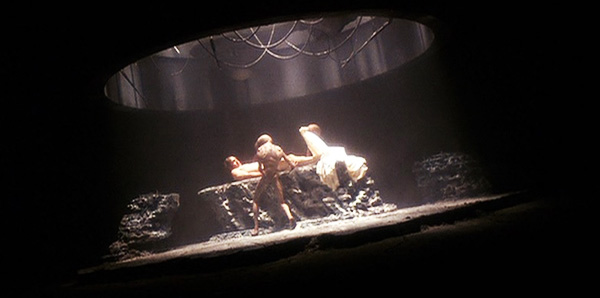

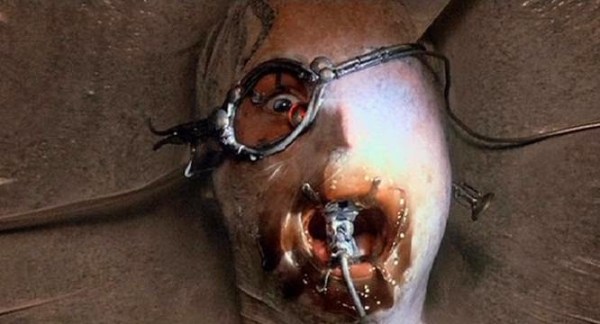
The special effects behind the aliens and their craft were awesome and maintain my attention even today! Various chambers are enshrouded in membranes lined with slimy goop. The inner shipscape appears somewhat organic a la Alien(s) (1979, 1986), complete with snotty, mucousy, crusty textures throughout. This all aroused unease, but their “devices” instilled terror.
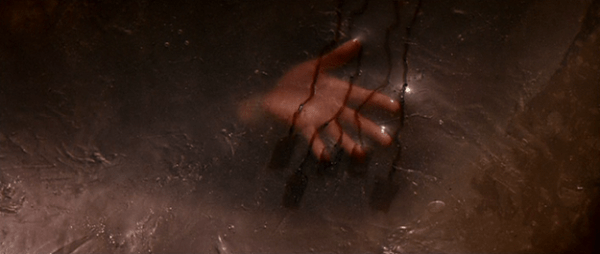
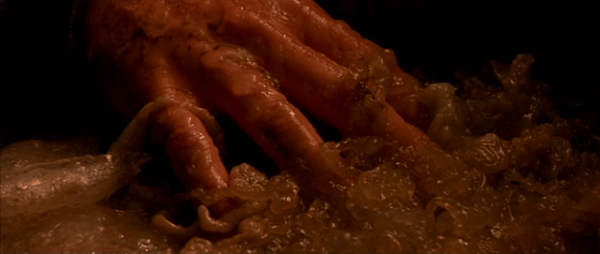
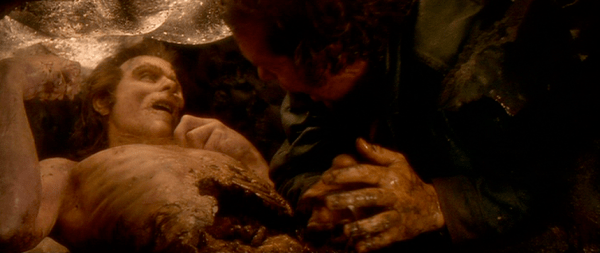
This film and its cast embrace the bewildered terror of such an event and captured the admixture of fascination and horror that may intermingle one’s reactions to such unknown, even unknowable things.

Much to my dismay, director Robert Lieberman (The Expanse, Rogue, Haven) turned to a career directing television. Having not seen it since the 90s, I remain impressed by how well this film held up. I’m strongly recommending this to anyone looking for a good alien abduction movie. Despite its age, the scenes remain powerful and the effects are sufficiently compelling. This movie is solid and I look forward to sharing it with more avid sci-fi fans!
Share this post:

Hello all. Mark here.

You can download the pod on Itunes or LISTEN TO THE POD ON BLOG TALK RADIO.
If you get a chance please make sure to review, rate and share. You are awesome!
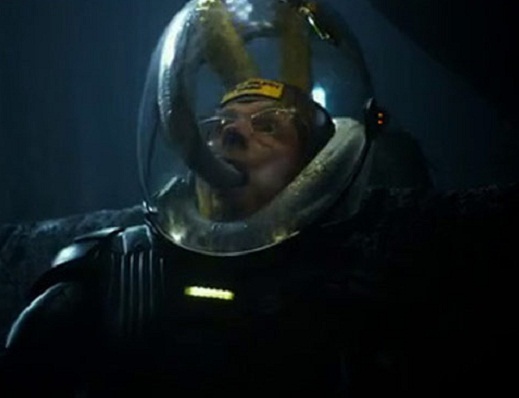
Cinematic space travelers never learn….
The MFF podcast is back and we are talking about the perils of cinematic space exploration. After seeing movies like Life, Passengers and watching the Alien: Covenant trailer I started thinking about space travel in movies and how horrible it is. I would never want to be a fictional space explorer because I would undoubtedly be attacked by aliens, space goo or asteroids. I would never be safe and even if I was safe the stupid spaceship I was on would probably break down.
Ridley Scott hates space travel.
As always we answer random listener questions and ponder if I will watch The Maniac Cop remake (NEVER!!!!!!). If you a fan of the podcast make sure to send in some random listener questions so we can do our best to not answer them correctly. We thank you for listening and hope you enjoy the pod!
You can download the pod on Itunes or LISTEN TO THE POD ON BLOG TALK RADIO.
If you get a chance please make sure to review, rate and share. You are awesome!
Share this post:

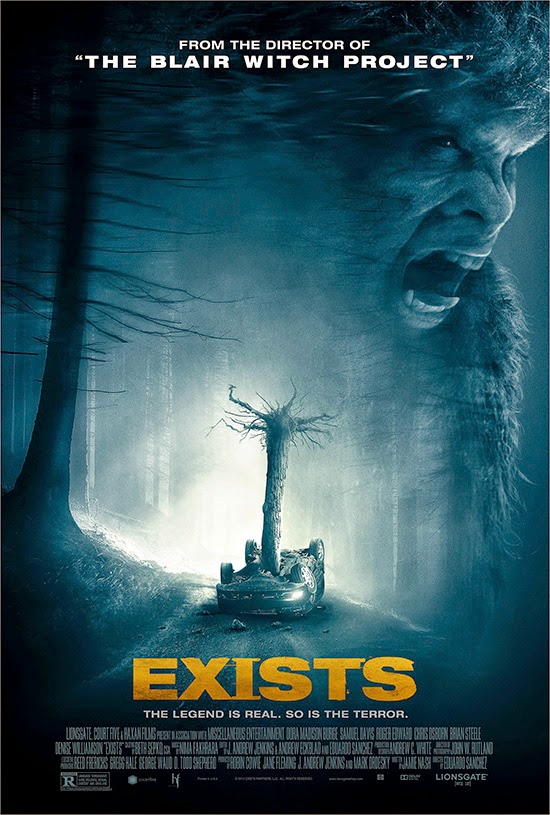
MY CALL: This is pretty straightforward. It’s an unsubtle, action-driven, found footage film about some vacationers who stumble across bigfoot in the woods. MOVIES LIKE Exists: I’d actually favor Willow Creek (2013; podcast discussion) when considering found footage or bigfoot films, and it does a better job of both. Unless, you want excitement, that is. Exists delivers constant excitement with empty characters whereas Willow Creek is a character-driven super-slow burn. For more folklore horror I’d direct you to Thale (2012), Krampus (2015; podcast discussion), Rare Exports: A Christmas Tale (2010), Trollhunter (2010; podcast discussion), The Hallow (2015; podcast discussion), Killer Mermaid (2014) and Leprechaun Origins (2014).
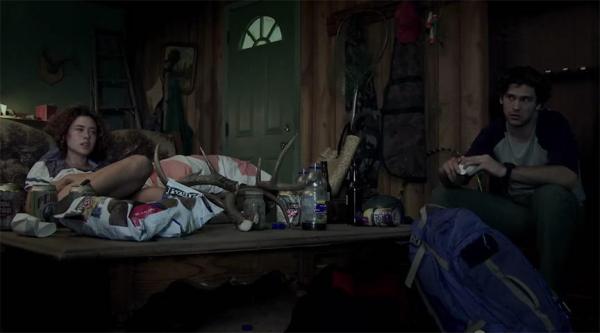
Almost as soon as we push “play” things start getting weird for our protagonists after hitting “an animal of some sort” on their way to a cabin in east Texas. This film wastes absolutely no time (or tact) with subtlety. Just minutes deeper and we don’t just hear its howls, but we make frequent blurry sasquatch sightings.
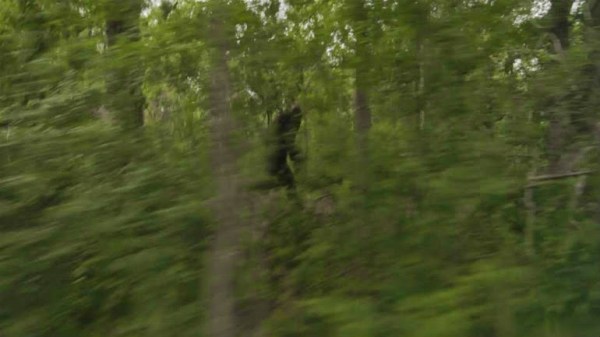
Despite the abundant evidence of a sasquatch (or several?), this film starts out feeling rather boring. The characters aren’t interesting, the shaky shots of bigfoot aren’t really impressive (or effective), and I just don’t find myself caring about anything going on here.
One bearded vacationer, rather certain from the start of a cryptozoological presence, remains ever prepared, filming everything in hopes of capturing evidence of this large-extremitied hominid. Meanwhile, everyone else doesn’t care or believe—they just want to have a good time.
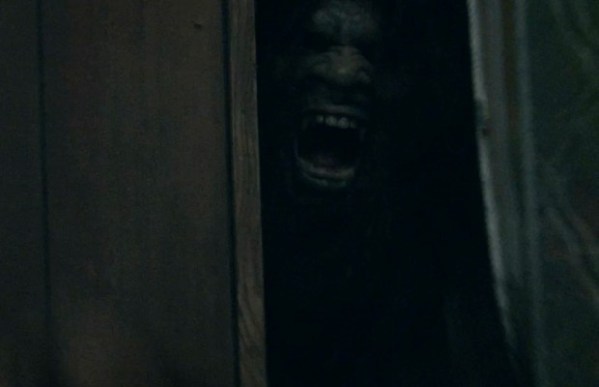
As things escalate in our opening act (i.e., the first 30-35 min) weak jump scares follow up lame pranks or party shenanigans, and the unsatisfying “action” is so abundant that no actual event ever really matters.

But hold on…is this film about to take a turn for the better?
Reminiscent of Ash’s twisted bridge marooning (Evil Dead 2), our bigfoot sabotages our survivors’ only way out—harpooning their car with a small tree.

Bigfoot straight up Jason-Bourne-sprints through the woods in the most satisfying scene of the film so far! Later he gets a hold of one of the girls and it’s aggressively exciting and brutal, even if shaky and goreless, as he slams her ragdoll body around like Hulk whipping Loki. But what’s important to note here is that I think I’m beginning to forgive the boring first 30 minutes of this movie. After that stupid first act, this really picks up and becomes something fun! I’m not going out of my way to recommend this, but I must admit this ended up feeling quite worthwhile.
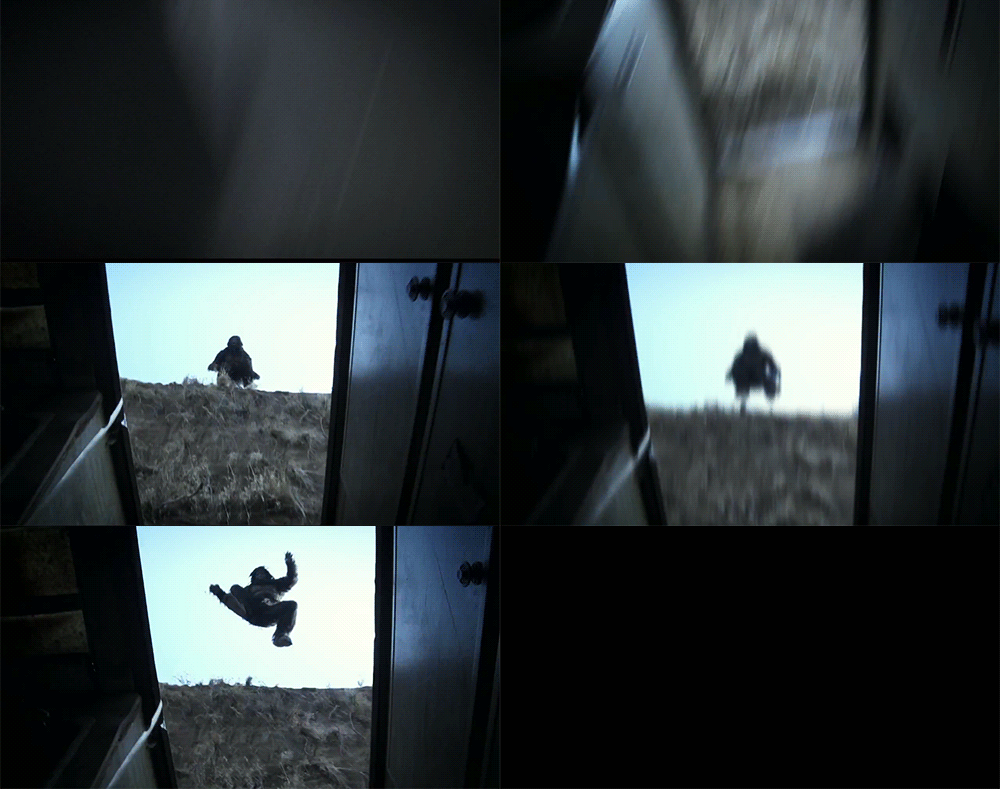
This film toes the line between horror and Tremors (1990). It’s not nearly as funny (nor does it try quite that hard for comedy), but it relies more on raw physicality than actual scares, terror or tension. Things started out a bit dodgy and the characters were all weak, but director Eduardo Sanchez (The Blair Witch Project) pulled off an entertaining experience mixing feistiness and intensity.
Share this post:

Diving Into the Deep Data of Deep Blue Sea
I love Deep Blue Sea. It is a brilliantly dumb film that never gets old and always gets better. I was working in a movie theater when it was released in 1999 and I loved sitting in the theater listening to the audience go crazy. In all my years working at a theater no film came close to getting the reaction that Deep Blue Sea did. I’ve been writing, podcasting and talking about it for years and I haven’t been able to shake one scene in particular. Stellan Skarsgard’s (AKA Jim) incredibly long death scene is insane because it is a pure nightmare creation that is equal parts terrifying, inventive and funny.

This is getting ridiculous.
This is how it goes down. A genetically modified super shark bites Stellan Skarsgard’s arm off while the shark is being tested on. Stellan is taken up a freight elevator to a rescue helicopter. During the rescue, Stellan is strapped to a gurney and given an oxygen mask. As he is being lifted to the helicopter, a shark grabs hold of the gurney and Stellan goes on a long journey underwater that ends with him being used as a battering ram. It is a gnarly death that has somehow been overshadowed by the glorious demise of Sam Jackson.
.
The following post breaks down the amount of traveling poor Stellan had to endure.
Sidenote: I’ve tried my best to recreate a fictitious moment in an insane film about genetically engineered sharks herding humans to their death. The numbers are researched but I just didn’t have enough data to be 100% correct. There is some guess-work at play, but I believe they paint a believable picture of what happened to Stellan Skarsgard.
Let’s start off with the journey to the freight elevator. I’m guessing the trip was about 40 feet after he got his arm ripped off.
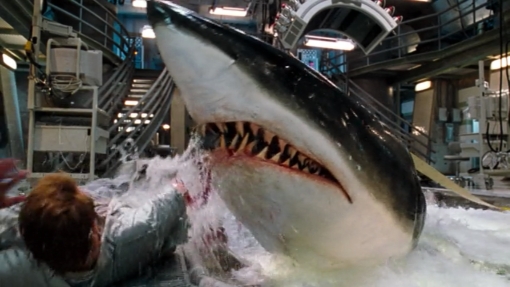
I don’t see an elevator anywhere close…
Once they got on the elevator the trip took 30 seconds. According to Stanley Elevators, a stock freight elevator moves at an average speed of 200 feet per minute. The elevator covered 100 feet in its 30 second journey. Next, Stellan had to be lifted onto a helicopter. The problem is he didn’t make it very far, therefore I’m guessing he covered approximately 50 feet. This is where things get interesting because the poor guy is pulled underwater with an oxygen tank strapped to his mouth.
I’m not a genetically engineered shark with a lust for blood and thus, I cannot track the exact movements underwater. I’d assume the shark was all business and put its energy into building towards battering ram speed. By using my shark brain (via a hat that looks like a shark fin) I’m guessing the shark circled the interior of the Aquatica figuring how to best hit the massive glass wall.

I really hope these humans don’t see me until it’s too late.
.
During a nice moment of expositional dialogue (thank you random scientist!) we learned there are a half mile of catwalks on the surface of the structure. After examining the structure I broke down the numbers and figured out the outside fenced dimensions to be 590′ x 295′ (give or take 15 feet or so). You’d think the perimeter would be a half-mile around but there several catwalks that travel through the perimeter, wrap around the structure in the middle and go outside the perimeter. The math looks like this.
Perimeter (1770′) + 2 catwalks (295′) + several additional catwalks (575′) = 2,640 feet.

Imagine the shark swimming three loops around the perimeter to gather speed.
The shark swam through the middle then circled the Aquatica and its prey until it got comfortable enough to send Skarsgard into oblivion. The total estimated distance is 1.09 miles and total time spent traveling untethered from the helicopter is 110 seconds. The shark swam at an average of 35.6 MPH which lead me to believe the shark started slow then built up to a much faster speed to accrue the 35.6 MPH average. The fastest shark on the planet can swim top speeds of 40 – 55 MPH, therefore I’m guessing the shark swam slower laps until it got everything just right and exploded to 60 MPH (this shark is really really ridiculously fast).

A big thanks to M.A. Designs for bringing the circling to life.
I love that this scene happened. It is wildly inventive and devious in its quest to kill somebody. My calculations may be slightly off but I believe the total estimated distance covered by Skargard is 5,959 feet or 1.12 miles. That is impressive!
In case you are still skeptical, I’ve come up with two other underwater options that are much less cool and make the shark look silly.
- The shark accidentally drops the gurney and Stellan falls to the bottom of the Aquatica. The shark swims down to the bottom and picks up the gurney (which takes a while because it is cumbersome). Then, the sharks swims to the far side of the fencing (hoping the other sharks didn’t see), and turns around towards the large glass window.
- The shark thinks it is going towards the large glass but realizes it is going the wrong way and has to course correct. Then it swims around like it knew what it was doing (so it doesn’t look dumb) and ends up covering over a mile in an effort to not look silly.
I’m hoping this data answers some questions you never knew you had but always felt like you should know. I realize this post won’t change the world but hopefully it put a smile on your face and solidified your love of Deep Blue Sea!
Check out the Deep Blue Sea podcast we recorded to celebrate its 20th anniversary. It is loaded with lots of weird DBS theories.
Make sure you check out more posts that feature mundane data!
- Jet Ski Action Scenes Are the Worst
- Analyzing the Unsuccessful Trap in Predators
- How Far Did the Shark Travel in Jaws: The Revenge?
- How Many Calories Did Shaggy and Scooby Ingest When They Are The Cotton Candy Glob?
- The Dolph Lundgren Front Kick Spectacular
- How Far Did the Creature From It Follows Travel?
- How Many Bullets Missed John Matrix in Commando?
- How Long Did it Take Batman to Setup the Bat Fire on the Bridge in The Dark Knight Rises?
- Kevin Bacon’s College Degrees
- How Fast Does the Great White Swim in Shark Night?
- Zara the Assistant and Jurassic World Had a Bad Day
- A Look at Elektra’s sandbag trainer in Daredevil
- How Far Did Nic Cage Run While Dressed as a Bear In The Wicker Man Remake?
- Breaking Down The Mariner vs. Sea Beast Battle in Waterworld
- How Long Did it Take The Joker to Setup the Weapon Circle in Suicide Squad?
- Michael Myers Hates Blinkers
- How Much Blood Dropped During the Blood Rave in Blade?
- Jason Voorhees Can’t Teleport?
- Michael Myers Loves Laundry
- How Far Did the Merman Travel in The Cabin in the Woods?
- How Far Did Matthew McConaughey Jump in Reign of Fire?
- How Fast can Leatherface Run?
- Deep Blue Sea and Stellan Skarsgard
- How Far Did Michael Myers Drive in Halloween H20: 20 Years Later
- How Did the Geologist Get Lost in Prometheus?
- People Love a Bearded Kurt Russell
- A Closer Look at Movies That Feature the Words Great, Good, Best, Perfect and Fantastic
- An In-Depth Look At Movies That Feature Pencils Used as Weapons
- Cinematic Foghat Data
- Explosions and Movie Posters
- The Fast & Furious & Corona
- Nicolas Sparks Movie Posters Are Weird
- How Do You Make the Perfect Kevin Smith Movie?
- Predicting the RT score of Baywatch
- The Cinematic Dumb Data Podcast
- What is the best horror movie franchise?
- How Fast Can the Fisherman Clean a Trunk in I Know What You Did Last Summer?
- It’s Expensive to Feature Characters Being Eaten Alive and Surviving Without a Scratch
- How Long Does it Take Your Favorite Horror Movie Characters to Travel From NYC to San Francisco?
- What was the Guy’s Blood Pressure in Dawn of the Dead?
- Why Were There So Many Lemons in National Treasure?
- How Far Does The Rock Jump in the Skyscraper Poster?
Share this post:

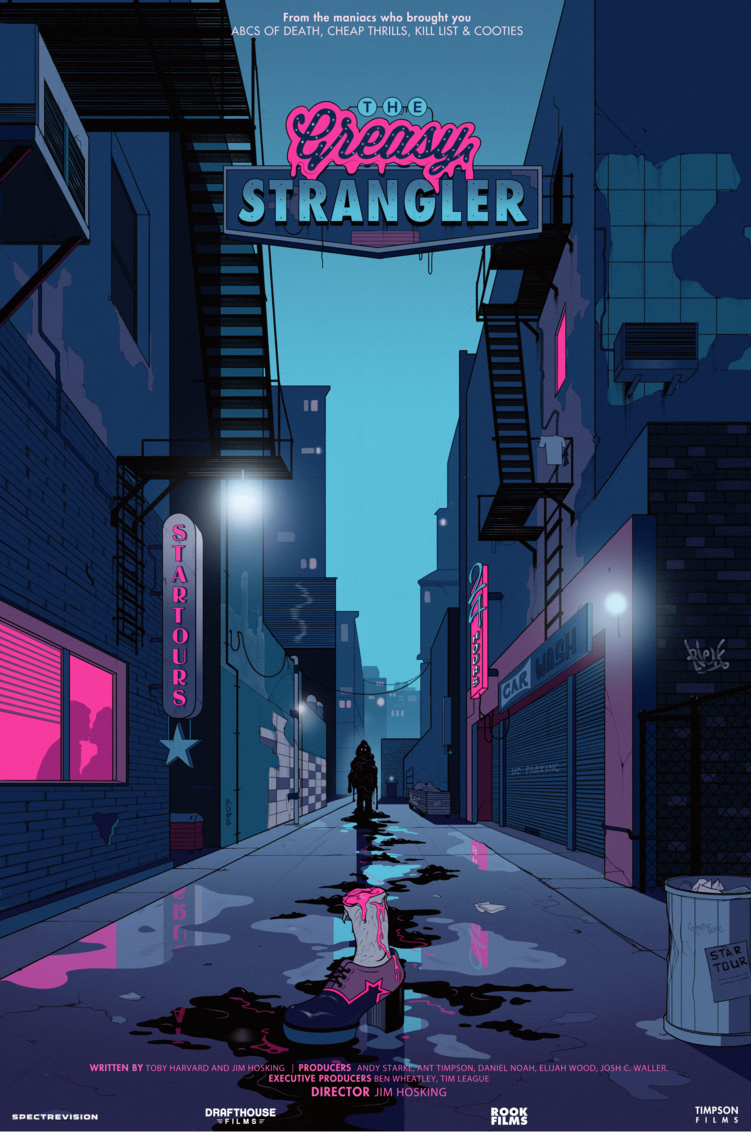
John’s Horror Corner: The Greasy Strangler (2016), a disgusting, awkward, exploitative, gross horror comedy.

MY CALL: This trashy movie aims for discomfort, awkward hilarity and excessive disgust. If you like that, then you should like this. MOVIES LIKE The Greasy Strangler: Movies like Street Trash (1987), Class of Nuke’em High (1986), Mutant Hunt (1987) and The Toxic Avenger (1984) come to mind. Perhaps even Manborg (2011), Turbo Kid (2015), Riki-Oh: The Story of Ricky (1991) and Kung Fury (2015).
Director Jim Hosking’s (The ABCs of Death 2 segment G is for Grandad) film is weird AF, socially awkward AF, perverted AF and gross AF. It’s important to be in the right frame of mind before venturing such deliberate filth. The social awkwardness blares in the opening scenes during a strange (almost stale) childish exchange between father and son. It smacks of a hard-R Napoleon Dynamite (2004). The gross-out factor also tiptoes the unease of The Human Centipede (2009), except that it makes Centipede feel more mainstream while sparing us any “realistic” situations or gore.

Father and son team, Ronnie (Michael St. Michaels; The Video Dead, Another) and Breyden (Sky Elobar; Son of Zorn), share the family business. During their “walking” disco tours they lead dumbfounded tourists to mundane locations while citing stupid facts about 70s music icons. These scenes seethe idiocy.

There’s an alarmingly heated debate over “free drinks” and, while drunkenly entertaining, this scene appropriately forecasts the bombarding lunacy to come. This belabored exchange is one of many that will induce uncomfortable “marijuana giggles.” It’s actually painfully shocking how many times the characters repeat essentially the same inanely argumentative lines—as if to nail an awkward joke, kick a dead horse until viewers are impatiently confused or uncomfortable, and then keep kicking that horse carcass until it’s perhaps funny again. At this point, films like Idiocracy (2006) may come to mind. But Idiocracy (2006) was far more intelligible and way less perverse. You know that extremely uncomfortable feeling you may have when you oversee something disturbing like a severely mentally disturbed person dry-humping a hand-rail or pooping, pants down, in the front lawn…and you just want to NOT be there? Yeah, a lot of the scenes are like that.
Our source of conflict is discovered when a young woman attends Breyden and Ronnie’s historical disco tour. Breyden is smitten, whereas Ronnie is awash with skepticism, fear of abandonment and jealousy.
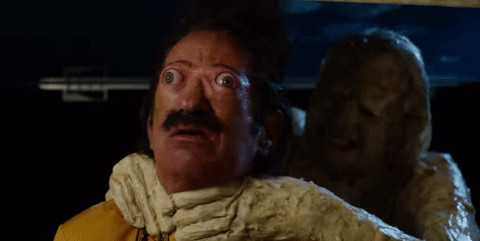
The title may suggest this to be more of a slasher/killer flick, but such concepts take a back seat to the strange father-son-love relationship. This is more of a psychologically abusive, perverted love story. The gore was limited to a few scenes and, despite an obviously low budget, included playfully rendered imploding face punches and cheap “choking until their eyes (literally) pop out” scenes. These effects are super cheap, but solidly amusing in their deliberate silliness.
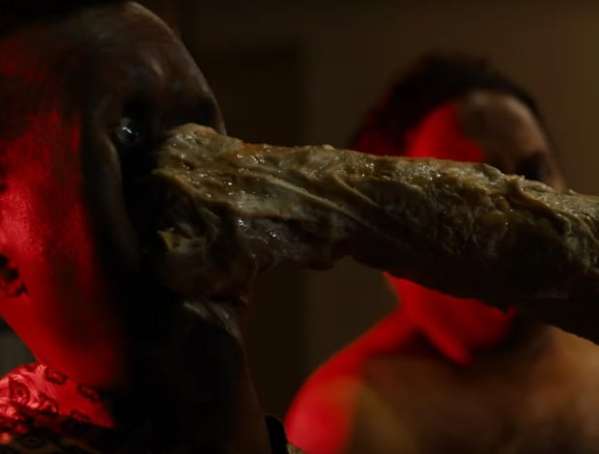
This movie may not feature much gore or sex, but it remains quite graphic. We endure lots of wrinkly old man butt, old man banana hammock, chubby men in skibbies, ding dong dangling, windblown (fake) old man weenis in the numerous “car wash” scenes, and full frontal (fake) nudity. It’s hard to explain, but all of these elements are pushed to weirdly excessive limits. For example, whereas full frontal nudity or sex scenes may make you uncomfortable watching a movie in certain company (e.g., your parents, kids or spouse), “this” full frontal nudity and “this” sex scene made me uncomfortable even though I was watching alone and free of judgment. Giant fake pubic wigs are just plain weird, especially when worn while having deadpan-straight-faced conversations about a father-son love triangle spewing dialogue fit for a 2nd grade reading level. Good Lord, this is weird. LOL. Let’s not even get into the “food” scenes…which were frequent and strangely disgusting on their own.
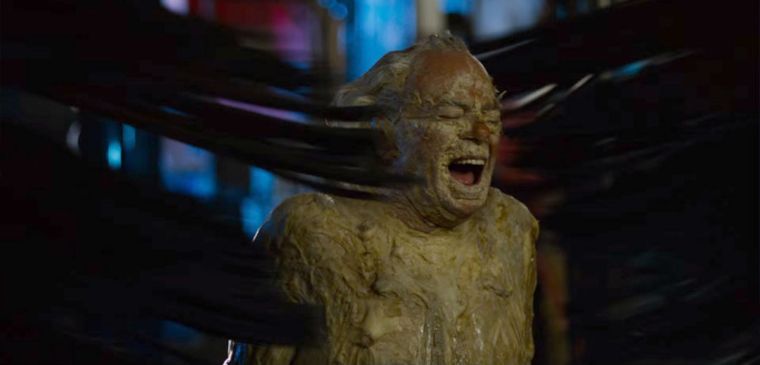
This film is for people who love weird, raunchy and perhaps somewhat exploitative films. I often felt as if every seen was specifically designed to incite discomfort and awkward giggles, and it does so obnoxiously. But despite this, I just shook my head, smiled and somehow enjoyed it. I enjoy a lot of weird, “extreme” cinema.
Some may find the lunacy of this film to be a rather novel flavor, others may simply find it exhausting after a while. I believe where you fall on this spectrum will depend as much on your taste as it does your expectations and mood when viewing something like this. Loads of “fake penis” scenes and rerunning the same retarded gag over and over can take its toll on someone who isn’t in an adventurous mood when hitting the “play” button on this. Contrastingly, some people might be looking for exactly this kind of hilarious ridicule.
Share this post:

Shin Godzilla: Bureaucracy and the Beast

.
Shin Godzilla tells the story of the Japanese government learning how to defeat a familiar creature that can’t be stopped. It’s not everyday that a giant creature comes from the sea and wrecks havoc on Tokyo. It most certainly isn’t expected that this creature evolves at an alarming rate and is virtually impenetrable to any weapon. Thus, the government elite (AKA many many people) and a rogue grouping of beautiful minds spend countless months figuring the creature out and learning how to exploit any weaknesses. It is an inspired take on Godzilla-lore and I love how it takes a classic creature and brings it successfully into the modern world. Shin Godzilla won Best Picture at the Japanese version of the Academy Awards and has deserved the praise heaped upon it.
I had no clue what to expect when I watched Shin Godzilla. I’ve been so conditioned to monster mayhem, rubber suits and random naps that I figured I would be watching more of the same. However, as the film progressed I dug how the focus was more on the dozens of people trying to deal with an unknown and dangerous threat. Every situation and idea are covered and I appreciated the systematic nature and political satire that take us down a rabbit hole of jurisdiction, more jurisdiction and American’s wanting to drop nuclear bombs.
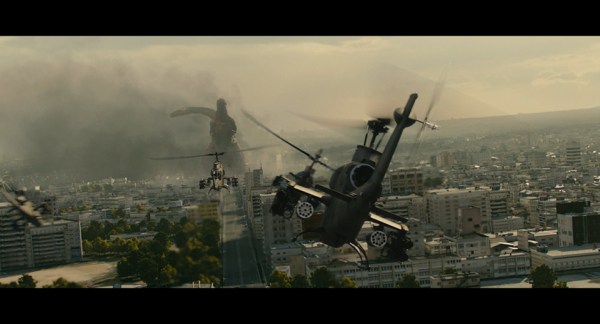
What I like about this version of Godzilla is how it evolves in front of our eyes. It begins as a slimy little thing that crawls around Tokyo and smashes various cars, buildings and unlucky pedestrians. It eventually starts walking and resembles a big-eyed/bug lizard that doesn’t know what to do with its growing body. Eventually, its arms unfold from its massive body and it starts to resemble the Godzilla that we know and love. This fully grown version of Godzilla is a lumbering giant who shoots lasers out of pretty much everywhere and doesn’t have an interest in property destruction. It just seems to be milling about in a hungover fog while people shoot missiles at it.
.
If you are looking for all-out monster mayhem that has a total disregard for plot, character and science (think Pacific Rim) you probably won’t love Shin Godzilla. However, if you like political satire, laser lights shows and a new spin on Godzilla it is worth a watch!

Share this post:

Hello all. Mark here.
I love using somewhat relevant data to predict a films Rotten Tomatoes score. The data isn’t exact and only somewhat reliable, but I enjoy seeing if old trends and actors/directors averages can somewhat predict the success of a film. I don’t have flowcharts, abacuses or an around the clock crew of rogue movie predictors working furiously in a dimly lit office. I have a will to scour through Rotten Tomatoes, Google and Youtube in an effort to have a solid data that predicts unimportant things.
I predicted XXX: The Return of Xander Cage would have a 36% RT Score and was pleasantly surprised when it received 43%. I actually wanted to add five more points to the finished product but I went against my Vin-O-Meter and ended up short. This time I’m trying to predict the RT score of Baywatch.
- I brought back my Jet Action Scene data because Baywatch features JS action. Jet ski action scenes are the worst and they average 29% on Rotten Tomatoes. Listen to our podcast to learn more.
- I collected the RT scores of recent comedic television adaptations. Aside from 21 & 22 Jump Street (85, 84), television adaptations haven’t done well with the critics. The overall average is 45.6% and only 21 & 22 Jump Street, Charlie’s Angels, Starsky & Hutch and The Man From U.N.C.L.E have fresh averages. Bewitched, Get Smart, Land of the Lost, Dukes of Hazard and The A-Team (and more) were not loved by the RT critics.
- Between The Fast & the Furious, G.I. Joe, Be Cool, Journey 2, Scorpion King, Get Smart, Walking Tall, Race to WitchMountain and Hercules, The Rock loves stepping into a preexisting material. Thus, I averaged out the scores and came up with 50.3% average
- Zac Efron’s recent comedic films have been up and down on RT. Neighbors 1 & 2 are fresh (73%, 62%) whereas Mike and Dave Need Wedding Dates (35), That Awkward Moment (23) and Bad Grandpa (11) are pretty rotten. The uneven comedies lead to a 40.8% average. It’s not good, but it could be a lot worse.
- Seth Gordon exploded onto the scene with the brilliant documentary The King of Kong (97%). The documentary about Donkey Kong catapulted him into directing big budget comedies Four Christmases (25%), Horrible Bosses (68%), Identity Thief (19%) and now Baywatch. His four films have an average of 52.25%. You need to watch The King of Kong now!
The average of these five categories is 42.32%. Normally I’d be happy to bestow that average on a film that features jet ski action scenes. However, the movie looks really funny and it features the beloved Dwayne Johnson. So, I’m going to add another 20 points to the average and boost it into fresh territory with a 62.32% average. I’m putting my reputation on the line with this score but I’m sticking to it.
Final Rotten Tomatoes average for Baywatch – 62.32%



 Movies, Films & Flix
